
Key points
- UN agencies unroll plans to serve more than 100,000 people in need
- The earthquake has affected 15 departments and 472 municipalities
- As of 17 August, 304 deaths, 4,400 injuries and 426 missing people had been reported, with more than 26,500 homes destroyed
- More than 75,000 students no longer have safe access to their schools with 1,631 educational institutions damaged and 263 either partially or completely collapsed, or deemed at imminent risk
More than 186,000 people have been affected, according to a report by the UN humanitarian aid agency, OCHA.
The World Food Programme (WFP) is seeking $23 million to provide food assistance to 100,000 people over the next three months.
More than 2,000 people received food assistance in Pereira and Quibdó on Sunday alone. WFP plans to expand operations this week using food stocks and its network of field offices and logistics hubs in Cali, Quibdó and Medellín.
Assistance needed for months
WFP said the immediate outpouring of solidarity from communities, businesses and individuals had been extraordinary, but warned that recovery will require sustained support.
“The solidarity shown in the immediate aftermath of the earthquake has been extraordinary,” said Nils Grede, WFP Country Director in Colombia. “But, we know from experience that recovery does not end when the first wave of support subsides.”
He said humanitarian assistance would be essential in the weeks and months ahead.
WFP is adapting its response to local conditions. In remote communities where markets are not functioning and access remains difficult, the agency is prioritising direct food assistance.
In urban areas where markets and basic services are beginning to recover, cash assistance can be scaled up so families can buy the food they need while also supporting local businesses.
Humanitarian access remains difficult in some of the worst-affected areas. Landslides and damage to at least 16 roads and 10 bridges are hampering the movement of relief teams and supplies, particularly in Chocó. The presence of non-State armed groups is also limiting access in some rural areas.
Existing vulnerabilities deepen the crisis
The earthquake struck regions already facing serious humanitarian pressures.
Before the disaster, close to seven million people in Colombia were experiencing moderate or severe food insecurity, according to WFP. In Chocó and Valle del Cauca, two of the hardest-hit areas, close to one in three people were already food insecure.
Conflict and displacement have also affected many communities in these regions, compounding the impact of lost homes, livelihoods and access to essential services.
OCHA says Chocó, Valle del Cauca, Risaralda and Caldas remain priority areas because of the scale of the damage. Urgent needs include food, shelter, safe water, healthcare and education.
What’s the UN doing?
WFP’s operation is part of a broader UN and humanitarian response supporting Government-led relief efforts, with coordination groups covering health, shelter, water and sanitation, food security, protection and education in emergencies in some of the hardest-hit cities, including Quibdó, Pereira, Armenia, Cali and Manizales.
Here are some highlights:
- In Quibdó, WFP, the UN Children’s Fund (UNICEF) and other partners have provided food assistance to hundreds of families
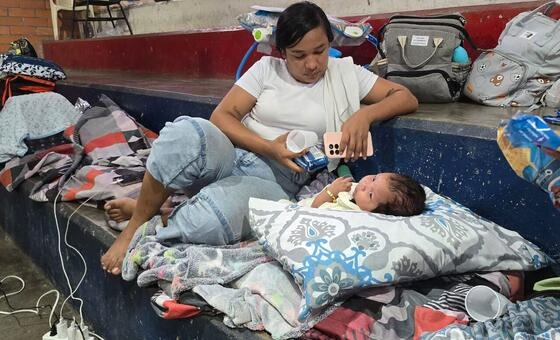
- UNICEF and its partners have distributed family hygiene kits, and other humanitarian teams are supporting water and sanitation services in temporary shelters
- OCHA is supporting humanitarian coordination across several affected departments
- The UN Development Programme (UNDP) is working with national authorities to use satellite imagery to assess population exposure and damage to buildings and support early recovery
- WFP has placed four mobile storage units on standby, with additional relief supplies available for deployment from the UN Humanitarian Response Depot it manages in Panama
Post-disaster trafficking risks
The International Organization for Migration (IOM) has warned that displacement, family separation and loss of livelihoods following the earthquake can increase the risk of human trafficking.
The agency said criminal networks may target people in temporary shelters or those seeking help elsewhere with fraudulent offers of jobs, transport, accommodation or assistance.
IOM urged affected communities to rely on official sources of support and avoid handing over identity documents or sensitive personal information to strangers.
Protection teams are also focusing on safe spaces for children and adolescents, family reunification, measures to prevent gender-based violence in shelters, and psychosocial support for affected communities.
