
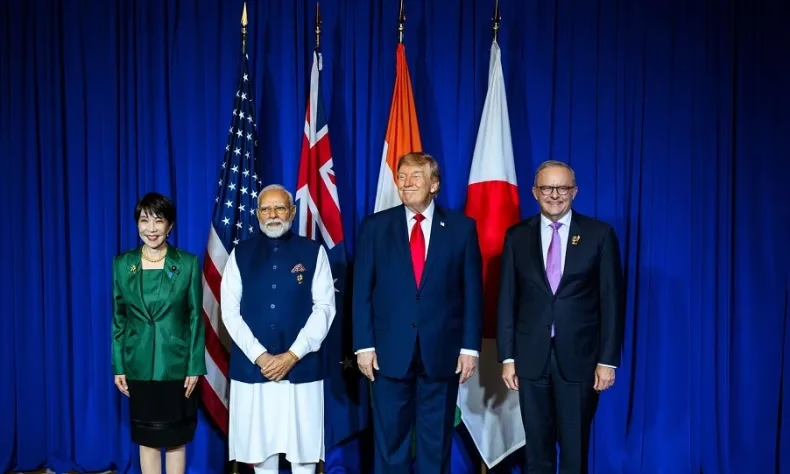
The seventh summit of the Quadrilateral Security Dialogue (Quad), held in the Philippine capital on November 17 on the sidelines of the ASEAN meetings, has given fresh momentum to a strategic partnership that critics had increasingly described as being on “life support.”
The gathering of leaders from Australia, India, Japan and the United States demonstrated that the Quad remains relevant to the Indo-Pacific’s evolving security and economic landscape. However, questions remain over how long the renewed momentum will last, particularly given the unpredictable foreign policy of US President Donald Trump.
The central paradox is that Trump, who helped revive and consolidate the Quad during his first presidency in 2017, has subsequently pursued policies that have complicated the strategic relationships underpinning the grouping.
His decision to abandon plans to attend the scheduled Quad Leaders’ Summit in India in late 2025, alongside his controversial remarks suggesting that the United States had “lost India” to China, raised serious doubts about Washington’s commitment to the partnership.
The imposition of tariffs of up to 50 percent on Indian imports further strained relations between Washington and New Delhi, undermining the mutual trust necessary for sustained strategic cooperation. Trump’s transactional “America First” approach has also appeared increasingly disconnected from the broader economic, technological and diplomatic agenda that the Quad developed during the Biden administration.
Against this background, the Manila summit represents an important demonstration of institutional resilience. Yet, whether the partnership can maintain its strategic direction will depend considerably on the consistency of American leadership.
The origins of the Quad date back to 2007, when officials from Australia, India, Japan and the United States held their first meeting on the sidelines of the ASEAN Regional Forum Summit in Manila.
The initiative, however, struggled to gain momentum. Governments in Australia and India were reluctant to pursue it aggressively, partly because of concerns that the grouping could be interpreted as an anti-China coalition. Beijing had also strongly criticised the emerging arrangement.
The four countries shared concerns about regional stability and maritime security, but there was little political appetite at the time to establish a more formal strategic framework.
That changed in 2017, when the Trump administration helped revive the initiative. The renewed engagement reflected growing recognition among the four governments that cooperation was necessary to maintain an open, free and inclusive Indo-Pacific.
The grouping subsequently gained institutional strength under President Joe Biden, who elevated the partnership through regular leaders’ summits and an expanding agenda covering maritime security, infrastructure, emerging technologies, public health, climate change and economic cooperation.
Over time, the Quad evolved beyond its original diplomatic and strategic purpose into a broader framework for practical cooperation across the Indo-Pacific.
Its development also demonstrated that the four countries could work together without establishing a formal military alliance or creating a treaty-based security organisation.
The Manila summit’s significance also reflects the sustained diplomatic work undertaken by the four countries’ foreign ministers, who maintained engagement despite uncertainties surrounding Trump’s commitment.
US Secretary of State Marco Rubio, India’s External Affairs Minister S. Jaishankar, Australian Foreign Minister Penny Wong and Japan’s Foreign Minister Toshimitsu Motegi held three meetings during 2026, on May 26, July 22 and October 31, to coordinate priorities and prepare the ground for the leaders’ gathering.
The ministers had also met twice in 2025, although Japan was represented by a different foreign minister at the time.
Much of what the four leaders announced in Manila formalised initiatives that had already been discussed and developed through these ministerial meetings.
Rubio’s role is particularly significant. His continued support for the Quad appears to have helped reinforce its importance within an administration whose broader foreign policy has sometimes sent contradictory signals to Washington’s Indo-Pacific partners.
The summit therefore demonstrated that institutional cooperation and sustained diplomatic engagement can preserve strategic initiatives even when political leadership becomes unpredictable.
Among the most significant announcements from Manila was the establishment of the inaugural Quad Business Leaders’ Forum, scheduled for early 2027.
The initiative will bring together business leaders, government representatives and policy experts from the four countries to strengthen private-sector partnerships, promote commercial agreements and encourage investment across the Indo-Pacific.
The forum reflects an increasing recognition that the Quad’s long-term influence will depend not only on diplomatic coordination and security cooperation but also on economic connectivity and commercial engagement.
The leaders also advanced plans for an AI Accelerator designed to coordinate and fund efforts supporting trusted artificial intelligence access, deployment and technical assistance across the Indo-Pacific.
The initiative is intended to help regional countries benefit from emerging technologies while strengthening their capacity to use artificial intelligence responsibly and securely.
Maritime security and surveillance also featured prominently. The Indo-Pacific Maritime Surveillance Collaboration will strengthen information sharing and maritime domain awareness, helping participating countries improve their understanding of developments across strategically important waterways.
The initiative is particularly relevant to a region where maritime trade routes, fisheries, territorial disputes and freedom of navigation remain central concerns.
The leaders also endorsed stronger cooperation through the Quad Partnership for Cable Connectivity and Resilience, which aims to expand access to secure and trusted communications infrastructure.
The partnership builds on work announced at the 2023 Quad Leaders’ Summit, when the four countries agreed to strengthen submarine cable systems across the Indo-Pacific by drawing on their expertise in manufacturing, deploying and maintaining undersea infrastructure.
Since 2023, Quad partners have committed more than $140 million to submarine cable projects in the Pacific.
India and the United States also hosted the Wavelength Submarine Cable Forum in New Delhi on July 16, 2025, with participation from other Quad partners. The meeting explored opportunities for cooperation in digital infrastructure and improving the resilience of regional communications networks.
Cybersecurity has emerged as another important area of Quad cooperation.
The four countries have been working to strengthen cyber resilience, protect critical infrastructure and promote a secure and open digital environment across the Indo-Pacific.
The Quad Senior Cyber Group regularly brings together government and industry experts to coordinate cybersecurity priorities. Its work includes promoting common cybersecurity standards, encouraging secure software development, strengthening institutional capacity and developing a skilled regional workforce.
On October 13, 2026, Quad senior cyber officials met in Singapore and reaffirmed their commitment to advancing cooperation and supporting a trusted and resilient cybersecurity environment.
Critical minerals also occupied a prominent position at the Manila summit.
Trump announced several important new agreements intended to secure supply chains and prevent any single foreign supplier from exercising coercive influence over the four economies.
The announcement reinforced priorities previously discussed by the foreign ministers, particularly the need to diversify supplies of strategically important minerals used in advanced manufacturing, clean energy, electronics and defence industries.
However, the challenge remains substantial. China continues to exercise considerable influence over global rare-earth processing and supply chains. Whether the United States and its partners can meaningfully reduce that dependence within the timeframe suggested by Trump remains uncertain.
The issue is particularly important because critical minerals are increasingly connected to national security, technological competitiveness and industrial resilience.
Despite its expanding agenda, the Quad is frequently portrayed as an anti-China grouping, particularly by Beijing.
There are understandable reasons for this perception. All four members have concerns about China’s growing strategic influence, military expansion and increasingly assertive behaviour in the Indo-Pacific.
The countries also cooperate on defence and security through bilateral arrangements and other regional and international mechanisms.
However, the Quad itself is not a conventional military alliance. It has no collective defence treaty, permanent military command or formal obligation requiring members to respond jointly to an armed attack.
Its broader objectives encompass public health, education, technological innovation, infrastructure development, maritime awareness, cybersecurity, climate change adaptation and economic connectivity.
The grouping’s principles emphasise respect for international law, sovereignty, territorial integrity and freedom of navigation.
Its opposition to unilateral and coercive attempts to change territorial or maritime boundaries is not necessarily directed against one particular country. Rather, these principles apply to all states.
Beijing’s criticism of the Quad as an anti-China coalition therefore overlooks the wider range of practical initiatives through which the four partners seek to support regional stability and development.
Nevertheless, strategic competition with China remains an important factor shaping the partnership’s evolution.
The timing of the Manila summit adds another layer of uncertainty.
Immediately after the gathering, Trump is travelling to China for the Asia-Pacific Economic Cooperation (APEC) meetings and talks with Chinese President Xi Jinping.
The discussions are expected to attract considerable attention because of the broader competition between Washington and Beijing over trade, technology, critical minerals and regional influence.
Trump’s approach to Xi will be closely watched by America’s Indo-Pacific partners, particularly India, Japan and Australia.
His willingness to negotiate directly with Beijing is not, in itself, incompatible with Quad cooperation. Maintaining communication with China is important for managing tensions and avoiding unnecessary escalation.
The concern, however, is whether Trump might pursue bilateral understandings with Xi at the expense of Washington’s wider regional partnerships.
His previous statements and policy reversals have already generated uncertainty among allies. Any suggestion that the United States is prepared to compromise on the principles underpinning the Indo-Pacific partnership could further weaken confidence in American leadership.
The Manila summit has demonstrated that the Quad remains operational and capable of producing tangible initiatives despite doubts about its political future.
The foreign ministers’ sustained engagement, expanding economic agenda and growing cooperation in maritime security, cybersecurity, artificial intelligence and critical minerals suggest that the grouping has developed institutional foundations that extend beyond individual leaders.
But institutional resilience cannot completely compensate for inconsistent political leadership.
The Indo-Pacific needs a credible Quad, particularly at a time when strategic competition, technological disruption and economic vulnerabilities are reshaping regional relationships.
For Australia, India and Japan, continued American engagement remains an important element of the partnership’s strategic value. For Washington, the Quad provides a platform to work with influential regional partners without relying exclusively on military alliances.
Trump’s first presidency helped bring the grouping back to life. His second presidency has raised questions about whether the United States remains committed to the strategic vision that originally sustained it.
