
Key points
- Ambulance attack highlights dangers facing responders
- Motorbike riders are key to tracking infections
- Surveillance and treatment capacity reinforced
“Almost on a daily basis we face some kind of reaction from the communities,” said Dr Thierno Baldé, WHO Incident Manager for the Bundibugyo virus disease in the DRC. “These are difficult situations. People are having their relatives who are sick, who are dying.”
Speaking via video from the outbreak’s epicentre in Bunia, the medic told reporters in Geneva that on Monday, one of the ambulances used in the response was attacked. It was not an isolated incident.
According to local authorities on Monday, the Ebola Bundibugyo outbreak has killed 2,325 people, surpassing the 2,299 deaths recorded in the DRC’s 2018-2020 outbreak, previously the most lethal. The fatality rate has risen to 46 per cent, according to Government data.
Dr Baldé said that the milestone of 5,000 confirmed cases has been crossed and confirmed that cases have been identified in a sixth province, Bas-Uele.
Working day and night
“The situation is quite difficult, but people are working here days and nights trying to control this outbreak,” Dr Baldé insisted.
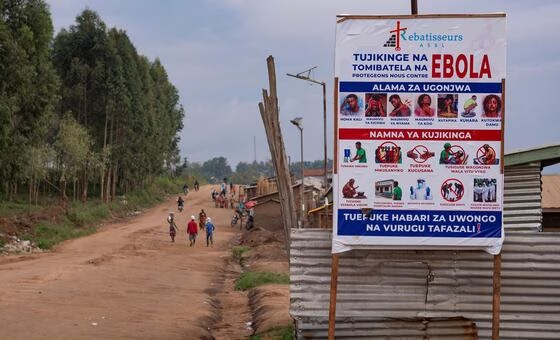
“We are really recentering all of the operational approach, all of our activities, around the engagement of the communities,” the WHO official said.
Describing the multi-pronged scale-up underway, he said that one of the key targets of the response is the association of motorbike riders, involved in the transport of patients and dead bodies.
Hand-washing stations and disinfectant have been made available, but the new objective is to recruit them as surveillance and response officers, Dr Baldé said.
The WHO medic explained that the bikers are one of the most affected categories in the population because of their transport duties. Some have lost multiple family members to the virus.
Because the motorbike riders are a key link in the chain of disease surveillance, they need to “be able to tell us wherever they transport a sick person”, contact the surveillance team and enable the suspected case to be tested, Dr Baldé explained.
This grassroots engagement is taking place “in a very dignified manner”, Dr Baldé said, “by convincing them, explaining to them…this is for the good of themselves, the good of their family”.
Treatment capacity push
In other response measures, WHO plans to deploy 100 additional expert epidemiologists in health zones. They will be supported by more than 500 community health workers who can pursue contact tracing and identify infected individuals and convince them to seek treatment.
Some 400 beds have been added in facilities in various localities over the past two weeks.
Dr Baldé insisted that an extra push is needed to ensure safe and dignified burials “by engaging those local people who are doing that in the villages and equipping them with chlorine and gloves “to be able to handle these bodies in a very safe manner”.
The WHO official highlighted the localities of Lita and Nizi as examples of progress today, whereas “we were overwhelmed by the number of community deaths about six weeks ago, seven weeks ago”.
“Today, we are reporting only few cases, few deaths, and those deaths are being safely and dignifiedly, buried at the right time…We have seen a kind of stabilization of the situation where we are capable of intervening as quick as possible,” he concluded.
The outbreak of Ebola Bundibugyo virus disease, for which there is no vaccine and no approved treatment, was declared by DRC authorities on 15 May.
Experts meet
On Tuesday, the International Health Regulations Emergency Committee met for the second time on the epidemic, which has already been declared a public health emergency of international concern. The panel was expected to advise on the current risk level in its recommendations to countries.
In his remarks to the panel, WHO Director-General noted that clinical trials are advancing for vaccines and therapeutics specifically to treat Bundibugyo virus.
For the first time, two vaccines designed specifically against Bundibugyo virus have entered human trials; a separate vaccine has shown cross-protection in animal studies and it is being proposed for phase III trial. This is the third of four phases of clinical trials and often precedes approval for a new treatment.
“The response still needs faster data sharing, enhanced surveillance, sustained financing, access and security, and stronger cross-border coordination,” Tedros insisted.
Equally, “we must also remember that Ebola is only one threat the people of DRC face, including maternal mortality, diarrheal disease, pneumonia, malaria, cholera and more”, the WHO chief stressed. “Even as we fight to end this epidemic, we cannot allow the response to disrupt access to other essential health services.”
According to WHO’s attacks on healthcare tracker, there have been 18 incidents – including six where people have died – since 1 January, including 14 on facilities, two on medical transport and 26 on health personnel and patients.
