
But now, she wants to tell her story beyond survival, having broken the stigma surrounding conflict-related sexual violence and moved on from her pioneering role as the first UN Goodwill Ambassador for the Dignity of Survivors of Human Trafficking, just over two years ago.
Over eight years of powerful advocacy working with the UN Office on Drugs and Crime (UNODC) – she ensured that survivors are recognised not simply as victims, but as leaders with the power to shape change.
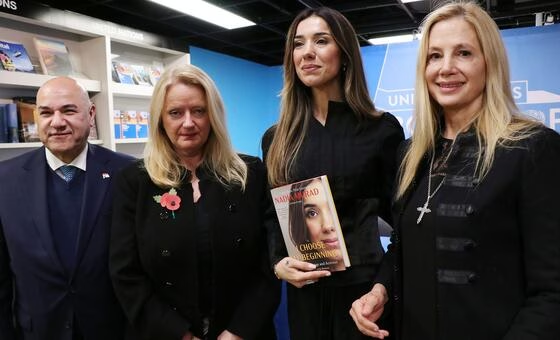
This week, Ms. Murad returned to UN Headquarters in New York, for a packed event at the UN Bookshop focused on her new memoir, I Choose My Beginning – a deeply personal account of rebuilding her life.
Turning the page
ISIL, also known by the Arabic moniker Daesh, conducted a genocidal campaign beginning in August 2014 against the Yazidis, whose historic homeland is the Sinjar region of northern Iraq.
Ms. Murad’s first book, The Last Girl: My Story of Captivity and My Fight Against the Islamic State, focused on that 2014 genocide where six of her brothers were murdered and she was taken into sexual slavery in Mosul – one of over 6,000 Yazidi women taken captive, according to UN figures. She escaped after three months, reaching a camp in Kurdistan and was then resettled in Germany.
With her new book, she said, she wanted to explore a different part of her journey – one centred on healing, relationships, love and the possibility of building a future.
“I was just another story – part of a global community of survivors of rape, men, women and children from all around the world” she said, recalling the early years of her advocacy.
She described how repeated public appearances and interviews left her feeling that she was disappearing into activism.
At certain point, Ms. Murad felt that she had lost herself – the girl who grew up on a farm, in a big family, was gone.
“I was disappearing, even physically, my hair was falling, I was losing weight, not sleeping, not eating” – but the fact that her niece and best friend was still in captivity kept her going, with the hope it would help rescue her.
“Day by day, I took it back piece by piece, I built it. – Nadia Murad
When her niece Kathrine was killed, she lost faith in humanity for the first time. “I couldn’t do it anymore.”
‘The world failed me’
Her family came together to remind her that she could feel safe again, get educated and pursue life beyond activism. “Finding love also changed me”, Ms. Murad explained.
In her book she writes that the first time she told her story, she felt it did not belong to her. “Day by day, I took it back piece by piece, I built it.”
“What they did to us was their legacy,” she said of ISIL’s three-year rule of terror, which “was the permanent mark that rape leaves on your body, on your mind.”
Nadia Murad presents her second book and memoir, I Choose My Beginning, at the UN Bookshop at UN headquarters in New York.
Survivors are blameless but you will always wrestle with your own memories: “I didn’t do anything wrong. The world failed me”, she added.
Push for justice
Nadia Murad came to the UN Security Council in 2015 to testify, and she recounted the atrocities committed against the Yazidi community and called for international action against human trafficking and sexual violence in conflict.
The UN system has sought to address sexual violence not only as a consequence of conflict, but as a crime that must be prevented and prosecuted.
For Ms. Murad, the response must go further: survivors must be seen not only through the violence they have endured, but as individuals with ideas – and the capacity to lead change.
Ms. Murad also called for survivors to be included in policy discussions as leaders and experts: “If we keep treating them as just victims and expect them to just never recover, we’re never going to prevent this from happening,” she told the audience.
A source of inspiration
Academy Award-winning actress and current UNODC Goodwill Ambassador to Combat Trafficking, Mira Sorvino, was at the bookshop too and praised Ms. Murad for challenging the tendency to see survivors only in relation to their trauma.
Ms. Sorvino, who also serves on the board of trustees of the UN Voluntary Trust Fund for Victims of Trafficking in Persons, said Ms. Murad had transformed unimaginable suffering and trauma into a source of strength and inspiration for others.
“She’s basically taking ownership of all the negativity of her life, and all the kind of public fascination that feeds on distress and feeds on trauma (…) and turned this on its head”.
“Her story is not the terrible things that were inflicted on her,” Ms. Sorvino said, reflecting on the message of the new book. Rather, it is about reclaiming life and rebuilding in the face of what happened.
“Unfortunately, Nadia can’t be the last girl – as conflicts and atrocities continue – but that doesn’t mean it’s not worth fighting for,” she added.
Ms. Sorvino shared her own experience as a survivor of sexual violence, saying that Ms. Murad’s courage had given her strength and underscored the importance of speaking out.
In her book, Ms. Murad writes: “Survivors, though, are changing. We are becoming bolder and more vocal, less likely to let the stigma of rape push us into some dark, silent hole.”
