
British Prime Minister Andy Burnham has reignited the debate over Britain’s relationship with the European Union, arguing that the country has lost more than it has gained from Brexit and needs to reconsider its long-term ties with the bloc.
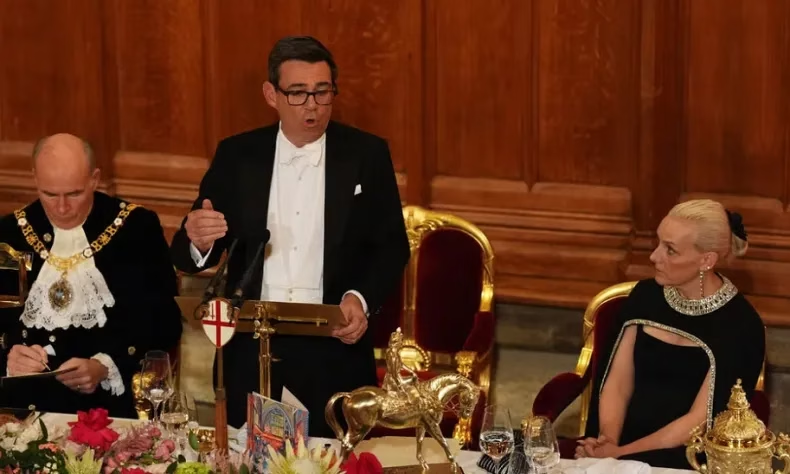
Speaking at the Lord Mayor’s Banquet in London on Monday, Burnham delivered his first major foreign policy speech, describing Britain’s departure from the EU as a strategic mistake that weakened the country’s international standing and contributed to a wider shift towards isolationism and protectionism.
“ To be frank, we have lost more than we have gained in the last 10 years,” Burnham said, adding that the current post-Brexit arrangements were insufficient for Britain’s economic and political interests.
“The hard Brexit we were given is not good enough for Britain,” he said.
The prime minister’s remarks came ahead of Friday’s UK-EU reset summit, where British and European leaders are expected to agree on several measures aimed at improving cooperation. The proposed agreements include an agri-food trade deal, linking the two sides’ emissions trading systems and establishing a new youth mobility scheme.
Following the summit, Burnham said his government would begin discussions with European partners on possible options for Britain’s long-term relationship with the EU.
“After the summit, we will initiate a discussion with our EU partners about options for our long-term relationship, recognizing that both Britain and the EU are very different to what they were,” he said.
However, he indicated that the process would take time, with the government planning to present its assessment of the available options ahead of the next parliamentary term.
“This will take time and we will present those options and our assessment of them to inform decisions in the next parliament. At every stage, the British people will be the boss,” he added.
The revised timeline suggests Burnham is taking a cautious approach to an issue that remains politically sensitive in Britain. He had previously indicated that he would outline the different options for the country’s future relationship with the EU around the time of the summit.
A government official, speaking anonymously, said discussions were now more likely to focus on the initial steps of the process rather than immediately presenting a detailed list of options for public consideration.
Burnham faces competing pressures within his own government over how closely Britain should align with the EU. Some Cabinet members favour deeper economic cooperation, while others remain reluctant to cross established political red lines, particularly on rejoining the EU single market or entering a customs union.
The prime minister insisted that his approach was not an attempt to reopen the political arguments surrounding the 2016 Brexit referendum.
“This is not about re-running the arguments of 2016,” he said, stressing that any new arrangement during the current parliamentary term would remain within Labour’s 2024 election manifesto commitments.
He also said any agreement must improve on the existing Brexit settlement and deliver tangible benefits for working people, particularly those facing the continuing cost-of-living pressures.
Burnham described Brexit as part of a broader international movement towards isolationism, arguing that Britain’s withdrawal had damaged its relationships with allies and international institutions.
“Brexit was exactly what our enemies wanted,” he said, describing Britain’s departure from the EU as the “first domino to fall in a global move towards isolationism and protectionism.”
“In the decade since Brexit, our standing in the world has diminished. We treated both allies and institutions with insufficient care, and the effects went beyond Europe,” he added.
His comments have already drawn criticism from prominent Brexit supporters. Former Conservative prime minister Boris Johnson, who signed Britain’s post-Brexit settlement with Brussels in 2020, warned Burnham against spending political capital reopening the European question.
In an interview with the Telegraph published on Monday, Johnson said the prime minister risked damaging his premiership and his party by revisiting the issue.
“He will impale himself and his party on this point, and he needs to move off it because he won’t win — because the reality is that people are not fools,” Johnson said.
Reform UK leader Nigel Farage, another leading figure in the 2016 Brexit campaign, has also attacked Burnham’s approach. In October, Farage accused the prime minister of a “total betrayal” after remarks that fuelled speculation about a possible return to freedom of movement.
Despite the political divisions, public opinion appears to be shifting towards closer European ties. An Ipsos poll conducted in October found that 56 per cent of Britons would vote for the country to apply to rejoin the European Union, while 51 per cent supported holding another referendum after the next general election.
The findings suggest that the political debate over Brexit remains far from settled, even a decade after the referendum.
For Burnham, however, the immediate challenge is to translate his criticism of the existing settlement into practical agreements without triggering another divisive confrontation over Britain’s European future. Friday’s summit is expected to mark an initial step in that process, rather than a fundamental reversal of Brexit.
