
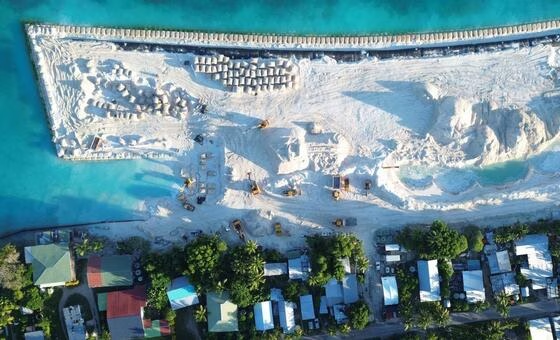
Yet, for the people of some low-lying small island States, what is at stake is more than just their houses. Their countries face the possibility of substantial losses of land territory and even complete submergence, which could render them uninhabitable.
Where will they go? What will happen to their nationalities? Their culture?
Global mean sea level is rising and accelerating. By 2100, the UN’s World Meteorological Organization estimates that seas will have risen by at least 0.5 metres – while the most pessimistic predictions estimate a full two metres increase.
For small low-lying nations in the Pacific Ocean like Tuvalu, Kiribati and the Marshall Islands, which lie only around two metres above the sea, this growing reality poses a very tangible threat.
Yet, despite the prospect of losing their homes, people from these States are determined not to lose their nationality, culture, cultural heritage or identity.
With most of its land only a few feet above sea level, Kiribati is seeing growing damage from storms and flooding.
Preserving sovereignty
States have recognised that preserving statehood and sovereignty is essential to prevent loss of nationality and statelessness and to safeguard the right of people to self-determination.
For a State to be considered a subject of international law, the elements normally considered necessary are:
- Defined territory
- Permanent population
- A government
- Capacity to enter into relations with other States
However, relevant legal instruments do not address the question of the continuity of statehood in the context of sea-level rise even as nations have expressed strong support in that regard.
This principle has been affirmed in several declarations of the Pacific Islands Forum and the Alliance of Small Island States.
Resource-rich maritime zones
Another issue of concern is the continuity of States’ maritime zones.
Under the UN Convention on the Law of the Sea (UNCLOS), maritime zones are measured from “baselines”, which are generally drawn around the coast at the low-water line.
If baselines were to shift as waters rise, the maritime entitlements of a State could change if coastlines move landward.
This in turn would mean losing such entitlements as rights over fisheries and other resource and conservation and management measures.
States have already called for baselines and the outer limits of maritime zones established in accordance with UNCLOS as well as settled maritime boundaries to be maintained regardless of physical changes caused by sea level rise.
This would support legal stability, certainty and predictability.
“We are not going to change the map for a crisis we did not cause,” stressed the President Hilda Heine of the Marshall Islands at the 2024 UN high-level meeting on sea level rise. Indeed, the States most affected by sea level rise are those that contributed least to the emissions that cause it.
“The answer cannot be that our borders will be ambiguous or open for international plunder of our resources,” she said.
What is the UN saying?
The United Nations provides a forum for all States and other relevant stakeholders to discuss this important issue and to identify solutions.
The upcoming high-level meeting of the UN General Assembly on sea level rise is an example of this action.
In relation to international law, the International Law Commission, an expert body established by the General Assembly, and the International Court of Justice, which is the principal judicial organ of the United Nations, examined the issue of sea level rise and provided important clarifications.
They both identified strong support among States for the continuation of statehood.
They also concluded that the UN Convention on the Law of the Sea does not require States to update their baselines or outer limits of maritime zones once they have been established in conformity with the Convention.
A boy stands on a seawall that protects his family home from the rising seas in Majuro Atoll in the Marshall Islands.
Tuvalu’s trailblazing “digital nation”
Tuvalu, an archipelagic country in the west-central Pacific Ocean, is spending millions of dollars on a coastal adaptation project to elevate vulnerable land and reduce coastal erosion, in an effort to protect its territory for as long as possible.
At the same time, it has been particularly proactive in elaborating how to concretely preserve its geography, administration and culture in the face of loss of territory or habitability due to sea level rise.
In 2022, it announced plans to become the world’s first “digital nation.”
The initiative aims to move all governmental functions into a digital space, which would allow the government to continue holding elections and referendums, as well as registering births, deaths and marriages.
It is exploring a digital ID system that could allow members of a future Tuvaluan diaspora to remain connected to each other and participate in public life from abroad.
The country is also recreating its territory digitally through a three-dimensional scan of all its islands – a new kind of “defined territory”.
Finally, the project is digitally archiving the country’s history and culture, including traditional songs, historical documents, recorded cultural practices, and stories, thereby protecting and preserving important cultural heritage and identity for future generations.
Where will people go?
International cooperation is essential to address the needs of communities facing difficult decisions about relocation due to sea level rise.
The International Law Commission identified practical tools to address the protection of people affected by sea level rise, such as climate mobility agreements, humanitarian visas and measures to prevent the loss of nationality and statelessness, with human dignity as a guiding principle.
In a world first, in 2023, Tuvalu and Australia concluded a treaty – the Falepili Union Treaty – through which Australia recognised the continuing statehood of Tuvalu notwithstanding sea level rise and created a special visa pathway for citizens of Tuvalu to move to Australia to live, work and study.
Last year, 90 per cent of Tuvalu’s population applied for the first round of the ballot for 280 visas.
