
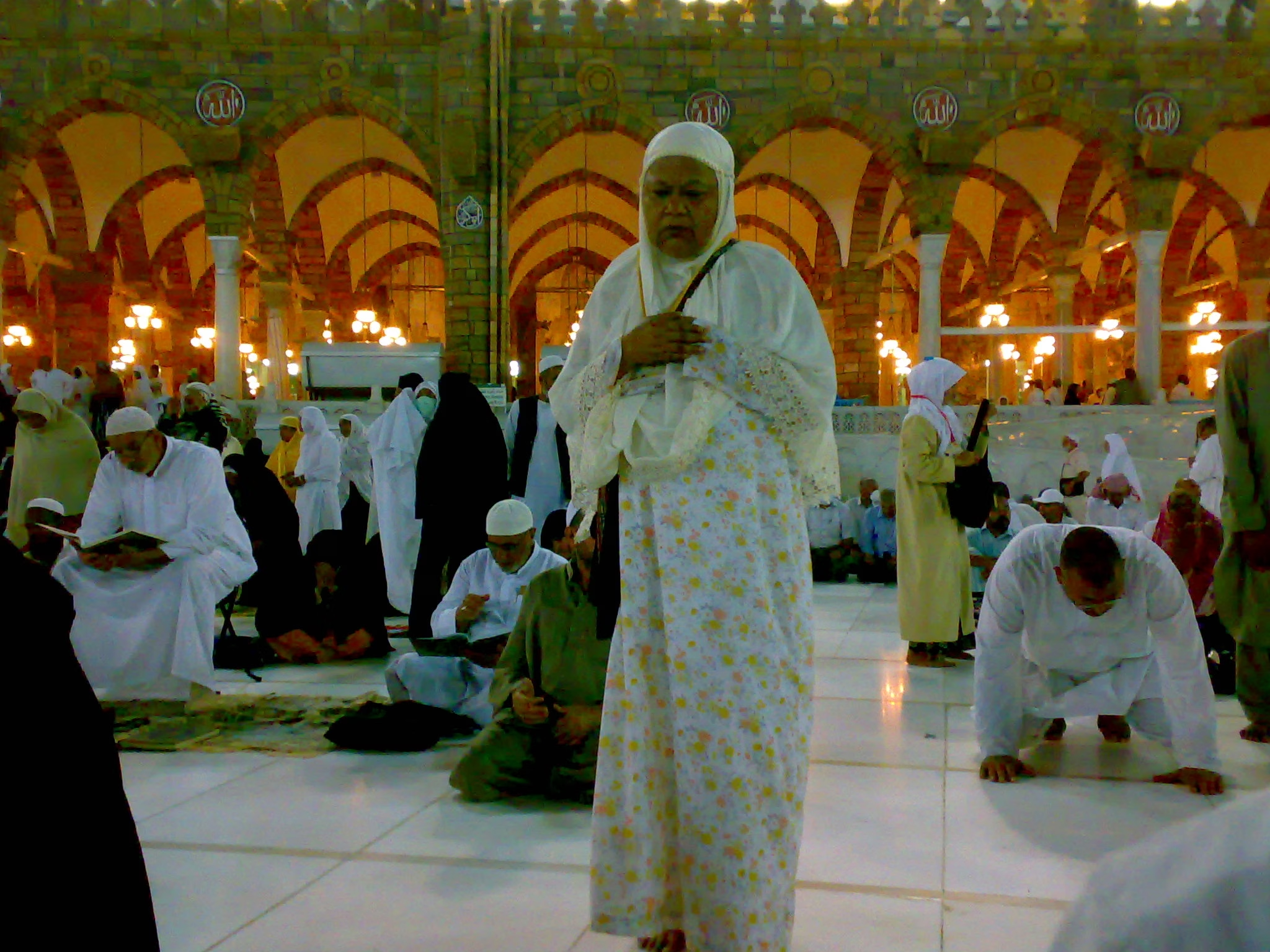
NEW DELHI: When Syeda Sakina Ashraf embarked on Hajj with her husband in 1996, she documented the journey in a memoir that would later serve as a reference guide for other Muslim women in Assam. A decade later, her daughter Ayesha Ashraf Ahmed followed in her footsteps, performing the pilgrimage and recording it in detail.
“The acuity with which both of them sketch out their journey makes one wonder at their tenacity and the sincerity of their purpose,” said Teresa Rehman, author of a recently published book on the tradition of women’s Hajj travelogues from northeast India.
Both Sakina and Ayesha’s memories are featured in the book, “Her Hajj Story: Travel Diaries of Women Pilgrims from Assam,” which studies the tradition from the mid-20th century until now.
“Ayesha, who has a doctorate in botany, started preparing for Hajj several months before the journey. She wanted to take the journey only once and was meticulous enough to take care of the minute details so that her Hajj was a flawless one,” Rehman said.
“In keeping with her habit of reading newspapers regularly, Ayesha used to pick up local newspapers like the Saudi Gazette and Arab News. She even wrote a letter to the editor of Arab News and was delighted when it was published. She has appended a copy of the published letter in her memoir.”
The memoirs written by the mother-daughter duo are among 11 narratives that Rehman has chosen to share, translate from Assamese and Bengali, and analyze in her book. Alongside them is that of Zebunissa, a schoolteacher who went for Hajj in 1978 and narrated her adventures on the 3,000-km-long journey across India to reach Mumbai, from where pilgrims back then traveled by sea.
Another one is the story of Syeda Nazifa Ahmed, who traveled with her son Nassif Ahmed in 2009. She wrote mainly about her feelings, about bonding with people of different nationalities, and how she befriended a Nigerian pilgrim, Hawa, who looked after her with daughterly care when she felt unwell.
“The women who wrote these memoirs were mostly middle-class and had varied academic backgrounds — from an 8th-grade pass to a Ph.D. They also ranged from being a homemaker, an actor, a botanist, a schoolteacher and a social worker,” Rehman said.
“The common factor among them was their love for reading and the desire to be seen and heard … Written mostly in their native language, these memoirs were meant mostly for private circulation among family and friends.”
While several such travelogues have eventually been printed by local publishers, there are many more manuscripts that now exist only in the memory of relatives.
As Rehman looked for them, “some unexpectedly tumbled out of curio collections of a few punctilious family members, who refused to junk old stuff. Sons and daughters revisited their mother’s memory through her Hajj memoir,” she said.
“For some, it was a matter of pride that somebody in their family had written a book, while some had hazy memories of a ragged, lost book that they couldn’t seem to trace anywhere … I mourn the loss of many such memoirs because of callous family members who did not feel the need to preserve them for posterity. Maybe, women’s writing was not taken seriously.”
While Indian literature recognizes female Hajj travelogues through the work of Nawab Sikander Begum — the ruler of the princely state of Bhopal in central India, published in 1870 — and her granddaughter’s pilgrimage diary from 1903, these were isolated examples.
Rehman believes that this tradition is unique to Assam. She traced the earliest examples of such writing to the early 1960s, and the most recent one in her book dates from 2025, as the tradition continues to this day. For her, it is a “living tradition” and a way for women to “reclaim agency in storytelling” in the lore that is dominated by male scholarship and writing.
Prospective pilgrims found these Hajj memoirs accessible, especially since they were written in their mother tongue.
While some authors focused on emotions and the spiritual dimension of Hajj as a life-changing event, others are more akin to travelogues — observational, describing the people and places, sharing practical advice and touching on taboo subjects, too.
“At one hand, they spoke boldly of their anxiety about the Hajj rituals and whether they would be able to perform them correctly; on the other, there were more worldly and practical discussions about the unbearable desert heat, the fear of losing oneself or a dear one in the overwhelming crowd, menstruation, the lack of adequate toilets, luggage, food, sanitation, and hygiene,” Rehman said.
“They talk freely about these taboo topics because they were meant for private circulation among their female relatives. They were uninhibited about their experiences as they had an audience in mind.”
