
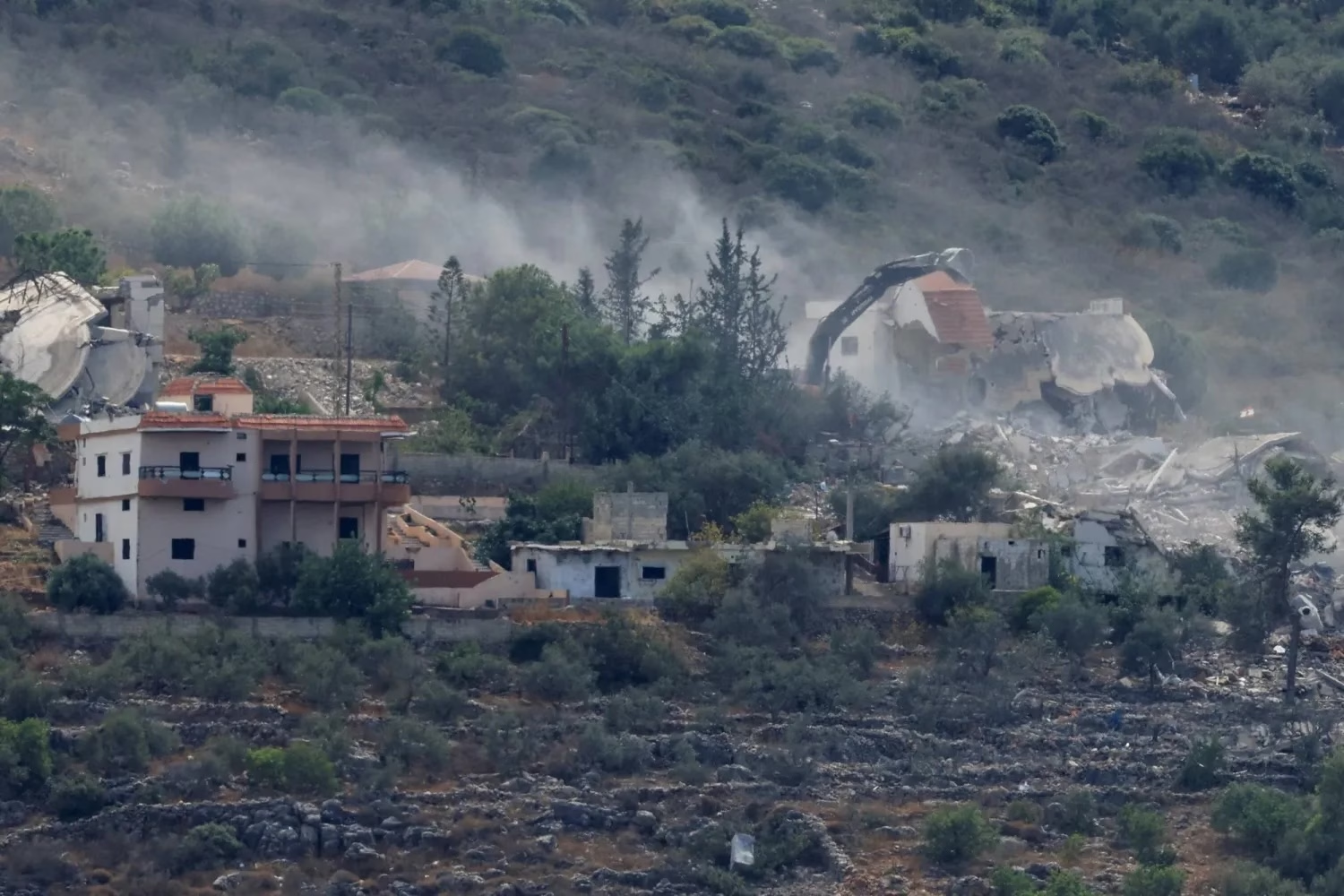
From protecting northern Israeli communities to disarming Hezbollah and ensuring that the Lebanese army can assume responsibility for security, Israel has set a series of conditions for the future of its occupation of southern Lebanon.
Although Israel says it has no territorial ambitions in Lebanon, statements by its officials in recent months have offered no clear timetable for withdrawal, instead linking it to a succession of security and political conditions.
From protecting the north to a “security zone”
Amid repeated Israeli statements focusing on maintaining the occupation of southern Lebanon, Israeli Defense Minister Israel Katz said on June 21 that the Israeli military would continue operating there.
He said troops deployed in the “security zone” would not withdraw and would retain freedom of action to eliminate threats.
Israeli Foreign Minister Gideon Saar later said Israel had no territorial ambitions in Lebanon, while stressing that it would not withdraw from the “security zone,” citing the need to protect Israeli citizens from Hezbollah attacks.
Katz was more explicit in rejecting any imminent withdrawal. On June 24, he said the Israeli military will not withdraw from the security zone, even if the US demands it.
The following day, the language shifted from security necessity to an open-ended timeline. Katz said Israeli forces would remain in security zones in Lebanon, Syria and Gaza “without any time limit.”
Disarming Hezbollah as a condition
At the end of June, Katz sought to reconcile Israel’s denial of territorial ambitions with its continued military control, insisting that Israel would not withdraw by a single millimeter before Hezbollah was disarmed.
Days later came his most direct statement. After US President Donald Trump raised the possibility of an Israeli withdrawal from Lebanon, Katz responded: “We did not ask permission from any party to enter Lebanon and we do not need permission to stay in Lebanon.”
A new condition: Strengthening the Lebanese army
The latest US statement introduced another criterion for the future of Israel’s presence. US Ambassador to Israel Mike Huckabee said on Saturday that the Israeli military will remain in southern Lebanon until the Lebanese army “is strong enough to be the securing force.”
Israeli objectives extend beyond withdrawal
Retired Lebanese Army Maj. Gen. Abdul Rahman Chehaitli said Israel’s objectives went beyond maintaining a military presence in the south.
They included reaching “a military and security agreement between the two countries and abolishing everything that defines Israel as an enemy,” eventually establishing relations “like those between any two states,” in addition, of course, to disarming Hezbollah.
In remarks to Asharq Al-Awsat, Chehaitli said Israel was seeking to establish a joint border committee to monitor violations, followed by economic agreements.
Its most important objective, he said, was a meeting between the Lebanese and Israeli presidents. He viewed Israel’s pressure on the Lebanese state as serving that goal.
Chehaitli rejected linking an Israeli withdrawal to strengthening the Lebanese army, arguing that Israel itself was obstructing efforts to secure the support the army needed. He cited the Paris conference, which ended without final decisions.
The Lebanese army, including its officers and troops, was “fully prepared to carry out its duties,” he said.
The army and Hezbollah’s weapons
Chehaitli said Israel wanted the Lebanese army to act as an “advance detachment,” confronting Hezbollah first before Israeli forces took over — a role he said the army “will not perform.”
The natural sequence, he said, was that “once Israel says it has completed its military operations in Lebanon, the Lebanese army can then carry out its mission.” In other words, an Israeli withdrawal would allow the Lebanese state and its army to assume their responsibilities fully.
Addressing Hezbollah’s refusal to surrender its weapons and Israel’s use of the issue as justification for continuing the occupation, Chehaitli said Israel had previously tied its withdrawal to the Lebanese government adopting decisions establishing the state’s exclusive control over weapons.
“That has happened,” he said. “Parliament granted the government confidence for the third time, including the Shiite component and Hezbollah in particular, which did not withhold confidence from it and therefore did not reject its decisions.”
After an Israeli withdrawal, Chehaitli said, the government could implement its decisions throughout Lebanon “regardless of whether Hezbollah explicitly agrees.”
Israel’s continued presence made the task of the state and army more difficult, he added. “The occupation is the obstacle preventing the state from implementing its decisions and assuming its full responsibilities.”
Two Israeli soldiers were wounded
The statements came as Israeli attacks continued at varying levels of intensity in recent days.
Nabatieh came under a barrage of strikes on Saturday. Israeli warplanes carried out two rounds of strikes on the Old Square neighborhood in Nabatieh al-Fawqa before launching a third strike that targeted emergency teams from the Islamic Risala Scout Association and the Bayt al-Talaba ambulance service as they headed to the site of the earlier attacks.
Members of both teams escaped unharmed, and no casualties were reported.
In Khiam, the Israeli military carried out a large demolition operation in the morning, coinciding with a powerful explosion in the Mansouri area. Israeli warplanes also launched a series of strikes on Mansouri and Kfar Tebnit and bombed Wadi al-Salouqi.
Israeli artillery shelled the outskirts of the towns of Haddatha, Haris and Mayfadoun at dawn as part of a field escalation affecting several areas of southern Lebanon.
Later in the afternoon, the Israeli military said two soldiers were wounded when an explosive device detonated inside what Israel calls its “security zone” in southern Lebanon. It accused Hezbollah of planting the device and announced a series of strikes on sites across several parts of the south.
The Israeli military said its targets included observation posts and facilities it said had been used to prepare operations against its forces. It also confirmed that its troops remained deployed inside what it describes as the “security zone” in southern Lebanon and said it would continue acting against what it considers threats to its forces and Israeli residents.
