
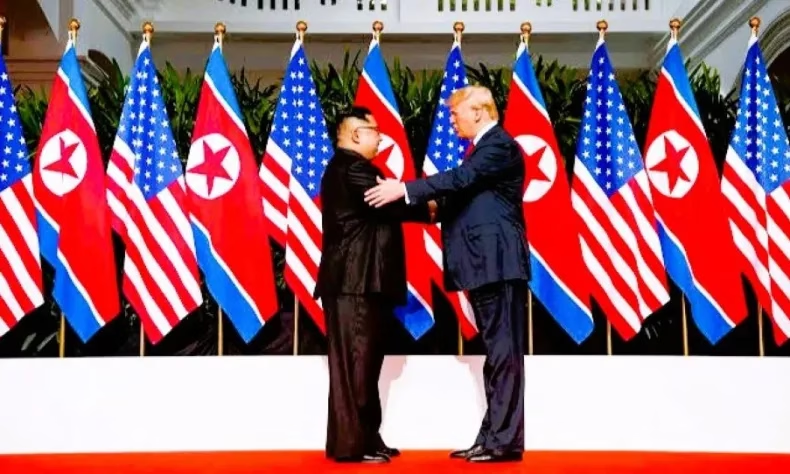
The United States and South Korea have begun their annual joint military exercises under an unexpected new political backdrop after US President Donald Trump ordered a sharp reduction in the scale of the drills and revived talk of another meeting with North Korean leader Kim Jong Un.
The 11-day Ulchi Freedom Shield exercise was shortened to five days, a decision announced by Trump just one day before the exercises were due to begin. The move immediately raised questions about whether the US president is once again treating military exercises on the Korean Peninsula as a bargaining tool in an effort to bring Pyongyang back to negotiations.
Trump has pointed to his “very good relationship” with Kim and also expressed frustration with South Korea over its refusal to support Washington during the US conflict with Iran.
The decision represents a significant shift in emphasis for an exercise that has long served as a central demonstration of the US security commitment to South Korea. For decades, the drills have been designed to improve the allies’ ability to respond to a North Korean attack and to maintain operational readiness against Pyongyang’s evolving nuclear, missile and conventional military capabilities.
North Korea, meanwhile, has consistently condemned US-South Korean military exercises as preparations for an invasion and has demanded their cancellation.
Yet despite the reduction in the drills, Pyongyang has shown little enthusiasm for Trump’s renewed overtures. The latest development therefore leaves open a central question: Is Trump attempting to use the exercises to secure concessions from North Korea, and does Kim have any reason to return to the negotiating table?
Trump has explicitly linked his decision to broader disagreements with South Korea.
The US president complained that Washington maintains roughly 39,000 troops in South Korea to help protect its ally against North Korea, while Seoul had declined to support the United States in what Trump described as an easy military operation in Iran.
“We have 39,000 soldiers over there, guarding you from Kim Jong Un, your next-door neighbour, and you’re not going to help us on a very easy military operation in Iran. That’s strange,” Trump told reporters.
The comments highlighted the increasingly transactional approach Trump has taken toward US alliances during his second term.
South Korean Foreign Minister Cho Hyun suggested that Trump’s message was broader than the military exercises themselves. According to Cho, Washington was applying pressure to Seoul over several unresolved issues, including South Korean investments in the United States.
“I think President Trump’s message includes pressure over several pending issues concerning the South Korean government, as well as a message to North Korea and an intention by the US to break a stalemate in the Iran war,” Cho said.
The reduction of the military exercises could therefore serve several purposes simultaneously.
It could be a signal to Pyongyang that Washington is willing to reduce one of North Korea’s longstanding security grievances. It could pressure Seoul on burden-sharing and other economic issues. And it could provide Trump with an opportunity to shift attention from the difficulties surrounding the Iran conflict toward a diplomatic initiative involving North Korea.
Analysts say the last possibility may be particularly important.
“Trump’s foreign policy track record during this second term has either been lacklustre or unsuccessful,” said Dr Nah Liang Tuang, a research fellow at the S Rajaratnam School of International Studies.
“I suspect that he’s trying to create an opening for diplomacy with North Korea so that he will hopefully have some foreign policy success before the November mid-term elections.”
Trump has already indicated that he wants to meet Kim again later this year.
That ambition is not new.
During his first presidential term, Trump met Kim three times. Their first summit in Singapore in 2018 was historic because it marked the first face-to-face meeting between a sitting US president and a North Korean leader.
In 2019, Trump became the first sitting US president to enter North Korea when he met Kim at the Demilitarised Zone.
The relationship eventually failed to produce a nuclear agreement, but Trump has continued to speak positively about Kim.
The latest reduction in military exercises is therefore significant because it goes beyond Trump’s familiar public statements.
“Trump has been clear about his desire to meet Kim again, and the scaling down of the (joint military exercise) is the latest signal,” said Dr Victor Cha, Korea Chair at the Center for Strategic and International Studies.
“What’s different this time is that it is a concrete action rather than just words and social media posts.”
Trump’s latest decision echoes his approach following the first summit with Kim.
After the Singapore meeting, Trump suspended major US-South Korean military exercises, arguing that they were expensive and provocative.
The decision alarmed some US allies and defence officials, who feared that reducing exercises could weaken military readiness. North Korea, however, welcomed the suspension as a step toward ending what it called hostile US military policy.
Trump is now once again reducing the scale of exercises as he seeks dialogue with Pyongyang.
That makes the drills a potentially valuable bargaining chip.
Military exercises are among North Korea’s most persistent complaints about the US-South Korean alliance. A reduction in their size or frequency can therefore be offered as a political gesture without immediately requiring Washington to dismantle the alliance itself.
For Trump, the calculation may be that a limited concession could create an opening for negotiations.
But there could be another strategic objective: Russia.
North Korea has developed substantially closer military relations with Russian President Vladimir Putin since Moscow launched its full-scale invasion of Ukraine.
Pyongyang has supplied weapons and sent troops to support Russia’s war effort, while Moscow has provided North Korea with economic and military benefits.
The relationship has fundamentally altered North Korea’s strategic environment.
A renewed US-North Korea dialogue could potentially give Trump an opportunity to pull Kim away from Moscow, or at least reduce the depth of the military relationship between the two countries.
However, Dr Cha has suggested another explanation: Trump may simply want to change the political conversation.
“Trump may (also) want to change the headlines from Iran to something else,” he said.
The Iran conflict has complicated Trump’s foreign-policy agenda, and a new initiative involving North Korea would provide the president with an alternative diplomatic narrative.
Trump’s decision also coincides with a separate push by South Korean President Lee Jae Myung to improve relations with Pyongyang.
Just two days before Trump announced the reduction of the military exercises, Lee proposed talks aimed at replacing the armistice that ended the Korean War with a formal peace arrangement.
The Korean War lasted from 1950 to 1953 and ended with a ceasefire rather than a peace treaty. As a result, the two Koreas technically remain at war.
Lee’s proposal therefore represents an effort to address one of the most fundamental unresolved issues on the peninsula.
There is now a degree of convergence between Seoul and Washington.
Both Trump and Lee have expressed an interest in reducing tensions and reopening dialogue with North Korea, although their broader motivations and strategic priorities are not identical.
Dr Jaehan Park, assistant professor at RSIS, said Seoul may have indicated to Washington that it was prepared to help facilitate renewed US-North Korea diplomacy.
“I don’t think it is too off the mark to speculate that the Lee administration might have had some say in Mr Trump’s decision to scale down the military drill and … subsequent comments as to the possibility of meeting with Mr Kim,” he said.
That does not mean Seoul and Washington coordinated the decision.
South Korea’s foreign minister said the government was not informed in advance of Trump’s decision to reduce the exercise.
Washington may instead have acted independently after determining that Seoul was willing to participate in a broader diplomatic process, Park suggested.
There is another issue that could bring the two governments closer together: South Korea’s desire for greater control over its own military.
Under the current alliance arrangement, South Korea maintains peacetime operational control of its forces, while the United States would assume wartime operational control in the event of conflict.
Lee has supported greater South Korean control over the country’s military.
The reduction in exercises, therefore, could become part of a broader debate over how the US-South Korean alliance should evolve.
“I think these things are sort of coming together to create a momentum where Mr Trump is proposing certain things, and Seoul might have an incentive to sort of partake in this process,” Park said.
The greatest obstacle to another Trump-Kim summit may be that North Korea itself is in a very different position from 2018.
At the time of Trump’s first summit, Pyongyang faced intense international sanctions and diplomatic isolation.
Since then, North Korea’s strategic relationships have changed substantially.
Its partnership with Russia has deepened, while economic ties with China have recovered after the disruption caused by the COVID-19 pandemic.
North Korea’s military relationship with Moscow has become particularly important.
Pyongyang has supplied Russia with weapons and deployed troops in support of the war in Ukraine. In return, North Korea has gained access to revenue and potentially valuable military and technological cooperation.
According to a Bloomberg analysis of government trade figures and intelligence, North Korea’s foreign revenue has increased sharply since Russia’s invasion of Ukraine.
South Korea’s Institute for National Security Strategy estimated in March that Pyongyang could have earned as much as US$14.4 billion from arms sales and troop deployments between August 2023 and December last year.
However, the report estimated that North Korea had received only about 4 per cent to 19.6 per cent of those projected earnings.
Even so, the economic relationship has provided Pyongyang with opportunities that were largely unavailable during the earlier phase of US-North Korea diplomacy.
North Korea’s trade with China has also recovered, reportedly reaching nearly US$3 billion.
The South Korean central bank estimated last month that North Korea’s economy grew by more than 3 per cent for a third consecutive year in 2025.
The combination of Russian support and recovering Chinese trade gives Kim greater room to withstand US economic pressure.
That could reduce his incentive to make concessions to Washington.
Kim could also approach a new summit from a fundamentally different negotiating position.
North Korea is now openly committed to maintaining its nuclear weapons programme and has repeatedly rejected demands for complete denuclearisation.
A return to the negotiating table is therefore unlikely to resemble the process Trump pursued during his first term.
Instead, Pyongyang could seek recognition of its nuclear status, a reduction in US military forces on the Korean Peninsula, sanctions relief and an end to what it describes as Washington’s hostile policy.
Dr Cha has argued that North Korea could also have a practical reason to maintain communication with Trump.
The US conflict with Iran may have demonstrated to Pyongyang the risks and benefits of dealing directly with an unpredictable American president who has shown a willingness to use military force.
For Kim, maintaining a channel with Trump could therefore be useful even if a major agreement is unlikely.
The experience of the previous Trump-Kim summits may also have taught both sides that dramatic meetings can generate enormous publicity without necessarily producing detailed agreements.
According to Cha, the US approach to Iran has also demonstrated how Washington can issue “grand but vaguely worded statements” in which promises of future talks do not necessarily translate into concrete agreements.
That could actually make another summit more attractive to Kim.
Rather than entering prolonged denuclearisation negotiations, he could use a summit to seek political recognition, reduce military pressure and reinforce North Korea’s status as a nuclear-armed state.
For now, however, North Korea’s response to Trump’s overtures has been distinctly cool.
Kim Yo Jong, the North Korean leader’s powerful sister and a senior political figure, said Wednesday that she was “completely unaware” of Trump’s claims that Washington and Pyongyang were communicating.
She also dismissed the significance of the reduction in the US-South Korean exercises, arguing that the drills remained provocative.
North Korea subsequently conducted missile launches on Thursday, underlining that the reduction in exercises had not fundamentally changed Pyongyang’s military posture.
Yet Kim Yo Jong also acknowledged that her brother and Trump retain an “excellent” relationship.
That distinction is important.
North Korea may not be interested in immediately returning to formal negotiations, but it has not completely closed the door on Trump’s personal diplomacy.
The personal relationship between Trump and Kim remains one of the few channels that could potentially allow the two sides to restart communication quickly.
Park said the two leaders could have good chemistry, describing Trump as a larger-than-life figure and Kim as similarly assertive and self-confident.
Nah offered a more cynical interpretation.
“Trump admires authoritarians who have not done anything to offend him. Like Putin, Trump seems to like Kim and is thus predisposed to not take a hardline against the latter,” he said.
But the relationship could be useful to Kim as well.
“But it could also be that Kim realises that Trump is the only American president susceptible to flattery, and is hence using that as a weapon against the latter,” Nah said.
Whatever the personal relationship between Trump and Kim, it cannot eliminate the fundamental strategic differences separating Washington and Pyongyang.
The United States remains concerned about nuclear proliferation and the possibility of a major power dominating the Eurasian mainland.
North Korea, meanwhile, views the US-South Korean alliance as the central threat to its security.
Pyongyang also faces a powerful and prosperous South Korea directly across the Demilitarised Zone.
“From North Korea’s vantage point, having a powerful, prosperous and free South Korea on its border is not a good thing. On top of that, the US forces have been on South Korean soil for the past seven years plus,” Park said.
These structural factors are unlikely to disappear because Trump and Kim have a personal rapport.
Kim may therefore be cautious about accepting another summit.
The failure of previous nuclear diplomacy demonstrated the difficulties involved in converting personal engagement into a durable agreement.
Park said it was difficult to expect major breakthroughs in US-North Korea relations, particularly given the broader pattern of Trump’s diplomacy.
A meeting abroad would also be complicated for Kim.
A foreign trip by the North Korean leader would require extensive logistical and security arrangements. More importantly, failure to secure meaningful results could carry political costs inside North Korea.
“If he wants to make a foreign trip, the logistics are very complicated,” Park said.
“And if he doesn’t make any significant achievements in those meetings, it is going to be – if not detrimental – politically costly for him.”
Dr Chang Jun Yan, head of the RSIS military studies programme, cautioned against interpreting Trump’s decision too narrowly.
The reduction may simply be one element of a much broader political strategy.
It is also important to note that the scale of Ulchi Freedom Shield has already declined compared with earlier years. Based on publicly available data, the number of participating troops was roughly twice as large a decade ago.
Nevertheless, the exercises remain strategically significant.
For Washington and Seoul, they are not simply training events. They demonstrate military interoperability, test command structures and reinforce the credibility of the US commitment to South Korea.
That is why Trump’s willingness to use their scale as a diplomatic signal could have consequences beyond North Korea.
If military exercises become increasingly treated as bargaining chips, other US allies in Asia will be watching.
Japan and other regional partners could begin questioning whether American military commitments are unconditional or whether they could be adjusted according to Washington’s political priorities.
Nah said East Asian countries may increasingly need to become more self-reliant in national security, particularly while Trump and the MAGA movement remain influential in US politics.
Japan is already engaged in debates about how it should respond if Washington becomes less predictable, Park noted.
The evolution of the US-South Korean alliance could therefore have consequences far beyond the Korean Peninsula.
One especially important issue is wartime operational control.
Any acceleration of South Korea’s move toward greater independent command authority could substantially change the structure of the alliance.
“The trigger will be what’s happening with the US-Korean alliance,” Park said.
A major change to the command arrangement could alter the way US and South Korean forces operate together and influence defence planning throughout East Asia.
Despite the uncertainty surrounding Trump’s approach to North Korea, the broader US strategic competition with China is unlikely to disappear.
The United States still considers the Indo-Pacific a central arena of strategic competition, and South Korea remains an important part of America’s regional network of alliances.
That means even if Trump reduces exercises, seeks a summit with Kim or adjusts the military command structure, Washington will still have strong incentives to maintain a substantial strategic presence in East Asia.
For South Korea, the challenge will be balancing its desire for greater autonomy with its continued dependence on the US security umbrella.
For North Korea, the calculation is different.
Kim now has more economic and military options than he did during Trump’s first term. Russia offers an alternative strategic partner, while China remains an essential economic relationship.
That gives Pyongyang more leverage.
Trump, meanwhile, may believe that his unique personal relationship with Kim can succeed where conventional diplomacy failed.
The reduced military exercises could be the first concrete step in testing that assumption.
But North Korea’s response suggests that Kim is not rushing back to the table.
The immediate practical impact of shortening Ulchi Freedom Shield from 11 days to five may be limited. The exercises themselves have already evolved over the years, and the number of troops involved is lower than during earlier periods.
The political significance is much greater.
Trump has demonstrated that he is prepared to modify a major US-South Korean military activity while simultaneously talking about meeting Kim again.
That makes the exercises more than a military readiness issue. They have become part of the diplomatic signalling between Washington and Pyongyang.
For Trump, reducing the drills could be a way to show Kim that his administration is willing to offer tangible gestures.
For Kim, however, the value of such a gesture depends on what Washington is prepared to offer next.
North Korea is unlikely to abandon its nuclear programme simply because military exercises are reduced. Nor is Kim likely to give up the strategic benefits of closer relations with Russia and China without substantial compensation.
A new summit could therefore look very different from the denuclearisation-focused diplomacy of 2018 and 2019.
Trump may want a headline-making diplomatic breakthrough before the US midterm elections. Kim may want recognition, sanctions relief, security guarantees and greater acceptance of North Korea’s nuclear status.
Those objectives are not naturally aligned.
The question is therefore not simply whether Trump and Kim will meet again. It is whether either side believes a meeting can produce something materially different from the failed diplomacy of the past.
For now, North Korea’s missile launches and cautious statements suggest that Pyongyang is keeping its options open without committing to Trump’s initiative.
The shortened Ulchi Freedom Shield exercise may ultimately prove to be only a small military adjustment.
Its larger importance lies in what it signals: Trump is once again testing whether personal diplomacy with Kim Jong Un can reopen a channel that collapsed during his first presidency.
Whether Kim believes the opportunity is worth taking remains the much harder question.
