
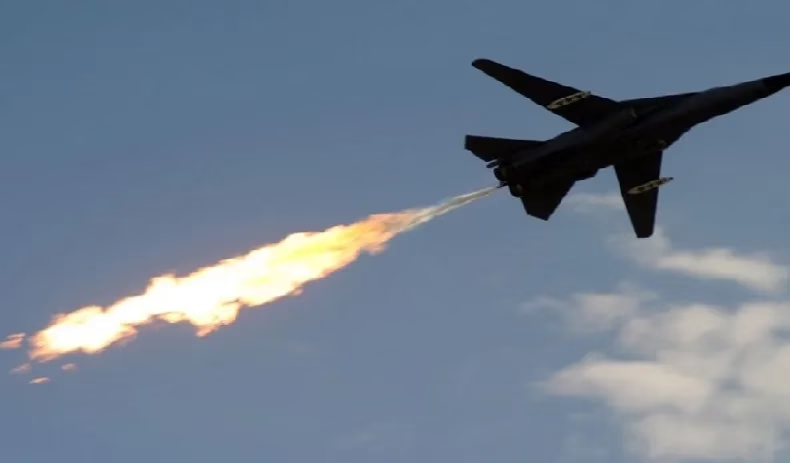
The unusual disposal of the Royal Australian Air Force’s once-feared F-111 fleet was driven by a hidden danger inside the aircraft: asbestos. Unable to safely dismantle the contaminated airframes, Australia chose to bury 23 of them in a controlled landfill.
In November 2011, an unusual convoy of trucks left Royal Australian Air Force (RAAF) Base Amberley in Queensland, carrying the remains of aircraft that had once represented the backbone of Australia’s long-range strike capability.
The cargo was not ordinary military scrap. It consisted of stripped, wingless fuselages of the General Dynamics F-111, a supersonic strike aircraft that had served the RAAF for nearly four decades and earned the nickname “Pig” among Australian aircrews because of its distinctive long nose.
Over three days, between November 21 and 23, 2011, 23 F-111 airframes were transported to Swanbank landfill, a former coal mine outside Ipswich, Queensland. There, the fuselages were lowered into a specially prepared disposal area, positioned alongside other aircraft components and eventually covered with earth.
For a military aircraft, this was an exceptionally unusual end. Instead of being dismantled for spare parts, recycled for valuable metals or sold for scrap, the Australian F-111s were buried underground.
The reason was not military secrecy, an attempt to prevent enemy access or an unusual artistic experiment. It was a serious occupational-health problem involving asbestos, a hazardous material widely used in the aircraft’s structural construction.
The decision reflected the difficulties of safely disposing of an advanced military aircraft designed and manufactured during an era when asbestos was commonly used in industrial applications.
The F-111 contained chrysotile, commonly known as white asbestos, in adhesive compounds used to bond structural panels and seal gaps between aircraft components.
These materials were part of the aircraft’s bonded construction. The problem was that asbestos-containing adhesives were not necessarily limited to easily removable components. They could also be incorporated into permanent structural sections.
Ordinarily, retiring a military aircraft involves dismantling it and recovering valuable components. Engines, landing gear, avionics, aluminium structures, hydraulic equipment and other materials can be reused, sold, recycled or retained as spare parts.
However, the Australian Defence Department faced a serious obstacle with the F-111.
Cutting, drilling, breaking or separating bonded structural panels could disturb asbestos-containing adhesives and release microscopic fibres into the air. Once inhaled, asbestos fibres can remain in the lungs for decades and cause potentially fatal diseases, including mesothelioma, asbestosis and lung cancer.
The risks extended far beyond the military personnel responsible for retiring the aircraft. Contractors, transport workers, recycling employees and anyone subsequently handling recovered materials could also be exposed.
The challenge was compounded by the difficulty of determining whether an individual aircraft was completely free of asbestos.
Establishing that would have required extensive inspections and potentially destructive testing of structural sections. Even if removable asbestos-containing components were identified and extracted, permanently bonded materials could remain inside the airframe.
Technical assessments by the Australian Defence Department concluded that completely removing asbestos and certifying individual F-111 airframes as asbestos-free was not practically achievable with the industrial capabilities and resources available.
Consequently, conventional dismantling was considered an unacceptable option for most of the remaining aircraft.
Rather than risk exposing workers to hazardous fibres, Australia decided to leave the contaminated materials intact and dispose of the airframes through controlled burial.
The financial calculations also made conventional disposal difficult.
Australian Defence Department estimates initially placed the cost of demilitarising an individual F-111 at approximately A$1 million. Asbestos removal and remediation could require an additional A$1.5 million.
That meant preparing one aircraft for potential museum preservation could cost as much as A$2.5 million.
These estimates may have underestimated the eventual costs because the extent of asbestos-containing adhesives throughout the aircraft was not fully understood when the initial calculations were developed.
There was also a regulatory consideration. The aircraft had been acquired through the United States Foreign Military Sales programme, which imposed requirements concerning secure demilitarisation and disposal.
This restricted the options available to Australia, ruling out unrestricted commercial sales and indefinite storage as straightforward solutions.
The government therefore had to balance several competing considerations: occupational safety, environmental regulations, disposal costs, international obligations and the historical value of the aircraft.
Controlled burial emerged as the most practical option for the majority of the fleet.
It allowed the authorities to dispose of large structural sections without extensively cutting, breaking or separating the bonded panels that could contain asbestos.
The Swanbank site, a former coal mine converted into a landfill, provided the location for the operation.
The disposal was conducted under contract rather than through an ordinary dumping exercise. The fuselages were transported from RAAF Base Amberley, placed in the designated disposal area and covered. Wings, tail surfaces and other components were also used to fill spaces between the airframes before the burial area was sealed.
By November 23, the operation involving all 23 fuselages had been completed.
Despite the unusual disposal decision, Australia did not bury its entire F-111 fleet.
Thirteen aircraft were retained for historical preservation, with 12 F-111Cs and one F-111G allocated to aviation museums and RAAF establishments.
Their preservation demonstrated that asbestos contamination did not automatically make an aircraft unsuitable for display. However, it imposed strict management requirements.
The preserved aircraft had to be treated as asbestos-containing objects, meaning that their maintenance, handling and public display required appropriate precautions to prevent disturbance of contaminated materials.
The distinction was between preserving an intact aircraft under controlled conditions and undertaking extensive dismantling that could release hazardous fibres.
The decision allowed Australia to retain a visible reminder of one of the most important chapters in its military aviation history while disposing of the majority of the fleet through a different route.
The F-111’s retirement also stands out internationally. Other countries have buried military aircraft for different reasons. During the 2003 invasion of Iraq, for example, Iraqi combat aircraft were reportedly buried in desert locations to protect them from coalition air attacks.
British artist Roger Hiorns also undertook unusual projects involving the burial of decommissioned aircraft in the United Kingdom, the Czech Republic and the Netherlands.
Australia’s operation, however, was fundamentally different. It was driven primarily by occupational-health concerns and the practical difficulties of safely managing asbestos-containing military equipment.
The aircraft’s unusual final destination is particularly striking considering the controversy surrounding its acquisition.
During the early 1960s, Australia’s principal strategic bomber was the British-built Canberra. Although it remained capable, the aircraft was increasingly becoming inadequate for Australia’s evolving defence requirements.
Canberra was concerned about the expansion of Indonesia’s military capabilities during President Sukarno’s period and the security of Australia’s northern approaches.
The country also needed an aircraft capable of operating across the vast distances of the Indo-Pacific, protecting maritime communications and providing a credible long-range strike capability.
The RAAF wanted a supersonic aircraft with substantial operational range, low-altitude penetration capabilities, significant weapons-carrying capacity and all-weather strike performance. A secondary reconnaissance capability was also desirable.
Several aircraft were considered, including the American A-5 Vigilante and the British TSR-2.
Australia ultimately selected the American F-111, developed by General Dynamics, because its capabilities appeared to match the country’s requirements. The purchase also strengthened Australia’s defence relationship with the United States.
The F-111 was an ambitious design. It featured two engines, variable-sweep wings and a sophisticated terrain-following radar system, allowing it to conduct high-speed, low-altitude penetration missions in challenging weather conditions.
Its variable-geometry wings could be extended for efficient long-range flight and swept backwards for high-speed operations.
However, Australia committed to purchasing the aircraft before it had even flown.
The F-111 made its first flight in December 1964, more than a year after Australia’s purchase decision. Critics questioned the government’s willingness to commit to an expensive and technically ambitious aircraft without evaluating a flying production model.

The programme subsequently encountered major engineering problems, requiring structural modifications and additional testing.
Australia had initially expected the aircraft to enter service around 1968–69. Instead, the first six F-111Cs arrived in 1973, following years of delays, technical difficulties and escalating costs.
The acquisition became a recurring political controversy, but the aircraft eventually established itself as one of the most important platforms in Australian military aviation.
The RAAF operated the F-111 from 1973 until 2010, making it the longest-serving bomber and strike aircraft in the service’s history.
Despite its preparation for high-intensity strike missions, Australia’s F-111 fleet was never deployed in combat during the Vietnam War or the 1991 Gulf War.
Its most significant operational employment came much later, during the 1999 East Timor crisis.
Following East Timor’s independence referendum in August 1999, widespread violence erupted, prompting Australia to lead the multinational International Force East Timor (INTERFET).
During the crisis, the RAAF deployed its RF-111C reconnaissance aircraft to conduct aerial surveillance over East Timor. The missions provided Australian commanders with important intelligence during a sensitive military and diplomatic operation.
The aircraft’s long-range capabilities, speed and reconnaissance equipment made it a valuable platform for monitoring developments across the region.
By the early 2000s, however, maintaining the ageing fleet was becoming increasingly expensive, and the F-111 was approaching the end of its economically viable service life.
Australia eventually retired the aircraft in December 2010.
On December 3, 2010, an F-111C carrying serial number A8-125 made the final operational landing at RAAF Base Amberley, formally ending the aircraft’s service with the Australian military.
The retirement marked the end of a 37-year chapter in Australian aviation history.
For an aircraft that had once been central to Australia’s regional strike strategy, the final journey was remarkably different from its operational missions.
Some were preserved in museums and military establishments, allowing future generations to see the distinctive swing-wing aircraft. The remaining 23 were transported to a former coal mine and buried underground.
The F-111 had entered Australian service amid controversy, spent decades as one of the country’s most powerful military aircraft and eventually became a celebrated part of RAAF history.
Yet its retirement revealed a problem rarely associated with advanced combat aircraft: the danger of materials hidden inside their structures.
Australia’s decision to bury the F-111s was therefore not simply an unusual disposal choice. It was a reminder that the legacy of military technology can extend well beyond its operational life, sometimes creating environmental and occupational-health challenges that are as complicated as the engineering that originally produced it.
