
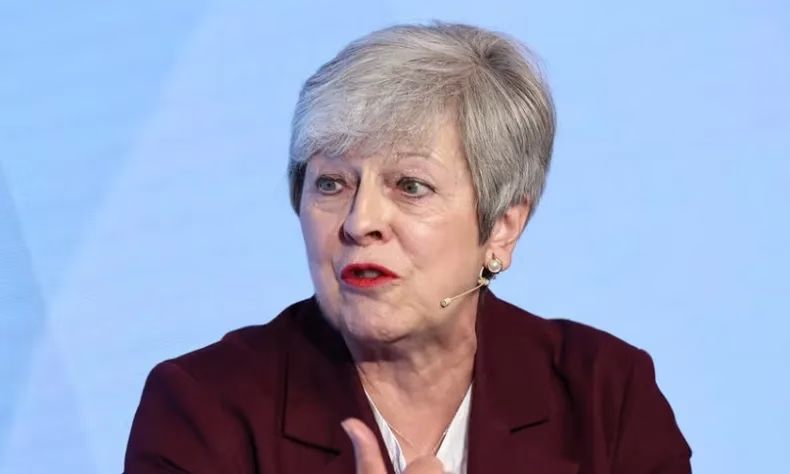
Former British Prime Minister Theresa May has criticised suggestions that Labour Prime Minister Andy Burnham could consider taking the United Kingdom back into the European Union, insisting that Brexit is settled and the government should focus on moving forward rather than reopening the divisive debate.
Speaking in an interview with the BBC broadcast on Sunday, May said she was “aghast” at the prospect of Britain revisiting the question of EU membership, warning that renewed negotiations could consume significant government time and political resources.
“People voted for Brexit. Brexit is done. Just accept Brexit and move on,” May said.
Her comments came after Friday’s summit in Brussels, where Burnham and European Union leaders announced a series of agreements aimed at strengthening relations between Britain and the bloc. The agreements covered food trade, emissions trading and youth mobility, marking a further step towards rebuilding cooperation following Britain’s departure from the EU.
The summit has also reignited debate over the longer-term direction of Britain’s relationship with Europe, particularly after Burnham reiterated his personal support for eventually rejoining the European Union.
Burnham has previously said he wants Britain to return to the EU within his lifetime. However, he has stopped short of committing his government to seeking membership or establishing a timetable for such a move.
During Friday’s discussions, he proposed an “informal brainstorming process” to examine possible options for the future relationship between Britain and the EU. He did not explicitly place rejoining the bloc on the agenda, but his proposal has raised questions about whether the government could eventually reconsider the country’s post-Brexit arrangements.
The government’s position remains cautious. European relations minister Hamish Falconer said on Friday that ministers would take their time before setting out possible options for future engagement with the EU, acknowledging the politically sensitive and divisive nature of the issue.
May, who campaigned for Britain to remain in the European Union during the 2016 referendum, warned that reopening the membership question would create unnecessary uncertainty and divert attention from other government priorities.
She said renewed discussions over EU membership could require extensive work across the government, involving everyone from the prime minister to civil servants and departmental officials.
May also accused Burnham of being dismissive towards voters who supported leaving the European Union, suggesting that reopening the debate could be interpreted as an attempt to undermine their democratic decision.
“He wants to pat them on their head and say, you know what, remember that vote? Well, you got it wrong, didn’t you? So have another go and come out with the right answer,” she said.
Her criticism reflects the continuing political sensitivity surrounding Brexit, nearly a decade after the June 2016 referendum in which 51.9 per cent of voters supported leaving the European Union, against 48.1 per cent who voted to remain.
May became prime minister shortly after the referendum, succeeding David Cameron, who resigned following the defeat of the Remain campaign. Although May had supported remaining in the EU, she pledged to implement the referendum result and repeatedly maintained that Britain would leave the bloc.
Her premiership was dominated by efforts to negotiate and secure parliamentary approval for a withdrawal agreement with Brussels. However, her proposed Brexit deal faced repeated opposition in the House of Commons, including from members of her own Conservative Party.
After several failed attempts to secure parliamentary backing, May announced her resignation in 2019, paving the way for Boris Johnson to become prime minister and complete Britain’s departure from the European Union in January 2020.
The latest exchange highlights the political challenges facing Burnham as his government seeks closer economic and diplomatic cooperation with European partners without reopening divisions over Brexit.
While the agreements announced in Brussels indicate a willingness on both sides to improve practical cooperation, the question of whether Britain should eventually seek EU membership remains politically contentious.
