
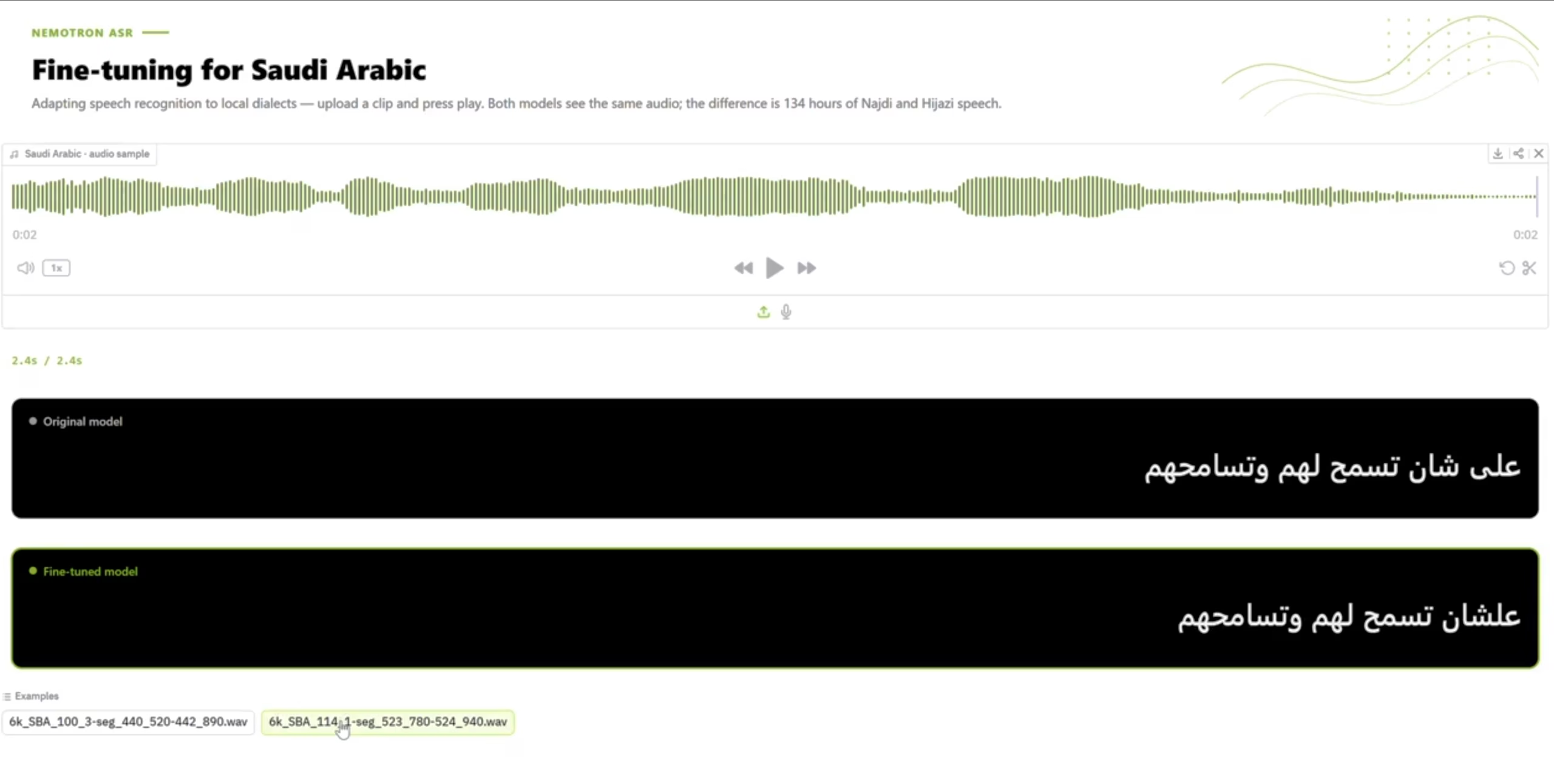
RIYADH: Global computing and artificial intelligence leader NVIDIA has announced that it used the Saudi Audio Dataset for Arabic, launched by the Saudi Data and AI Authority in partnership with the Saudi Broadcasting Authority, to train its Nemotron 3.5 ASR multilingual automatic speech recognition model.
According to a technical study published on NVIDIA’s Developer Blog, integrating the dataset nearly halved comprehension errors for Saudi dialects.
The model supports real-time transcription across around 40 languages and dialects, including Arabic. It initially misidentified about 55 of every 100 words in Saudi dialects.
After training on 133.7 hours of Najdi and Hijazi audio from the Saudi Audio Dataset for Arabic, the word error rate dropped to roughly 30 percent.
Across the full multi-dialect dataset, the error rate fell from 58.8 percent to 35.6 percent, while character-level errors dropped from 31.6 percent to 12.2 percent. Performance also improved in Modern Standard Arabic and English. The training took just four and a half hours using two GPUs.
Optimized for real-time interactive systems, the enhanced model has latency starting at 80 milliseconds, enabling applications such as intelligent voice assistants, conversational agents, live broadcast subtitling, and transcription of call centers, media archives, and meetings.
NVIDIA has also shared the workflows and tools needed for developers worldwide to replicate the methodology across other languages.
The Saudi Data and AI Authority previously released the Saudi Audio Dataset for Arabic on Kaggle to support international researchers and developers.
The dataset contains about 667 hours of transcribed audio, including more than 600 hours provided by the Saudi Broadcasting Authority from 57 television programs and series covering more than 10 Saudi dialects. Another 20 hours are reserved for validation.
The dataset, which consists of more than 125,000 categorized clips, enabled NVIDIA to target specific Najdi and Hijazi speech data.
The Saudi Audio Dataset for Arabic initiative supports academic and technical efforts to develop advanced audio models for speech recognition, text-to-speech synthesis, speaker diarization and demographic classification. It also contributes to digital Arabic content.
NVIDIA’s integration of the dataset highlights the role of high-quality national data in helping global AI systems better understand local dialects and improving technologies tailored for Arabic speakers.
