
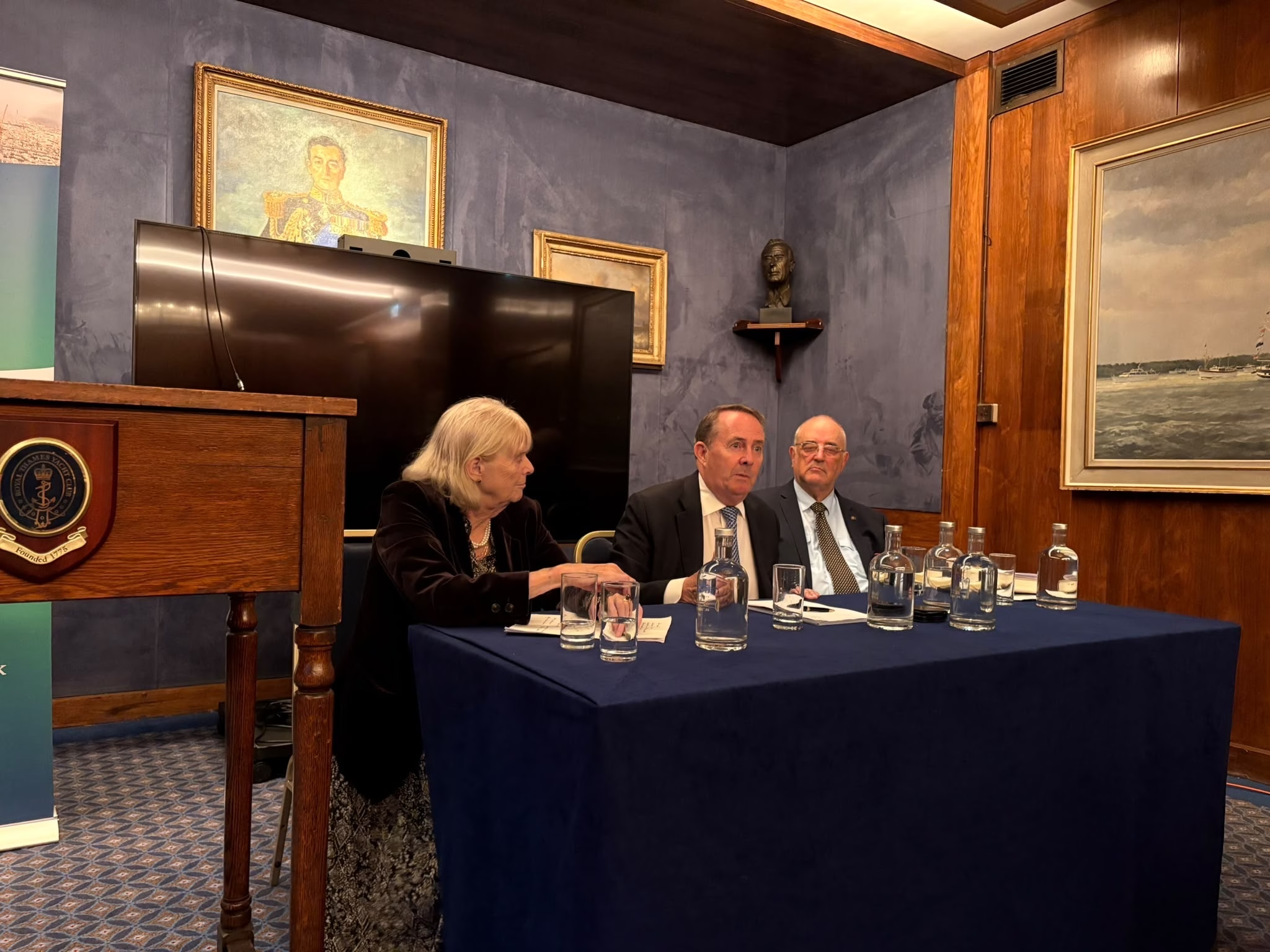
LONDON: For decades, the UK-Saudi relationship has been defined by energy, defense, trade and intelligence cooperation.
But as conflict and instability increasingly threaten the Gulf’s shipping lanes, energy infrastructure and critical technologies, Sir Liam Fox argues that the partnership now needs to evolve into something broader: a long-term security architecture capable of protecting both national sovereignty and the global economy.
Speaking to the Saudi-British Society at London’s Royal Thames Yacht Club on Sept. 29, Sir Liam framed the relationship around three pillars — economic partnership, counterterrorism cooperation and shared strategic interests in regional stability — arguing that each has become more important as risks across the Gulf intensify.
His argument was straightforward: Gulf security is no longer merely a regional issue.
The Strait of Hormuz and Bab Al-Mandab Strait are among the world’s most important maritime chokepoints. Disruption there immediately affects energy markets, shipping costs, insurance premiums and supply chains far beyond the Middle East.
“National security and economic security are inextricably intertwined,” Sir Liam said, warning that persistent instability can be almost as damaging as full-scale war if commercial actors begin treating insecurity as permanent.
“Freedom of navigation is central to a free market global trading system,” he added, describing Hormuz and Bab Al-Mandab as “global economic chokepoints” rather than regional concerns.
That distinction is becoming harder to ignore.
The unresolved confrontation between the US and Iran, tensions around Hormuz, and the Houthis’ operations around Yemen’s Red Sea coast have created overlapping risks to maritime traffic.
Sir Liam accused Iran of challenging freedom of navigation and said the Houthis remained a persistent threat to Yemen, Saudi Arabia and international shipping.
He also warned that the Houthi threat could not be understood solely through Tehran, arguing that the group has diversified its supply chains, sourced dual-use components from China and built smuggling routes through the Horn of Africa.
For Britain and Saudi Arabia, he argued, that means security cooperation can no longer be reactive.
Sir Liam proposed five areas in which London should deepen its role: sustained engagement with the Gulf, maritime security, integrated air and missile defense, defense-industrial cooperation and advanced technology.
“The Gulf cannot be treated as a region we rediscover only during crises,” he said.
On maritime security, he called for closer cooperation on deterrence, monitoring, lawful interdiction and de-escalation mechanisms.
On air and missile defense, he argued that recent drone and missile threats had demonstrated the need for stronger integrated defensive systems.
And on defense industry, he said Britain should work with Saudi Arabia on training, sustainment and industrial participation rather than viewing the relationship simply through arms purchases.
That reflects a wider change in the Saudi-British relationship.
Defense and intelligence remain central, but economic and technological cooperation are increasingly being presented as elements of national security in their own right.
Sir Liam pointed to the UK’s GREAT FUTURES campaign, launched in 2024, saying publicly reported agreements had supported more than 4,100 British jobs through over £4 billion ($5.29 billion) in UK-Saudi deals.
He also highlighted Saudi Arabia’s Vision 2030 reforms and its push into artificial intelligence, data centers and advanced computing, including the creation of PIF-owned AI company HUMAIN.
For Britain, Sir Liam argued, Saudi Arabia’s technological ambitions should be seen as an opportunity rather than competition.
UK strengths in applied research, regulation, professional services and startups could complement Saudi investment and scale, he said, particularly in healthcare, AI and critical infrastructure.
Cybersecurity and quantum technology could become another pillar.
Sir Liam warned that data collected today could become vulnerable as quantum computing develops, creating a shared need for post-quantum security across energy, transport, financial services and defense.
“This is not technology for technology’s sake,” he said. “It is national security by other means.”
That logic applies equally to AI, which will increasingly shape intelligence analysis, cyber defense, autonomous systems, logistics and the protection of critical infrastructure.
For both Britain and Saudi Arabia, the challenge is therefore not simply to acquire advanced technology but to determine how it fits into broader deterrence and resilience.
Sir Liam also raised the possibility of deeper cooperation around next-generation defense technology.
He pointed to Saudi Arabia’s interest in the Global Combat Air Program, the UK-Japan-Italy project developing a sixth-generation fighter aircraft for the 2030s.
Rather than promising Saudi participation, he argued for “structured dialogue” over what Riyadh could contribute and how cooperation might strengthen interoperability and regional deterrence.
Yet some of the least visible elements of the relationship may remain the most important.
Sir Liam described UK-Saudi counterterrorism cooperation as “the quiet work that saves lives,” built around intelligence sharing, operational cooperation, strategic communications and prevention.
That relationship, he said, now has to expand beyond conventional terrorism to include drones, missiles, proxy activity and other forms of “grey zone” pressure that can destabilize states without crossing the threshold into open war.
That was perhaps the central theme running through the speech.
The threat environment facing the Gulf is increasingly difficult to divide into neat categories. Missiles can disrupt energy markets without starting a war. Drone attacks can force expensive defensive deployments. Cyber operations can target infrastructure without a shot being fired. Militant groups can threaten commercial shipping far beyond their own territory, and insecurity at a chokepoint such as Hormuz or Bab Al-Mandab can export economic pressure to countries thousands of kilometers away.
For Saudi Arabia, this strengthens the case for deeper partnerships capable of combining intelligence, defense, maritime security and economic resilience.
For Britain, Sir Liam argued, it makes Gulf stability a direct national interest rather than a distant foreign-policy concern.
The speech also reflected a broader debate over what Britain’s role in the region should look like. Sir Liam’s answer was not a return to permanent military intervention. Instead, he called for predictability.
Britain should become a “dependable security partner” whose commitments continue between crises, rather than expanding during emergencies and receding once immediate danger passes.
That approach also requires balancing deterrence with diplomacy.
“Deterrence without diplomacy risks permanent confrontation,” Sir Liam said. “Diplomacy without deterrence risks becoming wishful thinking.”
A stable regional order, in his view, would require credible defense alongside diplomacy capable of keeping channels open for eventual de-escalation.
The goal he outlined was ambitious: a region in which sovereignty is respected, militias cannot hold states hostage, maritime trade remains protected and populations are not constantly exposed to the possibility of sudden escalation.
Whether the UK and Saudi Arabia can help construct such an architecture remains uncertain.
Much depends on forces outside either country’s control — the future of the confrontation with Iran, the Houthis’ military trajectory, freedom of navigation through the Gulf and Red Sea, and the broader competition shaping the Middle East.
But the underlying logic of Sir Liam’s argument is difficult to separate from those developments.
The UK-Saudi partnership is increasingly being tested not by one threat or one conflict, but by the convergence of economic, military and technological vulnerabilities.
That means the measure of the relationship may no longer be simply how much the two countries trade, how many defense agreements they sign or how effectively they cooperate against terrorism.
It may increasingly be whether they can build enough resilience together to stop the Gulf’s recurring crises from becoming a permanent feature of the international system.
As Sir Liam put it, stability is “not a slogan. It is a system, built patiently, defended competently, and sustained through trust.”
