
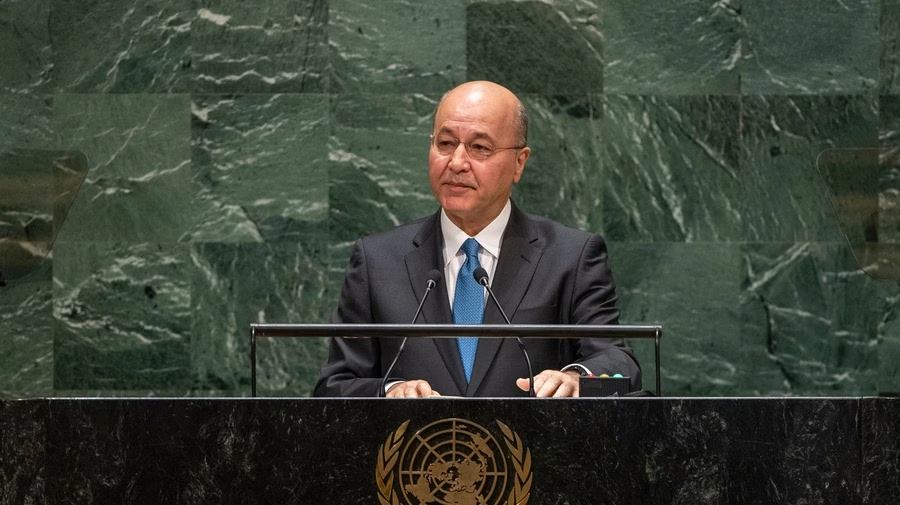
NEW YORK: The UN high commissioner for refugees has called for an end to the fighting engulfing Yemen, warning that the renewed violence that has driven tens of thousands from their homes and across the sea to Djibouti is endangering the prospects of peace in the country and the wider region.
“Yemen needs peace. Yemen needs stability. Enough of this violence that has plagued this part of the world,” Barham Salih told Arab News on the sidelines of the 81st session of the UN General Assembly.
“We’re extremely concerned, and we very much hope that the situation is brought under control and is restrained.”
Salih, a former president of Iraq and himself a former refugee, was elected by the UNGA in December 2025 for a five-year term and assumed office on Jan. 1, 2026.
“The whole situation is disconcerting. This is, unfortunately, most serious for the people of Yemen,” he said, noting that tens of thousands have already been forcibly displaced. “Many have reached Djibouti and other areas. This is a major humanitarian concern.”
The security implications and the prospects of peace in Yemen and the region “are all being impacted in a most serious way,” he added.
The latest fighting between the Iran-backed Houthi militia and the UN-recognized Yemeni government has set off a new humanitarian crisis.
The UN Refugee Agency warned this week that the number of people displaced in Yemen by the current fighting could swell from more than 130,000 today to more than 230,000.
More than 3,000 Yemenis crossed the Red Sea to Djibouti this month, and the agency expects that number to rise significantly after mid-October, when sea conditions are expected to improve. The agency is preparing for more than 10,000 arrivals.
Djibouti, with a population of about 1 million, already hosts around 36,000 refugees, most from Somalia and Ethiopia.
The agency says it needs $14 million to meet immediate needs for displaced families in Yemen, where it is also concerned for more than 65,000 registered refugees and asylum-seekers, most from Somalia and Ethiopia.
The fighting also threatens relief pipelines across the region. Continued insecurity in the Bab Al-Mandab Strait could affect shipping serving Yemen, Sudan and other emergencies, and further deterioration could force rerouting via the Cape of Good Hope, adding 25-30 days to shipping times.
Turning to Sudan, Salih said it is “truly a painful story.” He has not yet been able to visit the country, but described watching families cross into Chad and recount the horrors they endured as they fled, including the abuse of women and the war crimes that have been extensively reported.
“This country needs peace. This has to end,” he said. “The millions of Sudanese who’ve been forcibly pushed out of their homes don’t deserve that. They need to have an opportunity to go back to their country sooner rather than later.
“The hope is that there will be genuine peace, and that this unrelenting cycle of violence is brought to an end, fully and definitively. Enough is enough.”
The war that erupted in April 2023 between the Sudanese Armed Forces and the Rapid Support Forces has led to the world’s largest displacement, humanitarian and protection crisis. It has killed more than 200,000 people, and 14 million have fled their homes.
Five million have fled to neighboring countries, with new displacement continuing in parts of Darfur, Kordofan and Blue Nile regions due to ongoing insecurity.
Funding has failed to keep pace, where funding per refugee per month fell to $4 in 2025 from $11 in 2022.
Lebanon, where more than a million people were displaced during the latest war, presents a different picture, Salih said.
“Many of the Lebanese displaced have returned to their homes, but many haven’t been able to make it yet, and I don’t think we should accept this becoming the new normal for Lebanon,” he added.
Salih recalled visiting shelters housing displaced families at the peak of the crisis, describing it as “quite a sad and a painful episode.”
Significant numbers remain unable to go back “because their areas are still subject to all kinds of military activities and attacks,” he said.
Around 860,000 people displaced by the conflict in southern Lebanon have returned, while around 360,000 remain displaced, including at least 22,000 living in collective shelters, according to the UN. This as Israeli strikes on the south continue unabated despite a ceasefire signed in June.
The UN Refugee Agency is working with the Lebanese government, which Salih said is “doing a truly amazing job at a time of very, very constrained resources and difficult situations.”
The agency’s Lebanon operation is only 24 percent funded against requirements of $472.3 million for 2026.
For Salih, the answer across all three crises lies beyond aid. “We should be there to help from a humanitarian point of view as much as we can, and we’re trying our best,” he said.
“But at the end of the day, there’s no humanitarian solution without a political solution, without peace.”
