
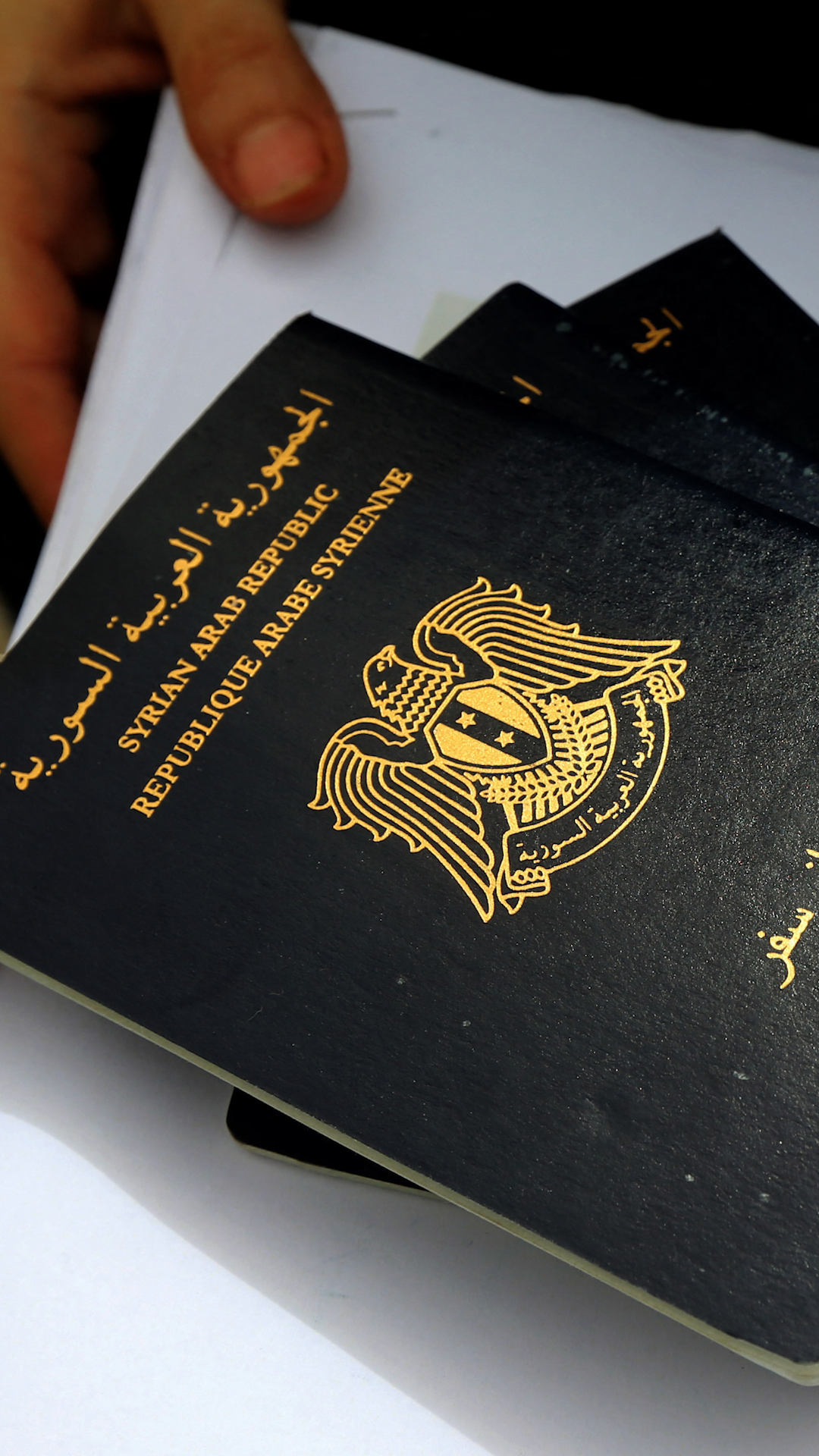
DAMASCUS: Munawar Akkad’s son was born in Syria and grew up in Syria. He has never once left the country. On paper, though, he is Tunisian, like his father.
“He speaks Syrian, eats Syrian, his friends are Syrian. He studied in Syria and works in Syria,” Akkad, a former teacher at the Higher Institute of Dramatic Arts in Damascus, told Arab News.
The reason goes back to a law issued on this day in 1969. Legislative Decree No. 276 was issued on Nov. 24, 1969, and its Article 3 makes the father the main route to citizenship. Under the decree, a child born to a Syrian father acquires Syrian nationality whether born inside or outside the country. A Syrian mother, however, can pass nationality under much narrower circumstances, including when the child is born in Syria and paternity has not been legally established.
For Akkad’s family, the cost was felt most sharply during the war. “At checkpoints, being Tunisian meant he could be one of the terrorists who came to Syria,” she said. “Every day we had a problem with some checkpoint. It hurts to have to justify all the time how this Tunisian came to Syria.”
The deeper wound, she said, is her own status. “When I can’t give my son my nationality, that is incomplete citizenship. I can’t even give him the protection of a nationality.”
Akkad added that the problem will follow her son into the next generation. He is now married to a Syrian, and his own child would face the same question of whether they are Tunisian or Syrian. Without citizenship, she said, children of Syrian mothers also face limits on property, inheritance, voting and employment. Graduates cannot apply for a master’s degree or doctorate without an exception from the Ministry of Higher Education.
Rasha Al-Tabshi runs “My Nationality Is Their Right,” a campaign that took up the issue in 2017. She said the most vulnerable are children who never obtained their father’s nationality. Their fathers may be unknown or missing, or their parents’ marriages were never registered.
“These children are at risk of statelessness. Their problem starts with their name,” Al-Tabshi told Arab News. “They can’t get any official paper proving their name, they can’t enter schools, they can’t get healthcare.”
Some families have resorted to workarounds that create new problems. “We documented several cases of women forced to register their children under the grandfather’s or the uncle’s name,” she said. “That means forged official papers and mixed-up lineage.”
No national statistics measure the scale of the problem, either before or after 2011, Al-Tabshi said. A 2023 survey by the campaign, which she said was meant to assess needs rather than serve as a census, reached about 600 affected mothers in just three villages in rural Idlib.
Since 2025, the campaign has moved from media advocacy to direct engagement with the government. It has also set up an advisory council of affected women and their children so they can press their own case. Al-Tabshi said meetings with government representatives in 2025 and 2026 drew a “very positive” response.
That shift became public this month. On Nov. 4, Social Affairs and Labor Minister Hind Kabawat told a high-level panel on legal identity in Syria, held in Geneva, that the proposal to grant citizenship to children of Syrian women married to non-Syrians had reached the approval stage. She did so without setting a date for its issuance.
Kabawat said a committee chaired by the Interior Ministry, with representatives of the ministries of Awqaf and of Social Affairs and Labor and the State Council, was formed to study the proposal. The conditions she outlined include a marriage officially registered in the civil status records and a mother who is Syrian by origin, not by naturalization, as well as an applicant with no criminal conviction. She also acknowledged that the ministry does not yet have complete figures on the number of children affected.
Al-Tabshi welcomed the momentum but warned against a partial fix. “If we are asking for this change to achieve equality, then putting conditions on Syrian women that don’t exist for Syrian men means we have not removed the discrimination,” she said.
She also urged officials to look beyond Syria’s borders. “The affected are not only inside Syrian territory,” she said. “Because of asylum and displacement over the past 15 years, they are in many countries around the world.”
Akkad said she is not calling for unchecked naturalization. Every country, she said, sets clear criteria for citizenship. But she argued that a mother who raised her children in Syrian culture, inside Syria, has the strongest claim of all.
“A Syrian mother has the right not to have incomplete citizenship,” Akkad said. “She has the right to full citizenship, just like the man who gives his nationality to his wife and to his children.”
