
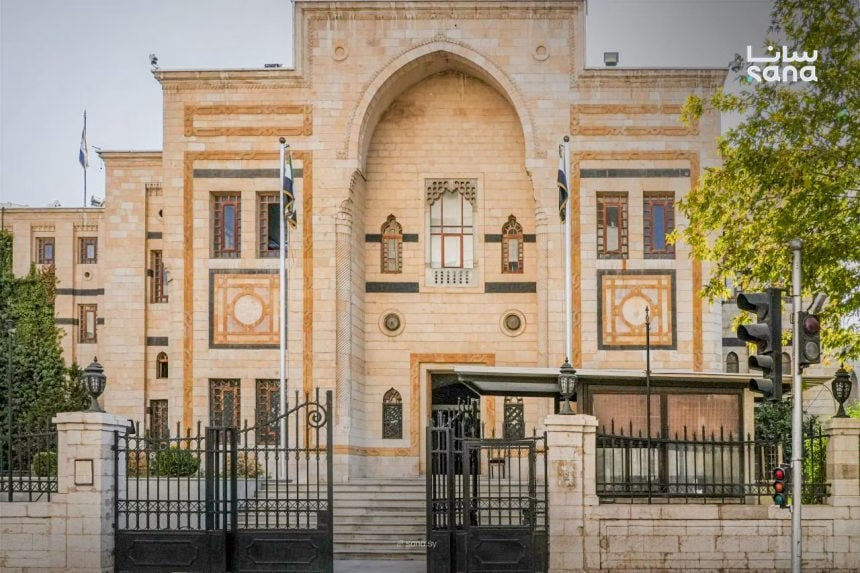
DAMASCUS: Syria faces a complex legal and administrative task in reversing the consequences of more than 90,000 cases handled by the now-abolished Anti-Terrorism Court, including confiscated property, legal restrictions and official records.
The legislation abolishing the court goes beyond dissolving the institution, establishing mechanisms to address the consequences of its rulings through specialized judicial committees. Legal experts say the success of the process will depend on how quickly and transparently those mechanisms are implemented.
The legislation was unanimously approved by the People’s Assembly during the third session of its first extraordinary sitting. It nullifies the legal consequences of the court’s rulings and assigns the Supreme Judicial Council responsibility for addressing them.
Restoring property and legal rights
Abdul Nasser Houshan, head of the assembly’s Constitutional and Legislative Committee, said specialized judicial committees would address the consequences of the rulings, including restoring confiscated property.
The committees will also close pending cases or refer them to competent courts, depending on the circumstances. Decisions previously issued by the Supreme Judicial Council on the matter will remain valid and enforceable.
The law also exempts people recovering confiscated property from taxes, fees and other costs associated with transferring ownership. The exemption covers property confiscated under rulings by the Anti-Terrorism Court, military field courts and military courts between March 15, 2011, and Dec. 8, 2024.
The court was established under Law No. 22 of 2012 and handled cases against civilians and military personnel under an exceptional legal framework that drew criticism over trial guarantees and defendants’ rights.
Fadel Abdulghany, director of the Syrian Network for Human Rights, told SANA that the network had documented at least 10,767 people prosecuted before the court as of October 2020, along with approximately 90,560 cases and 3,970 instances of property seizure.
He said the network had also documented at least 40,602 seizure and confiscation orders between 2012 and 2024 affecting about 320,000 people under the broader system of property seizures and confiscations established by the ousted regime.
Abdulghany said Article 7 of Law No. 22 allowed the court to disregard procedural rules that otherwise applied during prosecution and trials. The network documented the use of security reports and confessions allegedly extracted under torture, restrictions on defense rights and a lack of transparency in the publication and basis of rulings, he said.
Abolishing the court is only the first step
Repealing the court’s legal framework does not automatically erase the consequences of years of rulings.
Abdulghany called for an end to detentions based solely on the court’s decisions, cancellation of arrest warrants and travel bans, and correction of criminal, employment, pension and civil records.
He also called for families of people who died or were forcibly disappeared to be able to seek annulment of rulings and restoration of rights, as well as compensation and rehabilitation.
The process could therefore extend well beyond property restitution, affecting legal status, employment, pensions, freedom of movement and government records.
Review of judges and rulings
Authorities began examining the court’s legacy before its abolition.
In February 2025, the Justice Ministry referred 87 judges who had worked in the court’s prosecution, investigation, criminal and cassation departments to judicial inspectors to investigate their conduct.
On April 17, 2025, the ministry formed a specialized judicial committee to examine rulings and procedures issued by the Anti-Terrorism Court and other exceptional courts, assess their legality and compatibility with constitutional and legal guarantees, and submit reports to the Supreme Judicial Council.
Presidential Decree No. 88, issued June 12, 2025, implemented the dismissal of 67 judges who had worked in anti-terrorism courts following judicial inspections and disciplinary proceedings.
The Justice Ministry said investigations involving 10 judges had been closed, while disciplinary proceedings against nine others remained ongoing.
In August 2025, the ministry invited people who had been harmed by the conduct of the court’s judges to submit complaints and evidence to an investigating judge appointed by the General Assembly of the Court of Cassation.
Military field courts add to the challenge
The Anti-Terrorism Court is not the only exceptional judicial institution whose legacy must be addressed.
Military field courts, established under a 1968 decree, were abolished in 2023, with pending cases transferred to the military judiciary.
According to figures cited in a UN document based on human rights documentation, the courts issued death sentences against 14,843 people between March 2011 and August 2023. Of those, 7,872 executions were carried out, including 114 children and 26 women.
At least 24,047 forcibly disappeared people were referred to the courts during the same period, including 98 children and 39 women. Their fate remains unknown.
The United Nations said the abolition of the military field courts did not adequately resolve questions surrounding their previous rulings, including the preservation of court archives and records and disclosure of the fate of people sentenced by the courts.
UN documents have linked death sentences issued by the courts to executions in detention facilities, including Sednaya Prison.
From legislation to redress
Lawyer and legal researcher Firas Haj Yehia told SANA that the significance of the new legislation extends beyond abolishing the court to nullifying the consequences of its rulings, restoring property and exempting owners from related fees and taxes.
Its effectiveness, he said, would depend on speedy implementation, transparency in the judicial committees’ work and guarantees of reparation as part of transitional justice.
Radeef Mustafa, director of the Accountability Department at the National Commission for Transitional Justice, said abolishing exceptional courts and addressing the consequences of their rulings were part of a broader transitional justice process.
He said the legacy should be addressed through an integrated institutional process combining review of rulings, restoration of rights and accountability for those responsible for violations.
Judicial files and case records should also be preserved for future transitional justice and accountability proceedings, Mustafa said.
The task now facing Syria is to review thousands of cases, determine which legal consequences remain in force and establish practical mechanisms for affected people and their families to recover property and other rights.
The effectiveness of those measures — and the speed and transparency with which they are implemented — will determine whether abolishing the Anti-Terrorism Court produces tangible changes for people affected by its rulings.
