
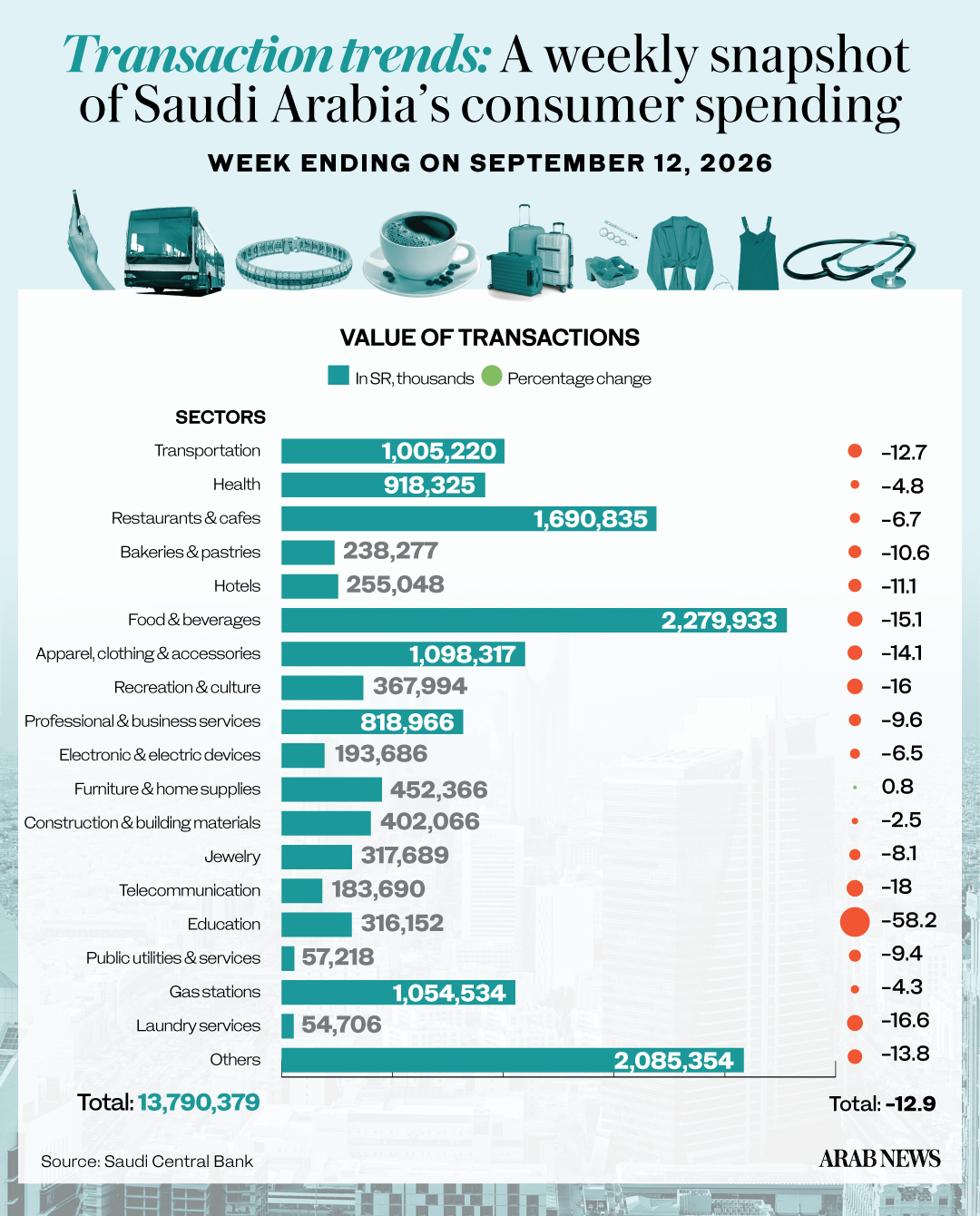
RIYADH: Saudi Arabia’s consumer spending remained above $3.5 billion in the week ended Sept. 12, despite a 12.9 percent decline from the previous week as education-related spending eased after the back-to-school surge, official data showed.
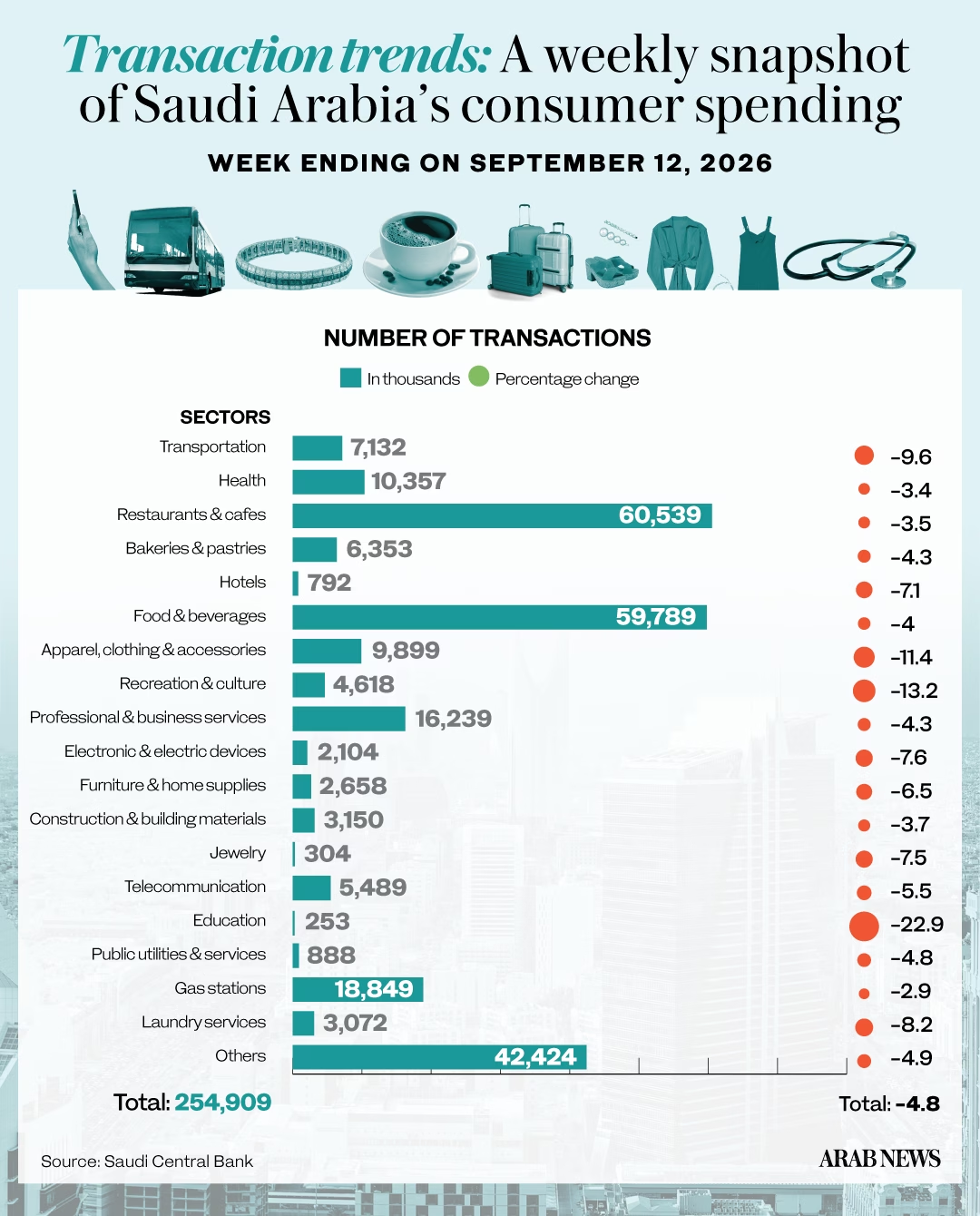
The Kingdom’s point-of-sale transactions totaled SR13.79 billion ($3.68 billion) during the week, while the number of transactions fell 4.8 percent to 254.91 million, according to data from the Saudi Central Bank, or SAMA.
The weekly decline was led by education spending, which plunged 58.2 percent to SR316.15 million. The number of education-related transactions fell 22.9 percent, the steepest decline among the activities tracked in the report.
Sectoral spending
Spending on food and beverages amounted to SR2.28 billion, down 15.1 percent from the previous week. Restaurant and cafe spending fell 6.7 percent to SR1.69 billion, while apparel, clothing and accessories declined 14.1 percent to SR1.10 billion.
Transportation spending fell 12.7 percent to SR1.01 billion, while spending at gas stations declined 4.3 percent to SR1.05 billion.
Healthcare spending decreased 4.8 percent to SR918.33 million, while professional and business services fell 9.6 percent to SR818.97 million.
Books and stationery spending fell 23.9 percent to SR138.93 million, as education-related spending continued to retreat following the back-to-school period.
Furniture and home supplies was among the few categories to record an increase, with spending edging up 0.8 percent to SR452.37 million.
Speaking to Arab News, economist Talat Hafiz said the week-on-week decline of the headline figures should be viewed more as “normalization” rather than necessarily the start of a longer slowdown.
“The previous weeks were supported by strong back-to-school spending, particularly on education, books and stationery, while the return of consumers from their annual vacations may also have affected spending patterns during this transition period,” he said.
Hafiz added that he believes spending across several sectors closely linked to daily life will remain relatively resilient, although it may fluctuate from week to week depending on consumers’ needs and timing.
“Therefore, I would expect some normal volatility in the coming weeks, but overall spending patterns should stabilize as the impact of the back-to-school season and the annual vacation period fades,” he added.
Geographic breakdown
Riyadh again dominated POS transactions, with spending in the capital reaching SR4.87 billion, down 12 percent compared with the previous week, as the number of transactions slipped 3.8 percent to 84.81 million.
Jeddah witnessed transactions amounting to SR1.89 billion, a decline of 11.9 percent, while the total number of transactions stood at 28.54 million.
In Dammam, consumer spending totaled SR689.96 million, down 9.5 percent, followed by Makkah at SR535.60 million, down 12.8 percent, and Madinah at SR519.35 million, down 12.3 percent.
Alkhobar recorded SR384.69 million in transactions, down 9.9 percent, while spending in Buraidah and Abha amounted to SR349.39 million and SR167.19 million, respectively, with Abha posting the sharpest citywide decline at 16.1 percent.
