
ALKHOBAR: Saudi Arabia’s rapid adoption of artificial intelligence has shifted the debate from whether businesses will use the technology to whether they can deploy it at scale — and prove that it creates measurable value.
Across the Kingdom, organizations are integrating AI into operations, customer experience, risk management and decision-making. But as experimentation gives way to implementation, industry experts say the next phase will depend less on deploying more tools and more on redesigning businesses around them.
“The bigger question now is value realization,” Ahmad Abu Hantash, consulting partner and digital and cyber lead at PwC Middle East, told Arab News.
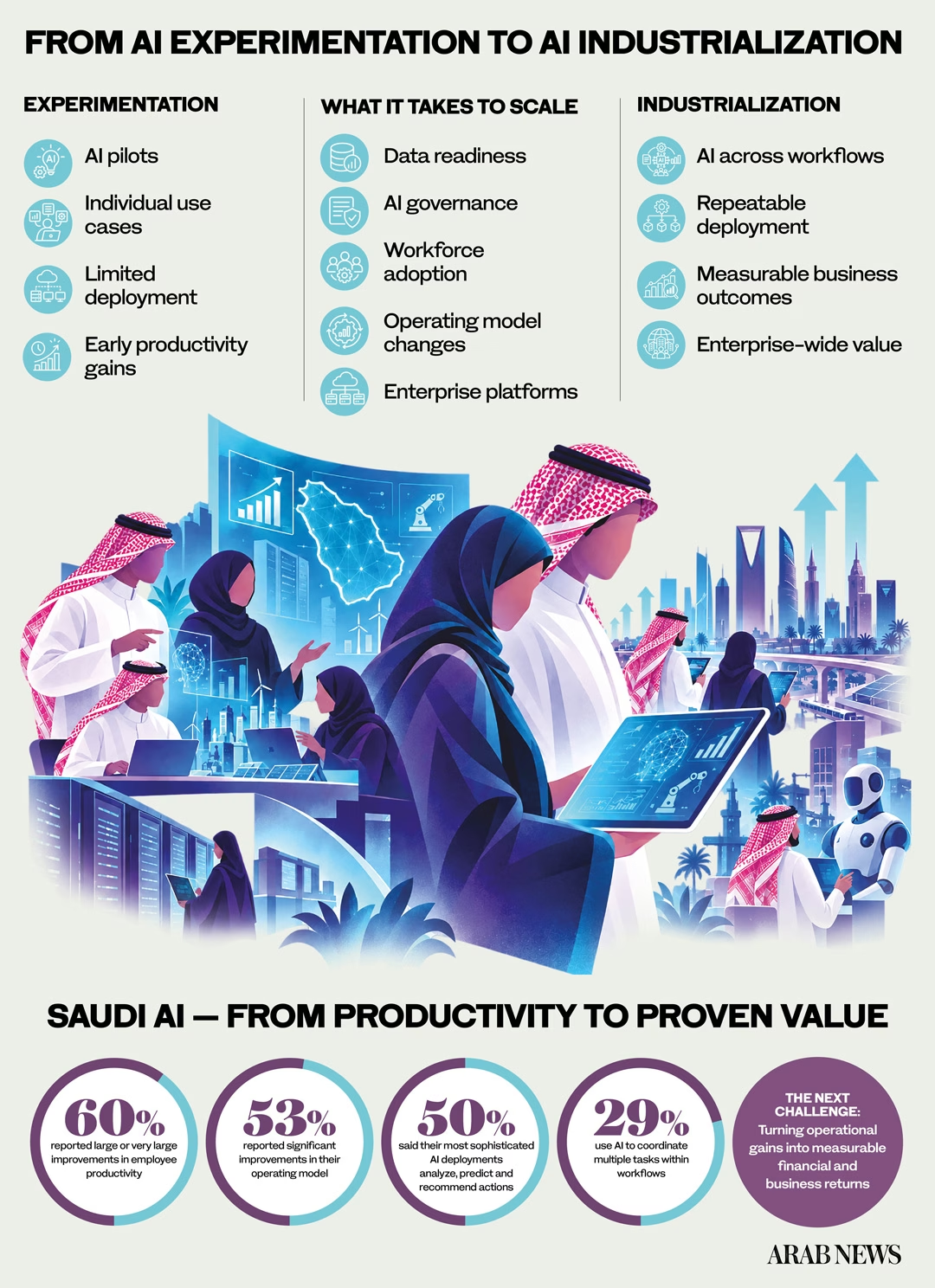
PwC’s AI Performance Study — KSA edition found that 60 percent of respondents reported large or very large improvements in employee productivity, while 53 percent reported significant improvements in their operating model.
But operational gains do not necessarily translate immediately into financial returns.
“The challenge is making sure those gains consistently translate into measurable business outcomes. In many cases, organizations in the study are beginning to create value before they have fully developed the mechanisms to measure, attribute and monetize it,” Abu Hantash said.
That gap between experimentation and measurable impact is emerging as a defining challenge as Saudi Arabia continues to invest in AI infrastructure, talent and capabilities under Vision 2030.
Aditi Nitin, partner and AI and data leader at Deloitte Middle East, said the challenge is increasingly about moving AI beyond isolated projects and embedding it across organizations.
“The biggest barrier is the inability to connect AI initiatives to enterprise-wide value creation,” she told Arab News.
“Many organizations have successfully launched pilots, but pilots often remain isolated because they lack the foundational capabilities needed to scale: data readiness, governance, operating model changes, workforce adoption, and enterprise platforms.”
Deloitte describes this transition as moving from “AI experimentation” to “AI industrialization” — taking systems that have demonstrated potential in controlled projects and making them reliable enough to operate across an enterprise.
“The challenge is not proving that AI works. The challenge is proving that AI can consistently deliver value at scale across the enterprise,” Nitin said.
For Saudi organizations, that distinction could become increasingly important as AI moves beyond relatively straightforward automation.
Abu Hantash said nearly half of respondents in PwC’s study reported that their most sophisticated AI deployments now analyze, predict and recommend actions, while 29 percent use AI to coordinate multiple tasks within workflows.
Fully autonomous deployments, however, remain relatively limited.
“To me, that suggests organizations are building confidence step by step. They’re using AI to inform decisions before entrusting it with greater levels of autonomy,” he said.
The next test may come from agentic AI, designed to carry out multi-step processes and take actions toward defined objectives with less continuous human direction.
“Agentic AI marks a significant shift from AI as a tool to AI as a participant in work,” Nitin said. “Traditional AI helps people complete tasks. Agentic AI can independently execute multi-step workflows, coordinate actions across systems, and collaborate with humans to achieve defined outcomes.”
Organizations could deploy specialized AI agents across procurement, customer service, compliance, human resources, project management and knowledge retrieval, she said. Government entities could similarly use them to transform how digital services are delivered.
But greater autonomy also raises the stakes when AI systems make mistakes.
As organizations give AI greater responsibility, accountability, cybersecurity, data protection and human oversight become increasingly critical to scaling the technology.
“One of the most important findings from Deloitte’s research is that AI adoption is accelerating faster than governance maturity in many organizations. This gap creates operational and reputational risk,” Nitin said.
“The solution is to embed governance directly into the AI lifecycle rather than treating it as a separate approval process.”
The shift is also changing the skills businesses need.
The AI talent debate has long centered on shortages of data scientists, engineers and other technical specialists. But both experts said scaling the technology will increasingly require capabilities beyond dedicated technology teams.
“AI maturity is not about hiring more data scientists. Organizations need enterprise-wide AI fluency, leaders who understand AI strategically, teams capable of redesigning processes, and robust governance. The future winners will be those who build an AI-native workforce, not just an AI team,” Nitin said.
Abu Hantash similarly identified leadership as a growing challenge.
“The bigger challenge is building leaders who know how to operate in an AI-enabled organization,” he said.
“Organizations need executives who can identify where AI can create value, managers who can redesign workflows around AI and teams that can measure impact and drive adoption across the business.”
The potential applications span much of the Saudi economy.
Nitin pointed to energy and industrial operations, government services, financial services and healthcare as areas positioned for further AI deployment. Tourism, real estate and giga-projects also offer opportunities to build AI into new infrastructure rather than add it later.
The larger divide, however, may ultimately be between organizations capable of changing how they operate and those that simply add AI to existing processes.
Abu Hantash said companies seeing the greatest returns are redesigning workflows and decision-making rather than treating AI as another technology layer.
That makes the next stage of Saudi Arabia’s AI development less a race to deploy the most systems than a test of whether organizations can turn them into lasting improvements in productivity, services and business models.
“By 2030, leadership won’t be defined by who adopted AI first. It will be defined by who used AI to reinvent how they create value,” Abu Hantash said.
Nitin offered a similar measure for the Kingdom’s progress.
“By 2030, success will not be measured by the number of AI models deployed. It will be measured by economic impact, productivity gains, improved citizen experiences, new industries, and Saudi Arabia’s ability to lead in trusted and sovereign AI.”
After years in which adoption itself served as a measure of progress, the benchmark is becoming more demanding: not how much AI Saudi organizations have, but what they can demonstrably do with it.
