
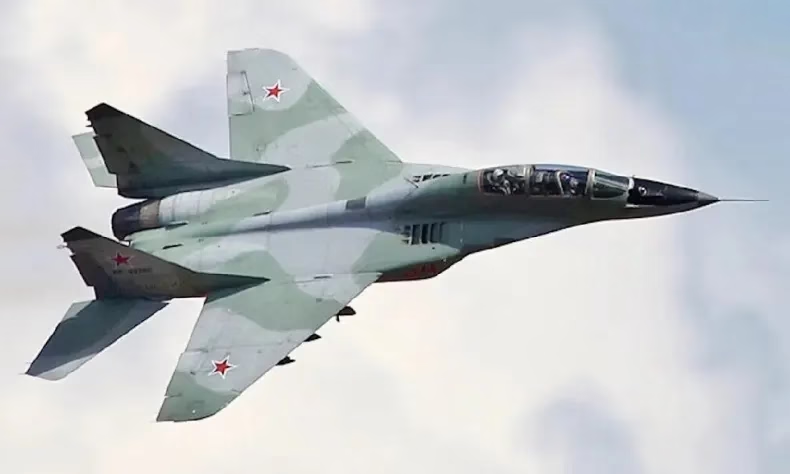
Iran’s efforts to acquire advanced Russian fighter aircraft have repeatedly run into opposition from the United States, which has intervened on several occasions to prevent Tehran from obtaining combat jets considered strategically sensitive. From MiG-29 fighters inherited by former Soviet republics to the long-range MiG-31 interceptor, Washington has used diplomatic pressure, financial incentives and direct purchases to frustrate Iran’s attempts to strengthen its air force.
Now, Tehran appears to have moved closer to securing another major Russian aircraft acquisition. An Iranian Army spokesperson has said that Iran has completed the purchase of Russian Su-35 fighter jets and could receive them after the ongoing conflict with the United States ends.
The announcement has renewed attention on a decades-long effort by Iran to modernize its ageing combat aircraft fleet through purchases from Moscow. It has also raised questions about whether Washington and Israel will attempt to obstruct the latest agreement, as they did with previous Russian fighter aircraft deals.
The Su-35 is among Russia’s most capable operational fighter aircraft, featuring advanced radar, long-range weapons, powerful engines and high manoeuvrability. Its potential introduction into Iranian service could significantly improve Tehran’s air-combat capabilities, although the number of aircraft involved, delivery schedule and operational arrangements remain important unanswered questions.
Iran’s earlier experiences suggest that securing a contract with Moscow does not necessarily guarantee delivery.
Iran’s pursuit of advanced Russian fighter jets dates back to the final years of the Soviet Union.
In 1989, Tehran purchased approximately 18 MiG-29 fighter aircraft from Moscow. Deliveries began in 1990, providing the Iranian Air Force with a relatively modern combat aircraft after years of struggling to maintain its ageing fleet of American-made fighters acquired before the 1979 Islamic Revolution.
The MiG-29, known by its NATO reporting name Fulcrum, was among the Soviet Union’s most advanced fourth-generation fighter aircraft. Designed primarily for air superiority, it combined high manoeuvrability, powerful engines and sophisticated weapons systems for its time.
Iran’s fleet subsequently expanded during the 1991 Gulf War, when several Iraqi MiG-29s were flown into Iranian territory by Iraqi pilots attempting to escape the US-led military campaign. Tehran retained the aircraft rather than returning them after the conflict.
Following the collapse of the Soviet Union in December 1991, Iran saw another opportunity to expand its fighter fleet. Several newly independent former Soviet republics inherited substantial military inventories, including advanced combat aircraft that their governments struggled to maintain financially.
Moldova, one of those countries, possessed a fleet of MiG-29 fighters that became the focus of an international competition.
Iran reportedly expressed interest in purchasing the aircraft, including the MiG-29C variant, which Washington considered particularly sensitive because of its reported nuclear-weapons delivery capability.
The United States, however, moved to prevent the aircraft from reaching Tehran.
American intelligence agencies had been monitoring the MiG-29 since the aircraft first appeared in satellite imagery during the late 1970s.
US analysts considered it a sophisticated fighter capable of challenging leading Western aircraft, including the American F-15 Eagle and F-16 Fighting Falcon.
One of the MiG-29’s most distinctive advantages was its combination of exceptional manoeuvrability and advanced short-range air-to-air weapons.
Its R-73 missile, known by NATO as the AA-11 Archer, could be paired with a helmet-mounted sight. This allowed pilots to direct missile engagements towards targets outside the aircraft’s forward-facing radar line, giving the MiG-29 an important advantage in close-range aerial combat.
When the Soviet Union disintegrated, Moldova inherited 21 MiG-29 fighters, including 14 MiG-29C aircraft. Washington became concerned that Iran or another country could acquire the jets and potentially use their capabilities to challenge American interests and regional allies.
The possibility of Iran obtaining aircraft with a nuclear-weapons delivery capability was particularly concerning to US policymakers.
Washington feared that such an acquisition could further complicate the Middle Eastern security environment, particularly for Israel and American partners in the Gulf, including Saudi Arabia, the United Arab Emirates and Qatar.
The Clinton administration therefore decided to purchase the aircraft itself.
In October 1997, the United States reached an agreement with Moldova to acquire the entire fleet, consisting of six MiG-29A fighters, one MiG-29B and 14 MiG-29C aircraft.
The agreement also included approximately 500 air-to-air missiles, spare parts and diagnostic equipment stored at the Moldovan air base.
The purchase was reportedly worth approximately $40 million, alongside additional assistance, and was financed through the US Cooperative Threat Reduction programme.
Then-US Defense Secretary William Cohen publicly defended the decision, saying Washington had credible information that Iran and other countries were attempting to acquire advanced military equipment left behind following the Soviet collapse.
“These MiG aircraft were on their shopping list,” Cohen said.
He also argued that Iran was pursuing chemical, biological and nuclear capabilities and that preventing Tehran from obtaining the aircraft was in American security interests.
The aircraft were subsequently transported to the United States aboard C-17 military transport aircraft and taken to Wright-Patterson Air Force Base in Ohio, where the National Air and Space Intelligence Center could examine them.
For Iran, the American purchase represented a significant setback. The aircraft could have provided a relatively quick opportunity to expand its existing MiG-29 fleet without waiting for new production or deliveries from Russia.
The American acquisition was not simply an attempt to deny Iran additional fighters. It also provided Washington with an opportunity to study one of the Soviet Union’s most important combat aircraft.
Once the MiG-29s arrived in the United States, American specialists examined their airframes, engines, avionics, weapons systems and other components.
The aircraft provided valuable intelligence about Soviet fighter technology, including the performance and limitations of the MiG-29C variant.
US pilots and military specialists reportedly studied and flew the aircraft, while their capabilities could also be assessed through dissimilar air combat training, commonly known as DACT.
Such exercises allow pilots to understand how unfamiliar aircraft perform against their own fighters, helping them develop tactics for potential encounters.
Israel was similarly interested in obtaining first-hand information about the MiG-29.
According to reports, the Israeli Air Force rented three MiG-29 fighters from an undisclosed Eastern European country to evaluate their performance.
The aircraft reportedly made a strong impression on Israeli pilots.
An Israeli Air Force lieutenant general identified in contemporary reports as M. described the MiG-29 as an advanced aircraft, particularly in close-range manoeuvring engagements.
He praised its sharp turns, acceleration and agility, saying that, as an aircraft platform, it did not fall short of Israel’s advanced fighters.
The episode demonstrated how seriously Western militaries viewed the MiG-29 during the period immediately following the Cold War.
Although the United States successfully prevented Iran from acquiring Moldova’s MiG-29 fleet, the transaction later became a major political and legal controversy inside Moldova.
Valeriu Pasat, who served as Moldova’s defence minister from 1997 to 1999, was arrested in March 2005 and accused of abusing his authority in connection with the sale.
Prosecutors alleged that the aircraft had been sold to Washington for approximately $40 million despite Iran reportedly being willing to offer substantially more.
They argued that Moldova had suffered financial losses estimated at around $55 million because of the transaction.
In January 2006, a court in Chisinau convicted Pasat and sentenced him to 10 years in prison. His lawyer, Gheorghe Amihalachioae, criticised the verdict as unfair and announced plans to appeal.
The case also revealed the extent of American diplomatic involvement.
Former Moldovan president Petru Lucinschi testified during the proceedings that Washington had pressured Moldova to sell the aircraft to the United States to prevent them from falling into Iranian hands.
Pasat spent more than two years in prison before an appeals court acquitted him of the MiG-29-related charges in 2007 and ordered his release under an amnesty.
A further ruling in July 2009 cleared him of the remaining charges.
The Moldova episode was not the only occasion when the United States intervened to prevent Iran from acquiring advanced Soviet or Russian fighter aircraft.
Tehran had also attempted to purchase the MiG-31, a much larger and more powerful aircraft than the MiG-29.
The MiG-31, known by NATO as the Foxhound, was developed as a long-range interceptor designed to detect, track and destroy hostile aircraft and cruise missiles at high altitudes and considerable distances.
Its powerful radar, high-speed performance and ability to carry long-range air-to-air missiles made it particularly valuable for defending vast airspace.
Iran reportedly ordered 24 MiG-31 interceptors in 1990, while the Soviet Union was still intact. However, the collapse of the Soviet Union prevented the planned delivery from proceeding.
Tehran tried again in 1992, placing another order with Russia for 24 MiG-31s alongside additional MiG-29s, Su-24 fighter-bombers and other military aircraft.
At the time, Russia was experiencing severe economic difficulties following the Soviet collapse and desperately needed foreign currency. The potential aircraft sale therefore offered Moscow an important source of revenue.
However, Washington strongly opposed the arrangement.
According to contemporary reports, the United States pressured Moscow to cancel the agreement and even offered to purchase the MiG-31 aircraft at a higher price than Iran was prepared to pay.
The proposed transaction eventually collapsed.
Iran reportedly made another attempt in 2001, this time paying in advance for 24 MiG-31 interceptors in an effort to make the transaction more difficult for Washington to obstruct.
That attempt also failed following renewed American pressure on Russia.
Instead of receiving the fighter aircraft, Iran reportedly received air-defence systems from Moscow.
These repeated failures exposed the limitations of Iran’s efforts to modernize its air force through Russian purchases. Even when Tehran reached agreements or reportedly made advance payments, American diplomatic and economic influence could complicate or derail the arrangements.
The latest reported Su-35 agreement presents a different strategic situation.
Unlike the MiG-29 and MiG-31 transactions of the 1990s and early 2000s, Russia is now engaged in a prolonged war in Ukraine and has increasingly relied on military exports and strategic partnerships to maintain its international position.
Iran, meanwhile, has sought advanced combat aircraft to compensate for decades of restrictions on acquiring Western military equipment.
The Su-35 could offer Tehran a substantial improvement over much of its existing fighter inventory. Its advanced radar, powerful engines, electronic warfare systems and ability to carry a range of air-to-air and air-to-ground weapons make it one of Russia’s most capable operational combat aircraft.
However, delivery would not automatically translate into an immediate transformation of Iran’s air force. Training, maintenance infrastructure, weapons integration, spare-parts availability and operational support would all be essential.
There is also the question of how Washington and Israel would respond.
The United States previously demonstrated that it was willing to intervene directly in international arms transactions to prevent Iran from obtaining aircraft it considered strategically dangerous.
Israel, which closely monitors developments in Iran’s military capabilities, would also have strong reasons to oppose a significant improvement in Tehran’s fighter fleet.
Whether either country attempts to obstruct the Su-35 arrangement remains uncertain. Russia’s current strategic circumstances, its relationship with Iran and the changing regional balance could make the latest transaction more complicated than previous fighter deals.
For Tehran, the Su-35 represents more than another aircraft purchase. It is part of a decades-long effort to overcome military isolation and rebuild an air force whose most capable Western-designed aircraft were acquired before the 1979 revolution.
For Washington, the potential delivery represents a familiar strategic challenge: preventing Iran from obtaining advanced combat capabilities that could alter the regional military balance.
