
US correspondence reviewed by Asharq Al-Awsat revealed that Washington had delivered a warning to the Houthis through what were described as “security channels.”
The precise substance of the warning was not apparent from the correspondence, but it was followed by a clear US assertion that Washington was not negotiating with the group.
The Houthis’ attempt to send a reassuring message that they would not target US vessels appears to reflect an effort to consolidate their position following weeks of military operations that culminated in advances along Yemen’s western coast overlooking the Bab al-Mandab Strait.
The advance poses a renewed threat to international shipping through the strategic waterway, which carries around 12 percent of global trade.
The US clarification in the diplomatic correspondence came a day after remarks by US President Donald Trump and Vice President JD Vance indicating that there had been communication with the Houthis, although neither explained the nature of those contacts.
Meanwhile, during a UN Security Council session on Bab al-Mandab on Tuesday, Washington said:
“The United States supports Yemen’s legitimate government in confronting the Iran-backed Houthi militia. We call on the Houthis to halt their advance, withdraw from the territory they have seized and stop launching attacks.”
On the ground, the Yemeni government is working to raise military readiness in an effort to regain the initiative after recent setbacks on the Taiz and western coast fronts.
Government forces, meanwhile, have made slow but seemingly more consolidated gains on other fronts, including Al-Jawf and Al-Bayda. They have also continued to repel Houthi attacks and respond to militia buildups near Marib.
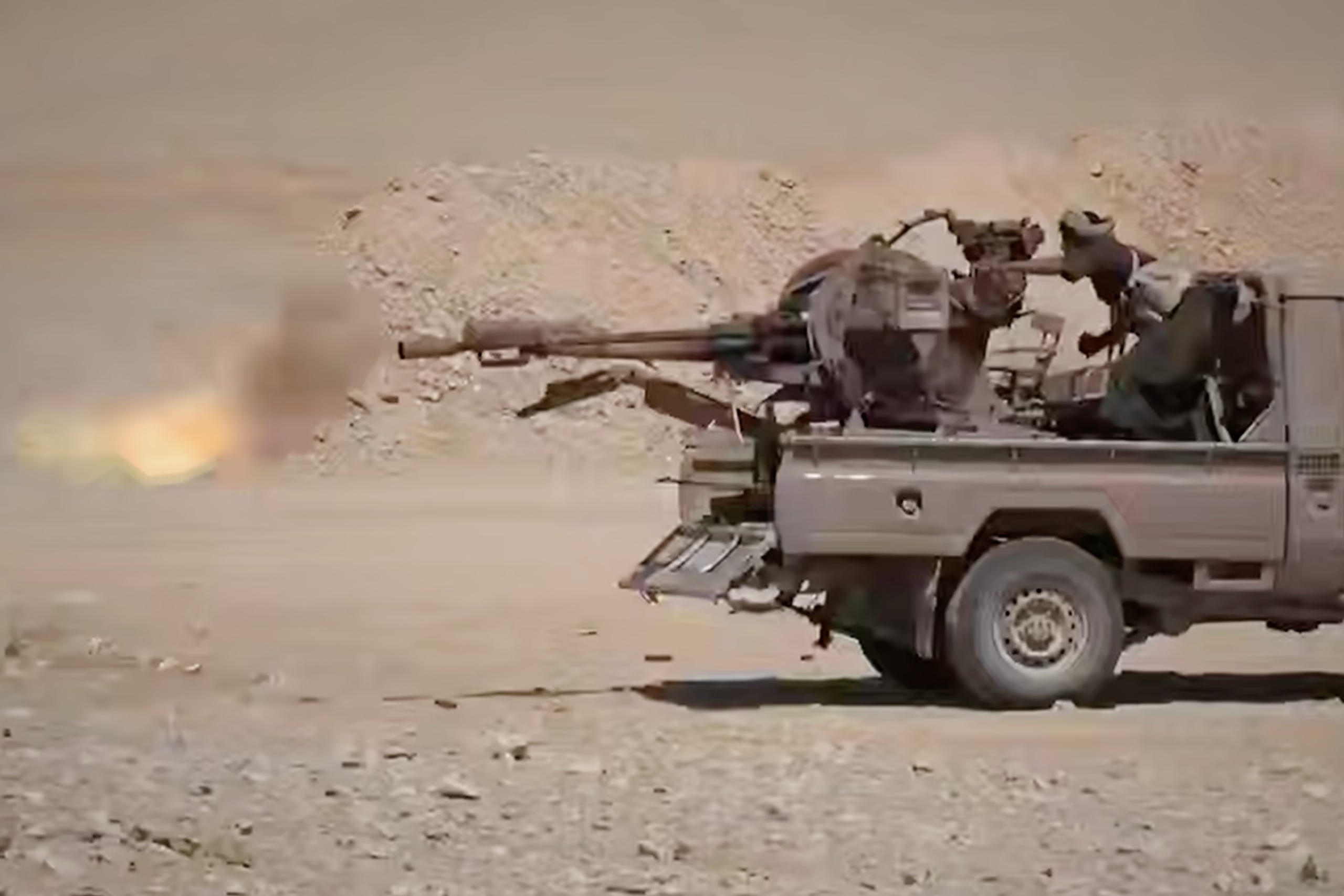
Government forces are engaged in fierce battles with the Houthi militia, which began escalating its military operations in August 2026.
The Houthis’ opponents accuse the group of violating de-escalation arrangements under instructions intended to ease pressure on Iran and allow Iran’s Revolutionary Guard to use the group as a means of exerting pressure on the United States during the war Washington launched in February 2026, which later intensified after Iran threatened to close the Strait of Hormuz.
Why Security Channels?
Observers speaking to Asharq Al-Awsat said that the use of security channels does not in itself indicate negotiations, a deal, or even U.S. acceptance of the Houthis’ assurances.
Al-Baraa Shaiban, a fellow at Britain’s Royal United Services Institute for Defence and Security Studies (RUSI), said the Houthi group was attempting to compensate for its lack of regional and international recognition by exaggerating the significance of opening communication channels with the US administration.
Asked about the phrase “security channels,” Shaiban said Western governments routinely maintain this type of contact with militias and terrorist groups.
Such communication, he said, remains limited, takes place outside diplomatic or political frameworks and is confined to sensitive or urgent security matters.
Iranian Tactics
Reports of Houthi communication with the United States were not treated in Yemen as merely another passing news item.
Many Yemenis sought to understand the group’s sudden move, particularly given that the Houthis’ slogan explicitly invokes “death to America.” The question, therefore, was how the group could simultaneously be communicating with Washington.
Mahmoud Shuhra, a fellow at Britain’s Royal Institute of International Affairs, Chatham House, told *Asharq Al-Awsat* that the current developments were “part of the Houthi strategy, which is an extension of Iran’s and the Revolutionary Guard’s behaviour and negotiating tactics.”
Shuhra, a former Yemeni diplomat, explained that Houthi behaviour is based on gradual escalation, followed by a rapid military confrontation.
“If they achieve gains during that confrontation, they then begin offering reassurances in order to avoid being drawn into an all-out war,” he said.
He argued that this is effectively what happened in Bab al-Mandab.
“The Houthis have now swallowed a very large bite and are trying to digest it,” he said.
The group is currently seeking to consolidate its gains, he added, and needs to offer reassurances in the meantime in order to avoid an immediate response against it.
This, he said, explains the attempt to reassure the United States and the wider international community.
The Houthis also routinely seek to isolate their opponents, according to Shuhra, a tactic that has been repeatedly used in the past.
He recalled the group’s takeover of Sanaa, when the Houthis initially sought to reassure all political factions.
Once they had consolidated their presence, he said, they began meeting each faction separately and portraying the others as the enemy, eventually sidelining them all.
“The group now wants to use the same approach at the international level, regardless of how successful it may ultimately be,” he said.
