
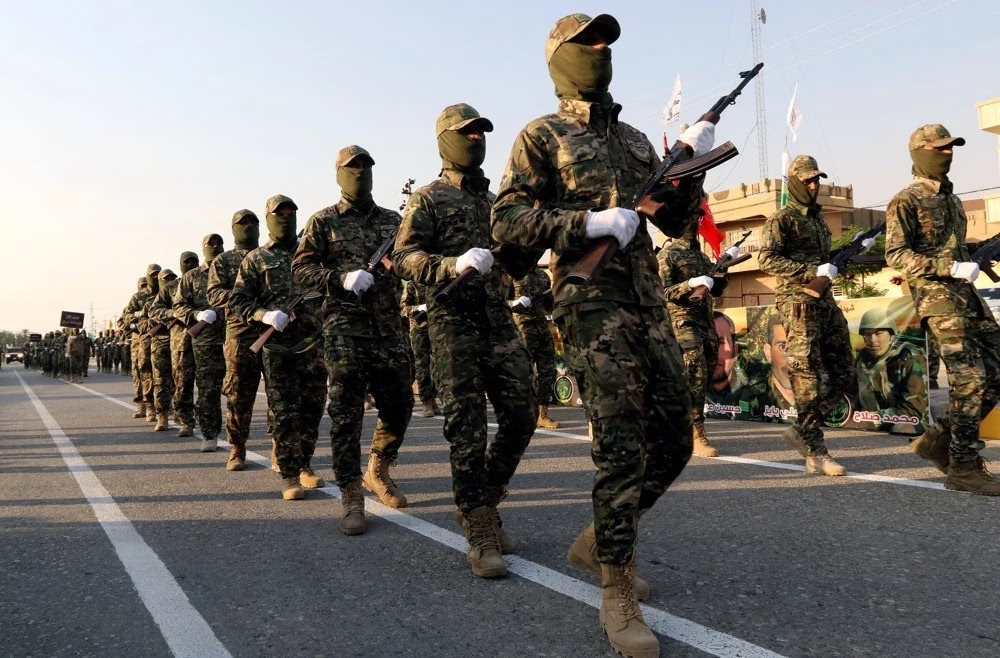
On Sept. 30, the US is due to complete its final withdrawal from Iraq, more than two decades after its ill-fated invasion. With this will come a moment Baghdad has branded “sovereignty day.” It is the date on which the Iraqi state is supposed to hold a monopoly on all weapons within its borders. But if recent history is any indication, that landmark achievement will not happen. Not because the process is complicated but because Iran has decided it will not happen. One of the most ironic outcomes of the US takeover of Iraq is that Iran has more say over Iraq’s armed factions than the government in Baghdad does.
Tehran has made its position clear. Senior Iranian officials, including the Quds Force commander and the parliament speaker, have reportedly told their Iraqi counterparts that disarming the “resistance” factions is a red line. For Tehran, it would revive a dangerous precedent: when its allied militias in Lebanon and Syria were attacked, cornered and, in some cases, dismantled. Hard-line Iranian leaders are not willing to let the same thing happen to what has become an indispensable asset in Iraq.
Iraq’s Popular Mobilization Forces and the factions aligned with them have become an essential part of Iran’s ad hoc strategy as it confronts the US-Israeli attempt to topple or subjugate the regime. The Iraqi proxies offer Iran a military option inside a strategic Arab country where Tehran has created incredible political influence.
Instead of disarmament — a US condition — Iran is pushing a different concept: regulation. In its view, regulation means merging militia weapons into the PMF’s infrastructure, which is loosely tied to the regular army. But in practice this means leaving the weapons, and the militias, essentially untouched and outside state control.
Iran’s goal is to make disarmament seem possible while avoiding any commitment to a set timeline
Osama Al-Sharif
Under Iran’s concept, the militias will store their weapons while retaining access. In the end, Baghdad can claim it launched a disarmament process without anything actually changing on the ground.
Meanwhile, the pro-Iran militias have issued their own demands as a precondition for disarmament. They include a complete American and Turkish military withdrawal from Iraq, an end to any use of Iraqi airspace for cross-border strikes and significant upgrades to the Iraqi military’s air defense capabilities.
Each condition presents a challenge for a country that remains deeply polarized, with a weak central government and a dysfunctional federal system. Most of the conditions are beyond Baghdad’s ability to secure or would take years of no foreign meddling and a strong government to achieve. While most conditions sound reasonable, Iran’s goal is to make disarmament seem possible while avoiding any commitment to a set timeline.
Hard-line groups — such as Kata’ib Hezbollah, Harakat Hezbollah Al-Nujaba and Kata’ib Sayyid Al-Shuhada — reject negotiations over disarmament as a matter of principle and have challenged the Iraqi government to try to enforce it. They remain strongly bound to Tehran through ideology, funding and their command structure. Their open allegiance to Tehran and defiance of the central government poses the most immediate threat to Iraq’s stability.
The more politically integrated Shiite parties, those with parliamentary seats and stakes in the current government, have taken a softer public line by voicing support for “state control of weapons,” while stopping short of committing to any actual handover of arms.
Ironically, Iran has ignored Iraq’s legitimate complaints for years. The current crisis in the Gulf has cost Iraq tens of billions of dollars in lost oil exports. Pro-Iran militias have used Iraqi territory to launch drone attacks against Saudi oil facilities. It is inconceivable that Iran was unaware of such attacks. If anything, these gross attacks underline Iran’s despicable violations of Iraq’s sovereignty.
Disarmament is unlikely while Iran’s confrontation with the US remains unresolved and American economic pressure on Tehran continues to intensify. Reports describe senior Iranian officials privately urging Baghdad to delay or cancel the Sept. 30 process altogether.
Every Iraqi government since 2003 has ultimately accommodated Iranian influence rather than confronted it
Osama Al-Sharif
Iran’s meddling in Iraqi affairs has meant that the militias have become more than a domestic problem for Iraq. They are being used as leverage in a larger regional confrontation, just as with the Houthis in Yemen and Hezbollah in Lebanon. But with the US withdrawal from Iraq taking place, Iran’s excuse of supporting and funding its proxies in Iraq becomes impossible to defend.
This leaves the Iraqi government in an impossible position with no realistic options. Iraqi officials, including the country’s national security adviser, have suggested a plan in which the US leaves as scheduled on the premise that a “comprehensive mechanism” for handling weapons will be negotiated later. That means the Sept. 30 deadline will pass with the disarmament question unresolved.
All this is unfolding against the backdrop of endemic corruption, which has drained Iraqi coffers for more than two decades and underscores the state’s inability to confront nonstate actors. Since 2003, one anticorruption commission after another has come and gone, resulting in the arrest of a handful of mid-level officials while the country’s oil wealth continues to disappear into the pockets of a corrupt political class.
Prime Minister Ali Al-Zaidi, who took office in May, has promised to break that class and take on official corruption. He has ordered dawn raids on Baghdad’s Green Zone, created a new Supreme Sovereign Council for Integrity, Oversight and Recovery of Public Funds, and overseen arrests that have recovered more than a billion dollars and implicated senior officials.
He has described his anticorruption campaign as the “first phase” in a longer fight. Iraqis have heard promises like this before. The success, or failure, of his campaign could determine Iraq’s future more than the Sept. 30 withdrawal deadline. Simply put, a state that cannot safeguard its treasury and protect its resources has little chance of controlling armed factions that answer to a foreign patron.
Linked to the corruption and the militia challenges is a deeper structural problem that no Iraqi government has been able to confront. The ethno-sectarian power-sharing system, installed by the US after 2003, was imposed to prevent any one group from dominating the others. But it has deepened divisions and stoked sectarian violence, while giving Iran a foothold that has become impossible to dislodge.
Today, Tehran’s influence runs through most Shiite parties, senior security portfolios and a handful of militia networks. Disengaging from Iran would require dismantling the same system that keeps the ruling class in power. That alone could trigger civil wars and spread chaos for years. The dysfunctional system has become a sort of Gordian knot for Iraq. It is to be noted that every Iraqi government since 2003 has ultimately accommodated Iranian influence rather than confronted it.
What we can expect, then, is a deadline the US is most likely to honor, for its own strategic reasons, but that misses the goal of disarming the militias. Washington will note Baghdad’s stated commitment to a “comprehensive mechanism” for disarmament but the government will struggle to implement it.
In the end, the factions will keep their illegal weapons and boast about their allegiance to Iran, while rejecting the government’s authority. And when another regional crisis erupts involving Iran, the same armed groups will still be standing exactly where they are now: outside the state’s control, inside Iraq’s borders and answering mainly to Tehran.
