
For millions of Indian families, becoming a doctor, engineer or lawyer remains one of the most coveted routes to professional and economic security. That ambition has helped create a vast private education industry, with coaching centres and tuition institutes preparing students for some of the country’s most competitive university and government recruitment examinations.
Across India, students spend years preparing for entrance tests such as the National Eligibility cum Entrance Test (NEET) for medical colleges and the Joint Entrance Examination (JEE) for engineering institutions. The enormous demand has transformed cities such as Kota and Sikar in Rajasthan into major coaching hubs, while private institutes have expanded into smaller towns and online education.
But the coaching industry is now facing growing scrutiny following a series of examination paper leaks that have undermined confidence in India’s high-stakes testing system.
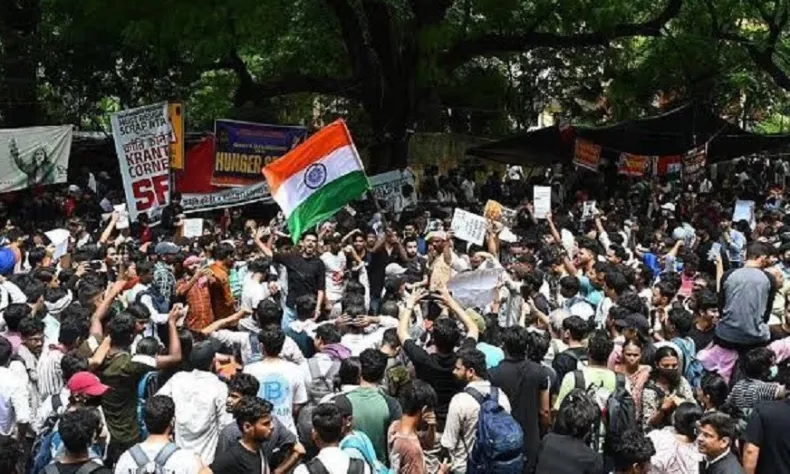
A major scandal involving the NEET examination triggered widespread anger after leaked questions emerged alongside allegations of irregularities in the examination process. More than two million students were caught up in the controversy, while the issue became a rallying point for a Gen Z-led protest movement that eventually contributed to the education minister’s departure.
Much of the public criticism has focused on examination authorities and government agencies. But education activists and analysts say another powerful actor has received considerably less attention: the private coaching industry itself.
Indian education activist Pradeep Poonia said cases investigated by authorities showed that some individuals connected to coaching institutes had allegedly become involved in the trade in leaked examination material.
In May, India’s Central Bureau of Investigation (CBI) arrested the owner of a private coaching institute in Latur after investigators recovered questions that allegedly matched those used in an actual examination.
A faculty member at a private education centre in Pune was also arrested in late May over allegations that he received leaked questions for the physics component of the NEET examination.
In July, Rajasthan police arrested a coaching centre operator in connection with the alleged leakage of a lecturer recruitment examination conducted in 2022.
Poonia said the enormous competition surrounding NEET and other examinations had created a lucrative market for leaked papers.
“It’s all about the money,” he said, arguing that large numbers of students and families are willing to pay for material that they believe could give them an advantage.
According to CBI investigations into the 2026 NEET leak, examination papers were allegedly sold for between 1 million and 1.2 million rupees, equivalent to roughly US$10,500 to US$12,500.
“That’s why it happens,” Poonia said.
For 17-year-old Shaikh Sidra Mudassar, who is preparing for this year’s JEE, the scandals have reinforced her belief that India’s examination system can be deeply unfair.
“Even after preparing for so long, (it feels like) you are being cheated,” she said.
“Not because you’re scoring low or not working hard enough – but because someone else’s parents can afford to buy that score for their child.”
Mudassar knows how demanding the preparation process can be. She said students preparing for the JEE are often expected to study for more than 10 hours a day, with some studying for as many as 16 hours.
“It’s quite hectic,” she said.
She enrolled at a test-preparation centre when she was 16 and in Grade 11, hoping that additional coaching would help her secure a high JEE score and eventually build what she described as a “bright future”.
She said many of her classmates joined coaching centres because of parental pressure, while children are increasingly starting preparation at much younger ages.
“Children now enrol as early as age 11,” she said.
The pressure is particularly intense for students pursuing medicine. Mudassar said her female cousin spent three years preparing for NEET, only to have her efforts disrupted by examination paper leaks in successive years.
Her family background added to the pressure.
“Her parents are doctors, her elder brother is a doctor,” Mudassar said, describing the expectations placed on her cousin to follow the same professional path.
The growth of coaching has been dramatic. Neha Singh, co-founder of data insights firm Tracxn, said that two decades ago, students generally did not need private coaching simply to prepare for university entrance examinations.
Today, however, private coaching has increasingly become a standard part of preparation for competitive examinations.
The financial scale of the sector reflects that transformation. A recent report by market research firm RedSeer Strategy Consultants estimated India’s entrance-exam preparation market at nearly US$15 billion and projected that it could reach at least US$23 billion by 2030.
Tracxn estimates that nearly US$4 billion has flowed into the sector through investments, including private-equity and venture-capital funding.
Coaching operators have rejected suggestions that examination leaks are widespread across the industry. Legitimate providers argue that leaks damage the reputation of an industry whose business depends on students trusting the quality of their teaching.
Rohit Gupta, chief experience officer at Physics Wallah, a major test-preparation company headquartered in Noida, said the organisation’s learning material is developed by faculty and academic teams using publicly available curricula and syllabuses.
“The safeguard is the provenance of the material – where the questions came from, who created them and what sources were used,” Gupta said.
He added that employees are required to report claims involving access to leaked examination papers through the company’s legal and compliance channels.
Shivkanya Deshpande, who runs coaching classes for banking and government recruitment examinations in Pune, also said legitimate institutes have much to lose from examination leaks.
“For legitimate institutes, this (paper leak scandal) is a nightmare,” she said.
“Our entire business model relies on a fair system where our rigorous training dictates the outcome.”
Yet the concentration of hundreds of thousands of students in major coaching centres creates a ready market for anyone seeking to exploit the examination system.
Cities such as Kota and Sikar have developed entire local economies around student accommodation, private tuition, test preparation and related services.
“(Coaching) hubs concentrate millions of desperate students, creating a lucrative market for syndicates,” Deshpande said.
She argued that while legitimate institutes depend on teaching to produce successful students, rogue operators could potentially view leaked examination questions as a shortcut.
Producing high-ranking students is particularly valuable because top results can be turned into powerful marketing tools, attracting new students and generating more revenue.
Kota, in Rajasthan, remains India’s best-known coaching centre. Hundreds of thousands of students travel there to prepare for highly competitive medical and engineering examinations.
Sikar has followed a similar model, but lower property, accommodation and living costs have helped the city expand rapidly, according to Poonia.
Despite criticism of the coaching sector, analysts caution against portraying all private institutes as unnecessary or harmful.
Independent analyst Pranav Bhavsar said organised coaching centres can provide structured courses and specialised preparation techniques that many schools struggle to offer.
“The standardisation is there, the curriculum is there. It’s almost like a mini college,” he said.
The underlying problem is the extreme mismatch between demand for elite university places and the number of seats available.
More than two million candidates sat this year’s NEET examination, competing for around 129,600 places across 823 medical colleges.
The situation is similarly competitive in engineering. Around 1.5 million candidates took the two rounds of JEE entrance examinations in January and April, according to National Testing Agency figures. Just over 67,000 seats were available across 138 of the country’s most sought-after government-funded engineering institutions.
The competition has created a system in which students can spend years preparing for a single examination while sacrificing other aspects of education and childhood.
Mudassar said ordinary schooling exposes children to a broad range of subjects and activities. Intensive entrance-exam preparation, however, can force students to concentrate almost exclusively on the subjects that determine their examination scores.
“We have to focus on the things which are important – but that leads to us being very pressurised – and not being able to do the things we actually like,” she said.
For many families, however, the sacrifice is considered worthwhile.
Education is widely regarded as one of the most reliable ways for middle- and lower-income families to improve their economic circumstances, Bhavsar said.
“We have a lot of middle class or lower income class households, which see education as their only way for coming out of their economic status,” he said.
That belief has allowed coaching centres to sell something more valuable than lessons: the promise of success.
Mudassar said some institutes market themselves aggressively to anxious parents, suggesting that enrolment will substantially improve a child’s chances of achieving a high rank.
“They sell dreams (and) convince parents that if they put their child in our institute, he will definitely get (good) results,” she said.
The industry relies heavily on the visibility of successful students. High-ranking candidates can become promotional material, with institutes using their achievements to attract future batches.
That competition has also generated allegations of questionable marketing practices.
India’s Central Consumer Protection Authority has repeatedly taken action against coaching firms over misleading advertising since 2023. By December 2025, the regulator said it had issued 57 notices to coaching institutes and imposed penalties totalling nearly 11 million rupees.
Deshpande described “topper poaching” as an open secret in some parts of the industry.
She alleged that some institutes offer cash, vehicles or fee refunds to high-ranking students in exchange for using their success stories in advertising, even when their association with the institute may have been limited.
Some centres also create elite “star batches”, selecting high-performing students and providing them with additional resources and access to prominent teachers. Critics argue that this can leave ordinary students with fewer resources despite their fees helping sustain the institutions.
The financial burden on families can be substantial.
Mudassar said coaching in smaller towns such as Ahilyanagar in Maharashtra can cost about 200,000 rupees a year, although scholarships and discounts may reduce fees for high-performing students.
In Kota, annual fees at some institutes can reach 500,000 to 600,000 rupees. For households earning roughly 500,000 to 1.2 million rupees annually, such spending represents a major financial commitment.
The debate therefore extends beyond whether coaching centres should be more tightly regulated. It raises a deeper question: why do students need private coaching to succeed in the first place?
“The first and best thing should be that there should not be any need for coaching in India,” Mudassar said.
She argued that schools should provide adequate preparation for demanding entrance examinations rather than forcing families to purchase additional education.
“The kind of preparation that we want and need for exams should be provided at our schools.”
India’s 2020 National Education Policy recognised the problem, warning that board and entrance examinations and the resulting “coaching culture” were consuming valuable learning time.
The policy called for examinations to place greater emphasis on conceptual understanding, reducing the need for students to rely on coaching to “crack” entrance tests.
Some private schools have already begun integrating school education with entrance-exam preparation, Singh said. Such programmes allow students to complete parts of their school curriculum and coaching within a common timetable.
But replacing coaching centres entirely with schools may not be straightforward.
Deshpande said schools are designed to provide broad education, while coaching institutes specialise in examination patterns, speed, mock tests and tactical strategies.
Poonia has proposed limiting the number of attempts students can make at high-stakes examinations. NEET candidates must be at least 17, but the 2026 examination bulletin does not impose an upper age limit or a cap on attempts.
“If there is no limit on the number of attempts, there is no exit for the student,” he said.
Students who have already spent several years preparing, while their families have invested large amounts of money, may find it difficult to abandon the pursuit and move on.
Other reforms could also reduce pressure: expanding university capacity, improving examination security, strengthening investigations into leaks and enforcing stricter rules against misleading advertisements.
Gupta said increasing the number of university places could reduce competition, although doing so would require more qualified teachers, infrastructure and a wider academic ecosystem.
Such changes, he acknowledged, cannot happen overnight.
Ultimately, however, policy reforms may not be enough if Indian families continue to view medicine, engineering and a handful of other professions as the safest routes to economic stability.
The challenge is therefore larger than the coaching industry itself. It concerns the structure of India’s education system, the scarcity of prestigious university places, the expectations placed on children and the enormous economic stakes attached to examination results.
For students such as Mudassar, meaningful reform would mean creating an education system in which academic ambition does not require sacrificing childhood, creativity and personal interests.
“Holistic development of a child is quite important,” she said.
