
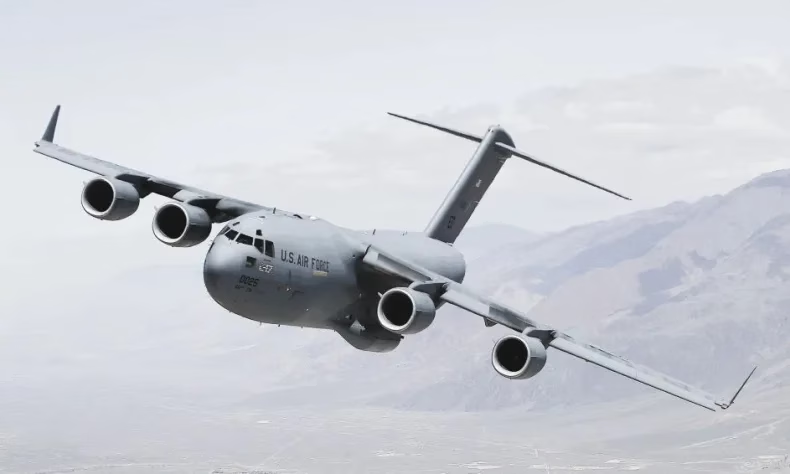
A U.S. Air Force C-17A Globemaster III landed at Moscow’s Vnukovo Airport on August 25, marking a rare American military-airlift operation into Russia at a time when diplomatic engagement between Washington and Moscow remains constrained and efforts to advance a settlement of the Ukraine war have stalled.
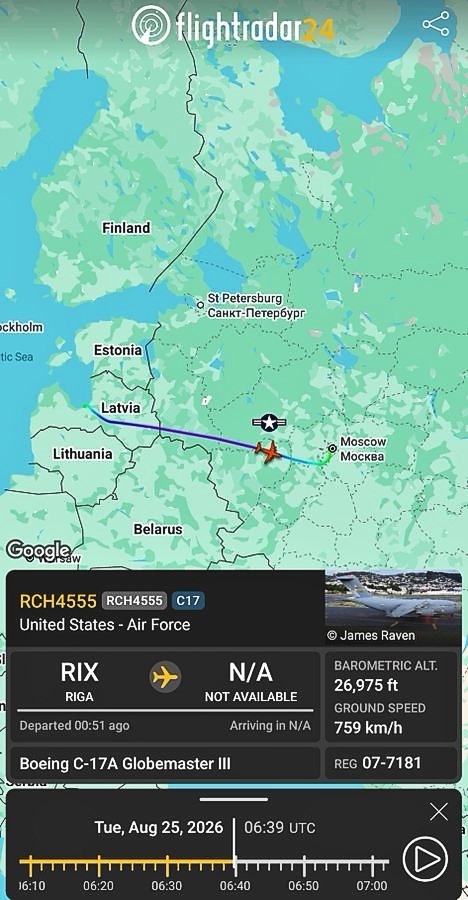
The aircraft, identified as C-17A Globemaster III serial number 07-7181 and operating under the callsign REACH 4555, arrived at Vnukovo at approximately 10:04 a.m. Moscow time after departing Riga, Latvia. Its mission, passengers and cargo have not been publicly disclosed.
The arrival was confirmed through aircraft communications and approach data after early tracking information generated uncertainty about the aircraft’s position and movement. Terrestrial multilateration tracking initially showed gaps, inconsistent headings and questionable speeds as the aircraft traveled eastward toward Russia.
The confirmation of the landing is significant because it transforms what initially appeared to be an ambiguous aircraft-tracking event into a verified U.S. military movement into Moscow.
What remains unknown, however, is why the aircraft was sent to Russia.
Neither the Pentagon, White House, U.S. State Department nor Air Force publicly explained the mission. Russian authorities likewise offered no detailed account of the aircraft’s purpose, passengers or cargo.
Kremlin spokesman Dmitry Peskov said he did not have information about the flight and added that no meetings with representatives of the U.S. administration were scheduled at the Kremlin during the week.
His comments did not rule out activity elsewhere in Moscow or other forms of communication between Russian and U.S. officials.
The aircraft’s arrival has consequently generated speculation that it could have been connected to diplomatic logistics, embassy support, personnel movement, a possible prisoner or detainee exchange, or preparations for sensitive senior-level engagement.
None of those explanations has been confirmed.
Direct U.S. heavy-airlift operations into Russia have become highly unusual since Moscow launched its full-scale invasion of Ukraine in February 2022.
Against that background, the appearance of an American C-17 in Moscow is noteworthy even if its ultimate purpose turns out to be routine government logistics rather than a major diplomatic development.
The C-17 is not a conventional diplomatic aircraft. It is a strategic airlifter designed to transport large quantities of cargo, vehicles, personnel and specialized equipment over long distances.
The aircraft can therefore carry considerably more than a passenger aircraft or executive jet. A mission involving a C-17 can potentially provide communications equipment, vehicles, security personnel, spare parts, logistical supplies and other support infrastructure needed for sensitive government operations.
Aviation trackers have associated REACH 4555 with a reported “SECDEF support” designation. That interpretation, however, has not been independently confirmed by the U.S. Air Force, Pentagon or official flight documentation.
Even if the designation is accurate, it would not demonstrate that Defense Secretary Pete Hegseth was aboard the aircraft.
A support mission can involve the advance movement of equipment and personnel for a senior official without the principal traveling on the same aircraft.
Such an arrangement can be used when secure communications, transportation, security or logistical infrastructure must be established before a senior government representative arrives.
The distinction is particularly important in interpreting the Moscow flight. A C-17 carrying support personnel or equipment could indicate preparations for official activity without proving that a U.S. cabinet official was traveling to Russia.
There is currently no public evidence that Hegseth was aboard REACH 4555.
Indeed, Hegseth was documented conducting a domestic tour in Nebraska and Wisconsin on August 24, making claims that he personally traveled aboard the aircraft toward Moscow difficult to reconcile with publicly available information.
The C-17’s journey also provides clues about the logistical architecture behind the operation.
The aircraft began its movement on August 22 from Joint Base McGuire-Dix-Lakehurst in New Jersey. It subsequently flew to Joint Base Charleston in South Carolina before repositioning to Joint Base Andrews near Washington.
Aircraft 07-7181 departed McGuire-Dix-Lakehurst at approximately 6:36 p.m. Eastern time and reached Charleston at about 8:08 p.m.
On August 23, it departed Charleston and arrived at Joint Base Andrews at approximately 5:36 p.m.
Andrews is closely associated with U.S. government and executive air operations, making the aircraft’s presence there an additional point of interest, although its location alone does not establish the nature of its mission.
The C-17 later departed Andrews at approximately 8:38 p.m. UTC and crossed the Atlantic, eventually landing at Riga Airport in Latvia at about 5:18 a.m. UTC on August 24.
The flight from Andrews to Riga lasted roughly eight hours and 41 minutes.
The aircraft remained at Riga until the following morning.
That overnight stop could have provided time for crew rest, logistical coordination, cargo preparation, diplomatic clearances or other operational requirements. However, there is no evidence establishing which of those activities occurred.
REACH 4555 departed Riga at approximately 5:48 to 5:50 a.m. UTC on August 25.
It then traveled eastward across Latvia and toward Russia before approaching Moscow and landing at Vnukovo.
The Riga-to-Moscow flight lasted roughly one hour and 14 minutes.
The sequence created a clear transatlantic-to-forward-staging-to-Russia logistics chain.
McGuire-Dix-Lakehurst, Charleston and Andrews provided successive points within the U.S. military mobility network, while Riga served as the final staging location before the aircraft entered Russian airspace.
A Boeing C-40 operating as REACH 790 also arrived in Riga from Andrews on August 23 and was observed parked nearby.
That parallel movement has prompted questions about whether the aircraft were connected. However, there is no publicly available evidence establishing a common passenger manifest, cargo load, command relationship or mission objective.
The presence of another U.S. aircraft therefore remains an interesting correlation rather than proof of coordinated activity.
The reported “SECDEF support” association has attracted particular attention because of its apparent connection to the Pentagon.
But aviation callsigns and tracking classifications should not be treated as definitive evidence of an aircraft’s passengers or political mission.
A heavy airlifter assigned to senior-leadership support could carry equipment and personnel needed to establish a secure operating environment.
That could include communications systems, vehicles, security teams, logistics personnel, maintenance equipment or other specialized assets.
Such a mission can be conducted independently of the principal’s travel.
The U.S. military operates several aircraft types associated with senior leadership and government transportation, while C-17s can provide the larger logistical footprint needed to support those operations.
The aircraft’s ability to carry outsized cargo also makes it particularly useful when sensitive government activity requires more equipment than can be transported aboard a conventional executive aircraft.
However, no public document has established that REACH 4555 was specifically tasked to support Hegseth or another senior U.S. official in Moscow.
The distinction between capability, association and confirmation is therefore critical.
The aircraft’s capabilities are established.
The reported support designation is unconfirmed.
The political purpose remains unknown.
Russia’s response has been notably limited.
Peskov said he did not possess information about the aircraft and stated that no meetings with representatives of the U.S. administration were planned at the Kremlin that week.
The statement neither explained why the American aircraft was permitted to arrive nor ruled out other U.S.-Russian contacts.
That distinction matters.
A meeting outside the Kremlin, an embassy-related operation, an exchange involving detainees or a logistical mission would not necessarily constitute a Kremlin meeting.
Russia’s lack of explanation therefore preserves considerable ambiguity.
The United States has been even more restrained.
There has been no public explanation from the Pentagon, White House, State Department or Air Force regarding the aircraft’s tasking, manifest, cargo, diplomatic clearance or onward itinerary.
That silence could reflect the sensitivity of the mission.
But it could equally reflect a desire not to publicize routine military logistics.
The absence of official information should therefore be treated as an indication that authorities have chosen not to disclose details, rather than as evidence that a major diplomatic operation is underway.
One of the explanations circulating around the flight is the possibility of a prisoner or detainee exchange.
Vnukovo has previously been associated with the return of Americans from Russia, including teacher Marc Fogel and former U.S. Marine Robert Gilman, who was released on August 11, 2026.
That precedent makes Vnukovo a plausible location for a future sensitive transfer.
But precedent is not evidence of a new exchange.
There is currently no publicly identified detainee, negotiated agreement, receiving delegation or official announcement connecting REACH 4555 with another prisoner transfer.
A C-17’s ability to transport personnel and equipment also makes it possible for an aircraft to participate in an exchange without the aircraft itself providing evidence of what is being exchanged.
Until officials identify the individuals involved or confirm an agreement, the prisoner-exchange theory remains speculative.
Embassy support is another possibility.
The U.S. diplomatic mission in Moscow operates in an exceptionally difficult environment, with relations between Washington and Moscow severely strained and bilateral personnel and logistical arrangements constrained.
A military transport could theoretically move equipment, supplies or personnel required to sustain American government operations.
The C-17’s capacity makes it suitable for transporting cargo that cannot easily be moved through conventional commercial channels.
Again, however, there is no public evidence confirming that embassy resupply was the purpose of this particular mission.
The same caution applies to theories of back-channel diplomacy, confidence-building or preparations for senior-level negotiations.
The timing is undoubtedly notable.
The flight occurred amid stalled U.S.-Russia contacts concerning Ukraine, delays involving U.S. envoys Steve Witkoff and Jared Kushner, and discussions surrounding a new proposal reportedly prepared by Ukraine with American and European officials for presentation to Moscow.
Those circumstances make the aircraft’s arrival politically interesting.
They do not establish a direct connection.
The most important aspect of the flight may therefore be what it demonstrates about the practical relationship between Washington and Moscow.
Despite severe political hostility, sanctions, military confrontation and disagreement over Ukraine, the two countries retain mechanisms through which highly controlled logistical movements can occur.
An American military aircraft cannot simply appear at a Russian airport without extensive coordination involving airspace access, airport operations, security arrangements and other administrative procedures.
The fact that REACH 4555 completed the journey demonstrates that such channels remain functional when both sides consider them necessary.
This does not mean that U.S.-Russia relations are improving.
Nor does it prove that negotiations have resumed at a high level.
Instead, it illustrates a form of controlled compartmentalization in which governments can maintain intense strategic confrontation while preserving limited channels for specific operational requirements.
For Washington, the operation provides flexibility without requiring a public diplomatic announcement.
For Moscow, allowing the aircraft to land provides controlled access without necessarily signaling a political concession.
The same ambiguity can serve both sides.
The use of Riga is also significant from a military-logistics perspective.
The Latvian capital provided a forward staging point between the United States and Moscow.
Rather than making a long direct movement into Russia, the American aircraft first crossed the Atlantic and positioned itself in NATO territory before undertaking the comparatively short final sector into Moscow.
That arrangement potentially provides greater flexibility for crew management, cargo preparation, timing and coordination.
It also demonstrates how NATO-region infrastructure can remain part of the logistical chain for sensitive government movements even when the final destination is Russia.
The operation therefore connected U.S. strategic-airlift bases, executive-support infrastructure and a NATO staging point before reaching Moscow.
No combat aircraft or offensive military force was required.
Instead, the mission relied on mobility, logistics, communications and administrative coordination.
The episode also highlights the growing difficulty of keeping government movements completely secret.
Even when authorities do not disclose an aircraft’s mission, flight-tracking data, ACARS messages, approach information and open-source aviation analysis can reveal portions of the movement.
The initial tracking uncertainty surrounding REACH 4555 demonstrates both the opportunities and limitations of such monitoring.
Multilateration data can contain gaps or inaccurate calculations, particularly when aircraft move beyond the coverage of ground-based receivers.
That can create misleading impressions about speed, heading or position.
The subsequent confirmation of the aircraft’s arrival provided a stronger basis for analysis.
Yet even accurate tracking cannot reveal everything.
It can establish where an aircraft traveled and when it arrived, but not necessarily who was aboard, what cargo it carried or why the mission was authorized.
That distinction is increasingly important as geopolitical speculation can develop faster than governments release information.
The clearest conclusion is also the most limited.
A U.S. Air Force C-17A Globemaster III, aircraft 07-7181, operating as REACH 4555, traveled from the United States through Riga and landed at Moscow’s Vnukovo Airport on August 25.
The mission’s purpose remains undisclosed.
The reported “SECDEF support” designation has not been independently confirmed by U.S. authorities and does not establish that Defense Secretary Pete Hegseth was aboard.
A prisoner exchange, embassy logistics, personnel rotation, senior-level support or diplomatic activity are all possible explanations, but none is currently supported by sufficient public evidence to be treated as fact.
What is confirmed is the existence of a rare U.S. military-airlift corridor into Moscow at a highly sensitive moment in relations between the world’s two nuclear superpowers.
That alone is strategically significant.
The flight shows that beneath the public confrontation over Ukraine and wider European security, Washington and Moscow retain enough communication and administrative coordination to facilitate a highly controlled military movement when required.
It also demonstrates the strategic importance of air mobility.
A C-17 does not merely transport cargo. It can move the communications systems, personnel, vehicles, security elements and sustainment equipment needed to make sensitive government activity possible.
In that sense, REACH 4555 may ultimately prove to have been a routine logistical mission.
But its rarity, timing, route and destination ensure that it will remain significant regardless of the eventual explanation.
The aircraft’s landing did not announce a breakthrough in U.S.-Russia relations.
It did, however, provide a visible demonstration that the logistical infrastructure for selective engagement has not disappeared.
