
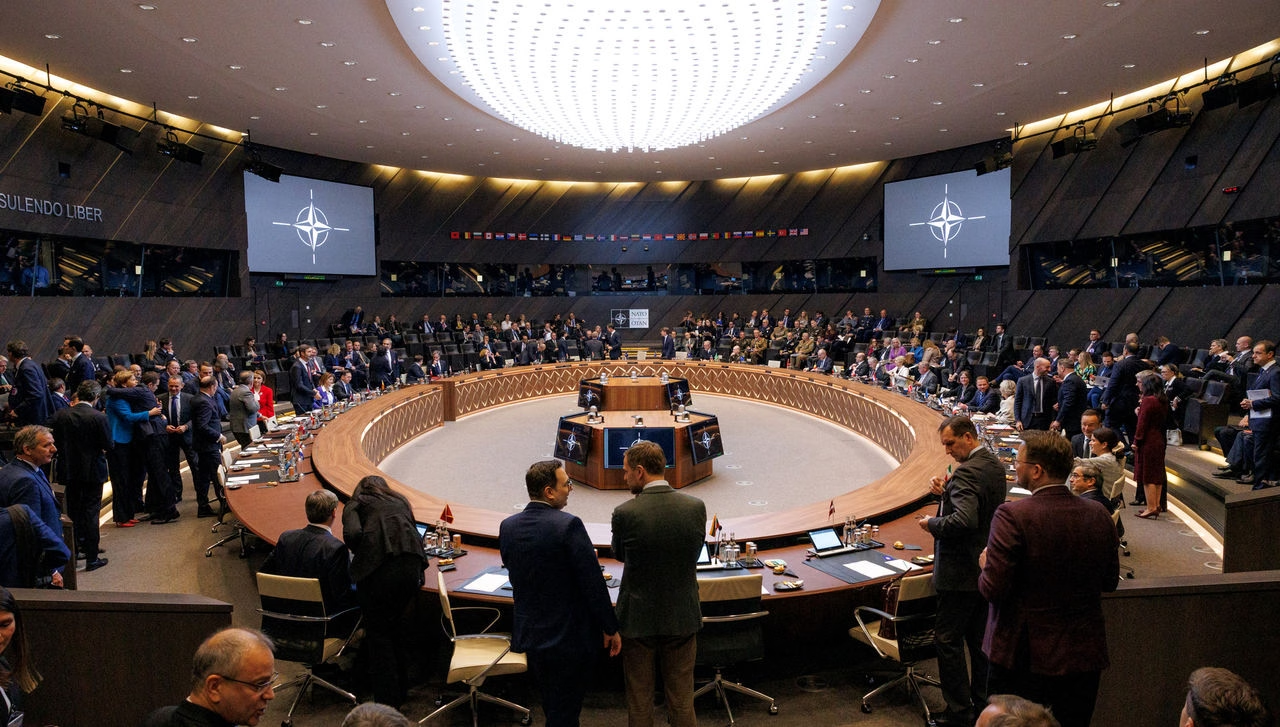
A packed agenda awaits foreign ministers from the 32 NATO countries when they meet in Brussels on Dec. 2. First and foremost, the US is expected to brief its allies on the future of US forces in Europe. There will also be discussions about progress toward meeting the defense spending targets agreed at the 2025 NATO summit in The Hague and the defense industrial cooperation pledged during the most recent alliance summit in Ankara in July. There is another area, however, that, considering current geopolitical circumstances, deserves more attention: NATO’s relations with the Gulf states.
The Istanbul Cooperation Initiative was established at the 2004 NATO summit in Istanbul to serve as the alliance’s main platform for engagement with the Gulf states. Currently, only four of the six GCC countries — Kuwait, Bahrain, Qatar, and the UAE — formally participate in the initiative, although Saudi Arabia and Oman take part in selected ICI activities.
Perhaps the most notable accomplishment of this initiative has been the establishment of the NATO-ICI Regional Center in Kuwait in 2017, which serves as a tangible link between NATO and the Gulf states. There have also been numerous high-level exchanges, simulated war games and training exercises in the two decades since the ICI’s creation.
Real-world cooperation between NATO and several Gulf countries has also taken place in Afghanistan and Libya, as well as on maritime security off the Horn of Africa and in the Gulf. Bahraini and Emirati forces contributed to NATO-led operations in Afghanistan, while Qatar and the UAE took part in NATO’s operation in Libya in 2011.
However, in recent years, the alliance has failed to realize the full potential of this format. This might now be changing.
There is considerable overlap in terms of shared security concerns
Luke Coffey
At the NATO summit in Ankara in July, foreign ministers from the alliance and ICI countries met on the sidelines of the forum for the first time since the initiative’s inception in 2004. They launched four flagship projects for multilateral cooperation between NATO and ICI partners: maritime security; countering unmanned aerial systems; chemical, biological, radiological, and nuclear defense; and counterterrorism. Considering the current security situation involving Iran, these four areas of cooperation should come as no surprise.
Since then, there has been a steady drumbeat of NATO engagement with the Gulf. In October, the regional center in Kuwait hosted a four-day crisis management and disaster response course involving more than 30 civilian and military personnel from Gulf states.
Earlier this month, NATO held its Southern Neighborhood Security Dialogue in Athens, with more than 100 representatives taking part, including those from ICI countries and Iraq. Notably, Saudi Arabia took part for the first time. Discussions focused on identifying shared security priorities and developing practical ways to cooperate.
Last week, GCC Secretary-General Jasem Mohamed Albudaiwi met with NATO’s Special Representative for the Southern Neighborhood, Javier Colomina, in Naples to discuss closer regional cooperation. Looking ahead to next year, Kuwait has proposed hosting a joint ministerial meeting between NATO and ICI countries.
Foreign ministers cannot afford to lose sight of the bigger picture
Luke Coffey
Closer cooperation between NATO and the Gulf states can benefit both the Middle East and the transatlantic community. There is considerable overlap in terms of shared security concerns. Furthermore, decades of Western military involvement in the Middle East have helped build strong relationships between the militaries of the transatlantic community and the Gulf. Looking ahead, both sides should focus on practical areas of cooperation that deliver tangible benefits to their people.
First and foremost is air defense. Europeans and Gulf states know all too well the importance of air defense in modern warfare. Just last week, three Russian cruise missiles landed in Poland during a large-scale Russian attack on Ukraine. Drones from Russia’s war against Ukraine have repeatedly entered NATO airspace. Meanwhile, the Gulf states bore the brunt of Iran’s drone and missile retaliation during the conflict earlier this year.
In both regions, Ukraine has played a positive role in helping countries defend against unmanned systems and improve their air defense capabilities. One area of focus for the ICI could be bringing together NATO, Gulf and Ukrainian experts to explore ways to deepen cooperation in the field of air defense.
Second, as the transatlantic community does more to bolster its defense industrial base, it should work with Gulf countries to explore ways to include them in various projects. Research and development is not inexpensive, and the more customers there are for a particular military capability, the lower the unit cost can become. Greater defense industrial cooperation between Europe and the Gulf could help make both regions more secure while making military equipment more affordable for taxpayers.
Finally, there needs to be more regular engagement between the two sides. While the engagement between NATO and the Gulf states over the past several weeks has been encouraging, it needs to become normalized and formalized. NATO should consider appointing a special envoy for the Gulf who can serve as a single point of contact between the region and the alliance.
When NATO foreign ministers meet next week, they will understandably focus on the issues that matter most to the alliance and the defense of the transatlantic community. However, they cannot afford to lose sight of the bigger picture. Many of the security challenges facing Europe and the Gulf are interconnected, and there is much that both can learn from each other. NATO already has an established framework for cooperation with the Gulf states through the ICI. What is needed now is the political will to realize its full potential, not only for the security of the transatlantic community but also for the wider Middle East.
