
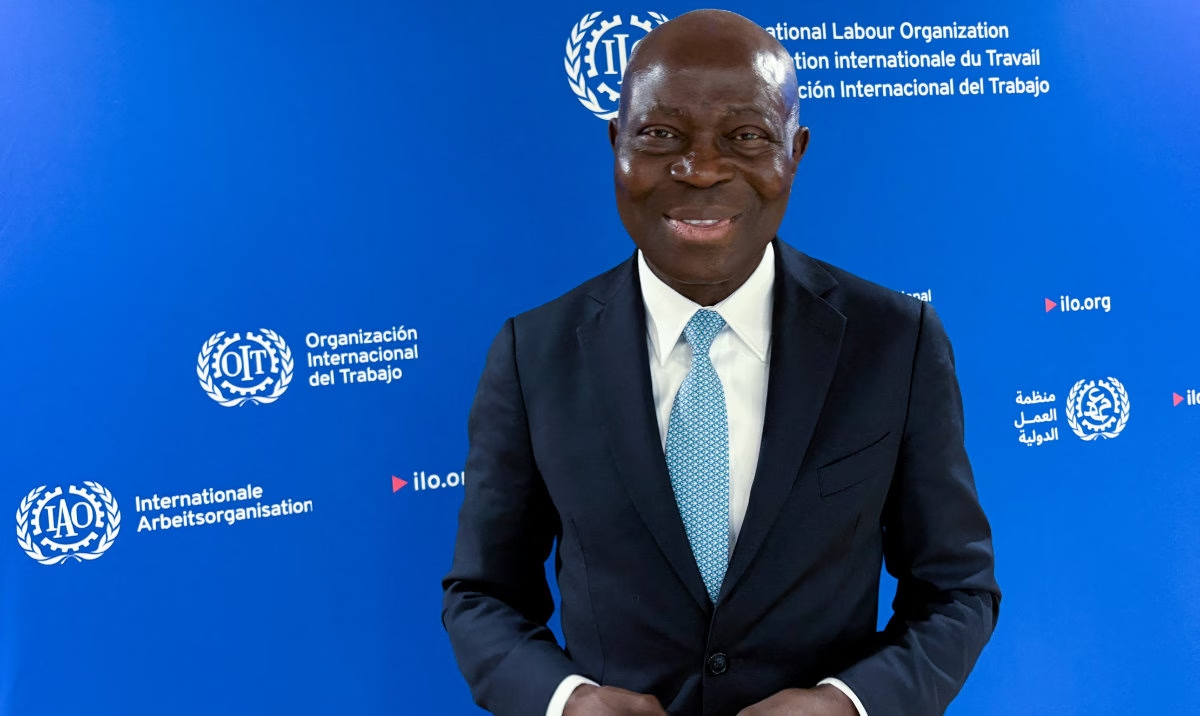
GENEVA, Switzerland: Former Togolese prime minister Gilbert Houngbo was re-elected Monday as head of the United Nations’ labor agency after the only rival candidate pulled out at the last minute.
Houngbo was re-elected for a second, five-year term as director-general of the International Labour Organization, starting on October 1 next year, after Spanish Labour Minister Yolanda Diaz Perez withdrew.
Houngbo received 51 votes out of 56 at the meeting of the ILO’s governing body, at the UN agency’s Geneva headquarters.
There were five abstentions, an ILO spokeswoman told AFP.
“More than a century after its founding, our organization remains charged with a mission that is more relevant than ever: to promote social justice as the foundation for universal and lasting peace,” said Houngbo, 65.
“Faced with the uncertainties of the world, we have a duty to defend human dignity, promote social justice and foster dialogue between nations, workers and employers.”
He said that among the challenges shaping the future, “none perhaps is more decisive than artificial intelligence,” saying AI would open up new possibilities but also raise fundamental questions about jobs and skills.
He said the ILO must be at the forefront in “ensuring that technological progress remains at the service of humanity.”
Turbulent period
Before the vote, Diaz Perez announced that she was pulling out, to avoid divisions within the trade union movement.
In a statement on Bluesky, she lamented that the current ILO leadership had “plunged the organization into the deepest financial crisis in its history.”
She said the general secretary of the International Trade Union Confederation and the spokesperson of the ILO Workers’ Group had chosen to stick with Houngbo, “against the feeling of a large part of the world’s trade union movement, which they have denied the freedom to vote.”
“I will not divide the trade union movement.”
Former Peruvian foreign minister Javier Gonzalez-Olaechea, the only other declared candidate, pulled out of the race on November 4.
The ILO has been going through a turbulent period for several months.
A decline in international funding — particularly from the United States — has forced the organization to undertake reforms including job cuts.
Founded in 1919, the ILO has 187 member states which, uniquely in the UN system, are represented by governments, employers and workers.
The ILO aims to promote rights at work, encourage good employment opportunities, enhance social protection and strengthen dialogue on work-related issues.
