
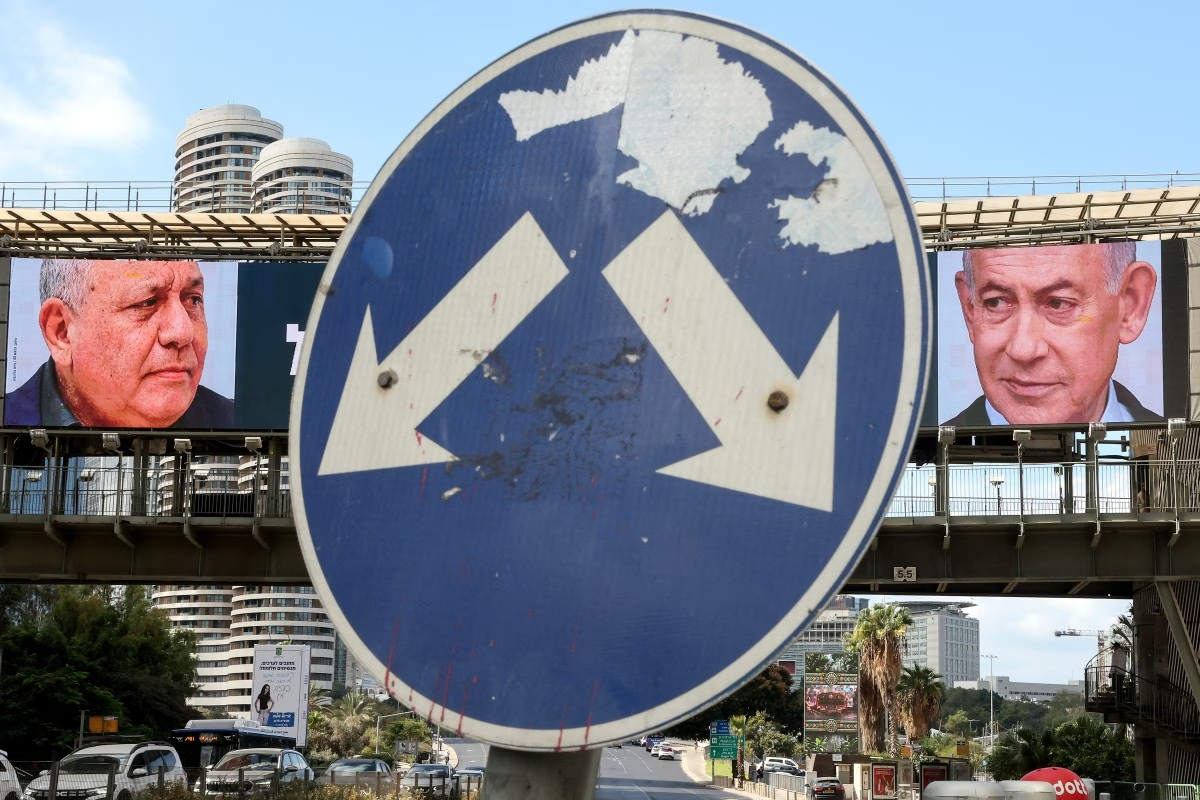
JERUSALEM: Following elections in which Prime Minister Benjamin Netanyahu and his main rival Gadi Eisenkot both fell short of a majority, each is claiming a mandate to govern — though neither has explained how.
Given the indecisive result, the two leaders will need to find a way to broaden their blocs if they hope to secure a governing coalition, but so far very little information has leaked about potential behind-the-scenes negotiations.
If neither succeeds in securing a coalition, the country will have to head back to the polls.
AFP looks at the most plausible scenarios for each side forming a government.
A Netanyahu-led government
The prime minister and his far-right and ultra-Orthodox allies came out ahead in the final vote count, with 53 seats in parliament, including 27 for the premier’s party, Likud.
But that is still short of the 61 needed for a majority.
If he hopes to stay in power, Netanyahu will have to reach out to opposition parties with a pitch to join his government — a major about-face after a campaign run on vows to unseat him.
Israeli President Isaac Herzog, who is tasked with tapping the candidate best positioned to form a coalition, has said a new vote must be avoided at all costs.
Of the four parties in Eisenkot’s camp, the least receptive to an overture from Netanyahu would be the left-wing Democrats, led by Yair Golan, which won eight seats.
Netanyahu’s former ally turned fierce critic Avigdor Lieberman, whose right-wing Yisrael Beiteinu party won seven seats, would also likely dismiss the prospect out of hand.
Lieberman said on Thursday that “the only conceivable coalition” was one without Netanyahu, though he suggested the rest of the premier’s party would be tolerated.
The stance of Naftali Bennett’s center-right Together party, which won 12 seats, is less clear.
Bennett had initially suggested he would not oppose an alliance with Netanyahu’s camp under certain conditions, notably the immediate creation of a commission of inquiry into the October 7, 2023 attacks. But he later backtracked and insisted his remarks had been misconstrued.
Finally, the possibility of an alliance with Eisenkot’s Yashar party, which nabbed 21 seats, seems remote given the ex-general built his campaign around promises to remove Netanyahu, who he said was unfit to lead.
There is a recent precedent for unlikely power-sharing scenarios. In 2020, Netanyahu and centrist Benny Gantz overcame their deep antipathy to strike a deal to rotate the prime ministership, but the partnership collapsed after a year.
Eisenkot has repeatedly ruled out such an arrangement, saying before the vote: “There will be no form of rotation in the post of prime minister. There will be only one prime minister, and it will be me.”
Outside the opposition camp, there remains the highly improbable option of Netanyahu turning to Arab-majority lists, with their 19 seats.
The prime minister spent the campaign casting them as bogeymen, and in the days since the vote has accused them of electoral fraud.
But nothing is out of the question when it comes to Netanyahu, a canny political operator who reached out to Arab parties in 2015 and 2021.
An Eisenkot-led government
By refusing to deliver a majority to Netanyahu’s camp, the Israeli people “have chosen change,” Eisenkot proclaimed on election night.
With his camp holding 48 seats, and having ruled out a power-sharing deal with Netanyahu, Eisenkot has two options going forward: establishing a minority government supported from the outside by other parties, or attempting to broaden his coalition by bringing in Arab lawmakers or defectors from the other camp.
The two Arab-majority groupings, Raam and the Joint List, emerged with eight and 11 seats, respectively.
Raam leader Mansour Abbas joined a short-lived coalition once before, and has voiced willingness to do so again, but that option is opposed by some parties in the opposition bloc.
The Joint List’s Yousef Jabareen, meanwhile, has said he is willing to support Eisenkot in parliament but without joining his government, expressing discomfort with, among other things, the war in Gaza.
Taken together, the Arab lists would give Eisenkot the seats he needs to move forward, but relying on them would mean going back on a campaign promise and gambling on a fragile minority government that observers say would be unlikely to last long.
A former army chief, Eisenkot is not a pacifist, and the possibility of future military operations — including in Gaza, where he has pledged to end Hamas rule in 18 months — could prompt his new allies to pull their support.
Eisenkot could also try to woo away defectors from Netanyahu’s camp.
Defections from the Likud are improbable given how firmly the party is aligned behind the premier, and its far-right allies are considered politically unpalatable to the change bloc.
But the remaining ultra-Orthodox parties currently aligned with Netanyahu, who hold 13 seats, could prove more amenable.
Eisenkot — who lost a son in the Gaza war — has argued forcefully for ending military service exemptions for the ultra-Orthodox community, which those parties oppose, though they could be willing to jump ship in the event of concessions from one side or the other.
