
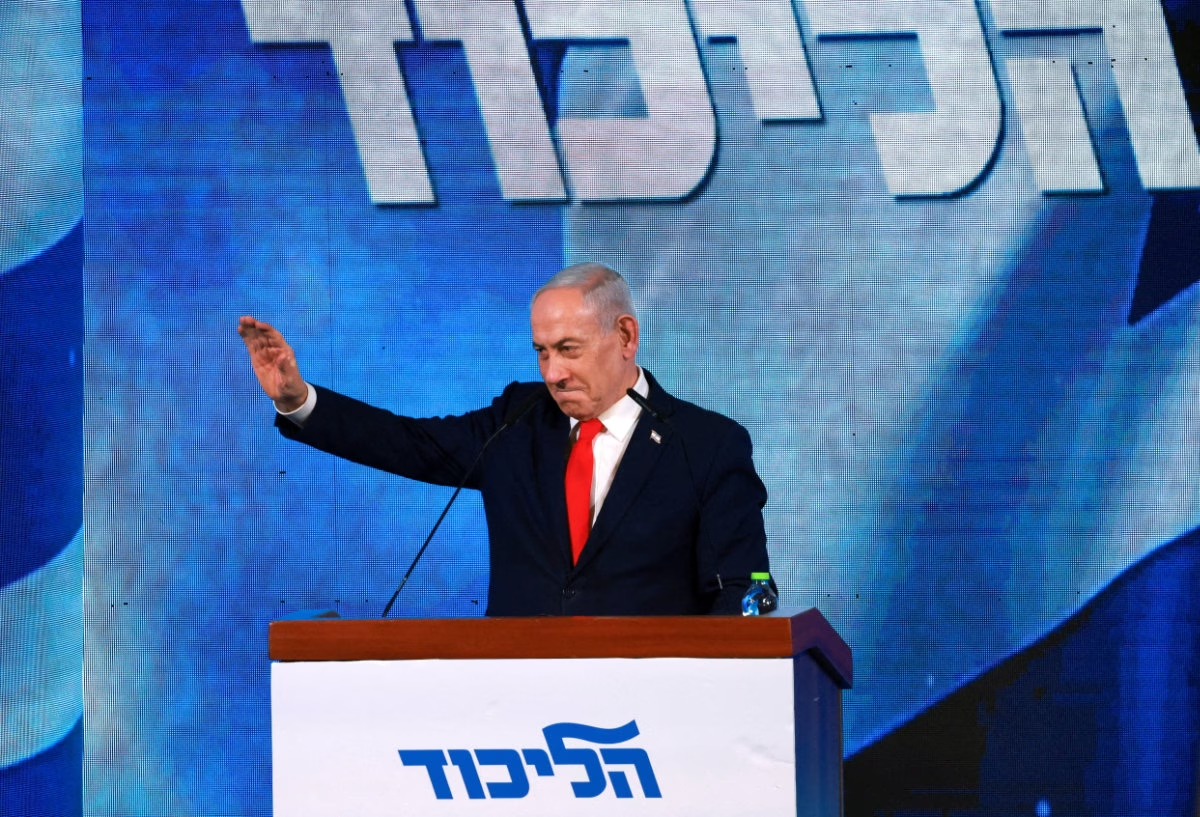
JERUSALEM: Israeli Prime Minister Benjamin Netanyahu’s right-wing and far-right bloc emerged ahead of the opposition in the country’s general election but fell well short of a parliamentary majority, according to final official results released early Friday, amid unsubstantiated claims by his Likud party that the vote had been “stolen.”
The Central Elections Committee said Netanyahu’s coalition won 53 seats in the 120-member Knesset, with Likud remaining the largest single party with 27 seats. The opposition bloc, led by former military chief Gadi Eisenkot, secured 48 seats, while Arab-led parties captured the remaining 19.
The results represent a major setback for Netanyahu, whose bloc had controlled 68 seats at its peak in the previous parliament, and leave the country facing potentially difficult coalition negotiations.
Following exit polls indicating a setback for Netanyahu in Tuesday’s election, Likud intensified allegations of electoral interference by Arab-led parties, claiming without providing evidence that foreign assistance had been used to influence the outcome.
In an inflammatory statement on Thursday, Netanyahu’s party declared: “The elections in Israel have been stolen!” It alleged that the purported interference was intended to facilitate a foreign takeover of parliament and bring down the right-wing government.
The allegations included claims, circulated by politicians and Israeli media, that Qatar had provided funds to Arab-led parties to finance vote-buying. The parties and Qatar denied the accusations.
Eisenkot accused Netanyahu’s camp of attempting to delegitimize the election results because it had lost its majority.
Netanyahu remains in office while political parties consider possible alliances and attempt to assemble a governing majority.
Election interference probe adds to political tensions
The controversy intensified after Supreme Court Justice Noam Sohlberg, who heads the election committee, referred suspicions of foreign interference to the Shin Bet domestic security agency for investigation.
In a letter to the agency, Sohlberg said he could not verify the allegations but considered their seriousness sufficient to warrant an inquiry.
The Shin Bet confirmed it was investigating suspected irregularities, but stressed that the probe was not intended to “cast aspersions or place blame on an entire sector that went out to vote in a democratic and lawful manner.”
The Central Elections Committee also sought to dispel concerns about the integrity of the vote. In a statement accompanying the final results, it said some information circulating about the investigation was entirely unfounded.
The committee said the investigation would not affect the final results submitted to President Isaac Herzog and did not concern any particular sector of the population. It is seeking the Shin Bet’s findings within a week.
Herzog described the situation as a sensitive moment for the country and called for a full investigation, warning against tarnishing an entire community that had exercised its democratic right to vote.
The allegations have particularly inflamed tensions surrounding Israel’s Arab citizens, who account for about 20 percent of the population and are of predominantly Palestinian descent.
Netanyahu and Likud had campaigned against Arab-led parties before Tuesday’s vote, portraying them as a threat to Israel, a strategy critics described as an attempt to marginalize the country’s Arab population.
The attacks, coupled with public discontent over Netanyahu and his far-right government, helped spur unusually strong Arab voter participation.
Arab parties could hold key to forming government
The election results have given Arab-led parties unprecedented leverage in the struggle to form the next government.
The 19 seats won by the Arab groupings, including Ra’am and the Joint List, could prove decisive if Eisenkot’s opposition bloc seeks to assemble the 61 seats needed for a parliamentary majority.
Eisenkot has left the door open to cooperation with Arab-led parties, although such an alliance would be politically sensitive. No Arab party had joined an Israeli governing coalition before 2021, when Ra’am briefly became part of a broad coalition.
The Arab parties could also wield influence without formally joining a government by supporting opposition candidates for parliamentary leadership positions and helping determine the legislative agenda.
Ahmad Tibi, a senior figure in the Joint List, said the opposition had approached him about replacing the Knesset speaker, adding that his party would support the bloc’s candidate.
The prospect of an alliance has drawn opposition from Netanyahu, who has suggested that Eisenkot’s cooperation with Arab parties would amount to treason.
For Netanyahu, losing office could also reopen scrutiny of longstanding corruption allegations against him and intensify calls for an inquiry into the security failures surrounding the Hamas-led Oct. 7, 2023, attack on Israel.
The final election results will be formally presented to Herzog on Wednesday. He will then consult party leaders before asking a candidate to form a government.
The designated candidate will face the difficult task of securing the support of at least 61 lawmakers. If negotiations fail after multiple attempts, Israel could be forced into another general election early next year, extending a period of political instability that has seen repeated elections in recent years.
