
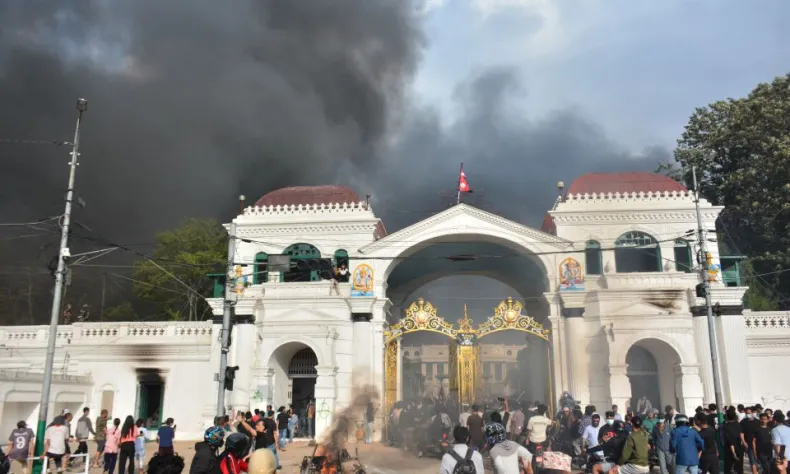
In Nepal, a youth revolt has toppled a prime minister, sparked digital resistance across the country, and ushered in the country’s first woman-led interim government. The country’s future, however, will be decided by the upcoming elections in January — and by whether a disorganized resistance movement can turn its street power into real political change.
Mandala, from Pokhara to Dharan, the nation’s youngest citizens erupted in anger — not merely in response to their government, but in response to a political system they believed had failed them for decades.
The Promise of Reform Has Faded
“performance of democratic institutions” and “prosecution of office abuse.” For decades, accountability mechanisms remained weak, and allegations of office misconduct were rarely investigated or prosecuted in a consistent, institutionalized manner, reinforcing a culture of impunity among political elites.
As a result, Nepal’s educated, tech-savvy, and globally connected Gen-Z was increasingly disillusioned. The generation faced a collapsing job market, rampant corruption, and an
with over 14.3 million active social-media users, according to the Nepal Telecommunications Authority — and young Nepalis used their newfound power. In the digital realm, they built
communities that transcended party lines and provincial borders, where ideas of accountability and transparency thrived even as governance stagnated.
Curfews, Crowds, and Oli’s Resignation
draconian attempt to suppress dissent ahead of planned protests over unemployment and inflation.
Virtual outrage spilled into the streets, with protesters waving posters reading “Digital freedom is our democracy.” By September 8, more than 400 protesters had been detained
and videos of police officers beating students went viral. That very night, a decentralized coalition emerged, leaderless but coordinated, organizing through VPNs and private servers.
A day later, Kathmandu resembled a city under siege. Curfews were imposed, but crowds defied them. Demonstrations spread to Pokhara, Biratnagar, Nepalgunj, and Dhangadhi, and
demanding the prime minister’s resignation. Even the Nepal Army turned its back on the government, signaling reluctance to intervene and insisting the protests constituted no
protesters demanding accountability.
Reconstructing a Broken State
So far, Karki has stayed true to that promise, governing through dialogue rather than decree. She has met with the chief ministers of all seven provinces, securing cooperation for the
delegates presented proposals for education reform, transparency in digital governance, and youth-employment programs.
have initiated volunteer drives to clean and rebuild damaged neighborhoods of Kathmandu and Pokhara. Karki’s administration also launched a National Integrity Audit, investigating
the misuse of development funds under the previous government, and suspended several high-profile bureaucrats. Estimates suggest that corruption under Oli caused damage
exceeding 150 trillion Nepalese rupees — roughly four times Nepal’s annual national budget. On elections, progress has also been made: As of late 2025, the Nepali Election Commission
the inclusion of Nepalis abroad remains unresolved due to technical constraints.

Painful Renewal Instead of the Death of Democracy
percent — has risen further as many businesses shut down. The National Planning Commission has warned that without rapid reforms, the country might face an exodus of
one million workers per year, many of whom are increasingly seeking a more viable future abroad.
Already, it is clear that the 2026 elections will be Nepal’s most consequential vote since 1990 — not just a contest for power, but a decision about its future. If the Karki government
manages transparent reconstruction and a fair election, Nepal could emerge stronger. If it succumbs to old habits, the cycle may repeat. As of November 2025, Nepal stands at a crossroads — battered, poorer, but politically awakened. It is now up to the interim government and civil society to create a future in which the 2025 uprising is remembered not as the death of democracy but as the beginning of renewal — a necessary fire through which a disillusioned nation began, once again, to
