
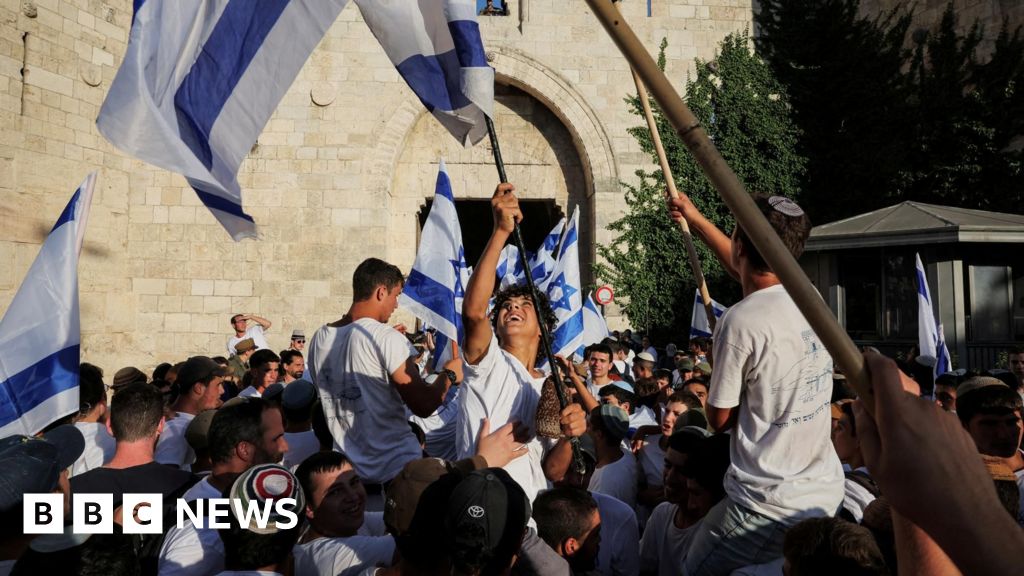
The flag march is always tense, but fears of violence were higher this year because of the war in Gaza.
Israel’s far-right National Security Minister, Itamar Ben-Gvir, took part in the march and said at the start that it was sending a message to Hamas that “Jerusalem is ours”.
“With the help of God, the full victory is ours,” he added.
Meanwhile, Prime Minister Benjamin Netanyahu told a special meeting in honour of Jerusalem Day that Israel was “surrounded by enemies” as it had been 57 year ago.
“They thought to strangle us, to wipe us off the map. But we are an ancient people, a people of brave fighters. We stood up as one and we defended ourselves,” he said. “We are also doing so today against Hamas in the south, Hezbollah in the north and Iran in the east.”
Hamas’s political leader, Ismail Haniyeh, condemned what he called the “rampage of settlers” in Jerusalem.
“Our people will not rest until the occupation ends,” he vowed.
Jerusalem, with its major Muslim, Jewish and Christian holy sites, is at the heart of the decades-old Israeli-Palestinian conflict.
Israel – which occupied the formerly Jordanian-held east of the city in 1967, and effectively annexed it in 1980 in a move not recognised by most countries – regards the whole of Jerusalem as its capital.
Palestinian leaders want East Jerusalem – which is home to about 350,000 Palestinians and 230,000 Israeli settlers – to be the capital of a future independent Palestinian state.
On the day of the Israeli flag march in 2021, Hamas fired rockets at Jerusalem, triggering a war in Gaza that lasted 11 days.
The current war began when Hamas attacked southern Israel on 7 October, killing about 1,200 people and taking 251 others as hostages.
At least 36,580 people have been killed in Gaza since then, the territory’s Hamas-run health ministry says.
