
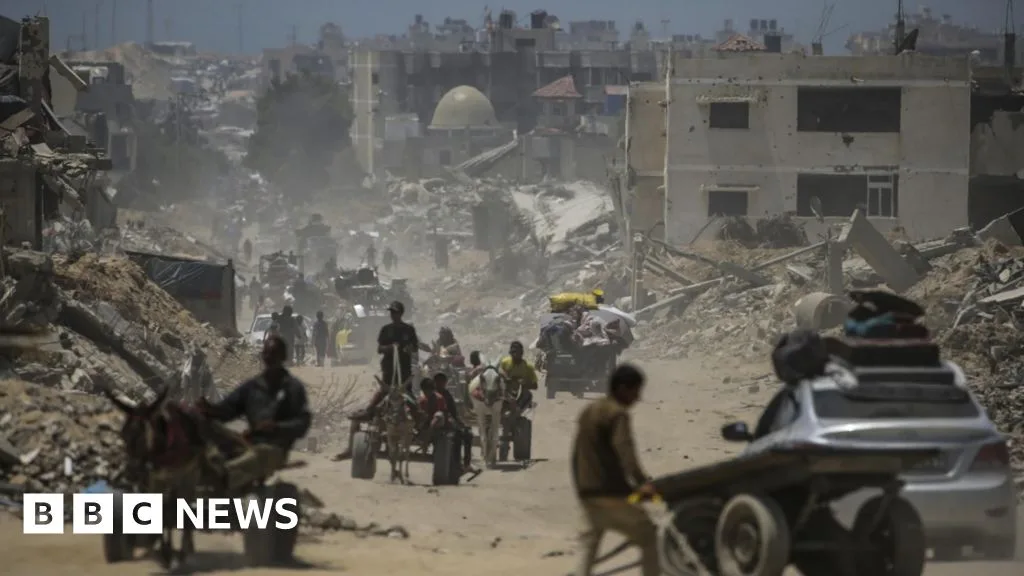
Speaking from Nuseirat refugee camp in central Gaza, Louise Wateridge of the UN agency for Palestinian refugees (Unrwa) told the BBC that its staff on the ground had been observing the “very chaotic” movement of civilians from eastern Khan Younis.
“[It’s] different from previous displacements, when we’ve seen trucks and vehicles loaded up,” she said.
“There are limited vehicles available, there’s limited fuel, the roads are so dangerous, the situation is so unsafe. People are really at this stage carrying what they can in their hands and moving. It’s devastating.”
Marwan, a father of four who has a pregnant wife, told the BBC that it had taken his family three hours to travel about 7km (4 miles) on a donkey-pulled cart from Khan Younis to al-Mawasi, which is inside a Israeli-designated “humanitarian area” that lacks basic services.
“We left in a rush, so we couldn’t get all of our luggage and important things,” he said. “I called a friend who resides in al-Mawasi. He told me there is a place next to me and you can come.”
He added: “For the bathroom, I have to dig in the sand and the mud and make a big hole.”
On Tuesday afternoon, nine members of an extended family who had fled Khan Younis were reportedly among 12 people killed in an Israeli air strike on a residential building in the central town of Deir al-Balah, which is also inside the “humanitarian area”.
The Associated Press cited hospital records as saying that Dr Hossam Hamdan, a 62-year-old dermatologist, his wife, their adult son and daughter were among the dead, external. Four of Dr Hamdan’s grandchildren and the mother of two of them were also killed, along with two other residents of the building and a man who was on the street outside, it added.
The Israel Defense Forces (IDF) said it was checking the reports.
