
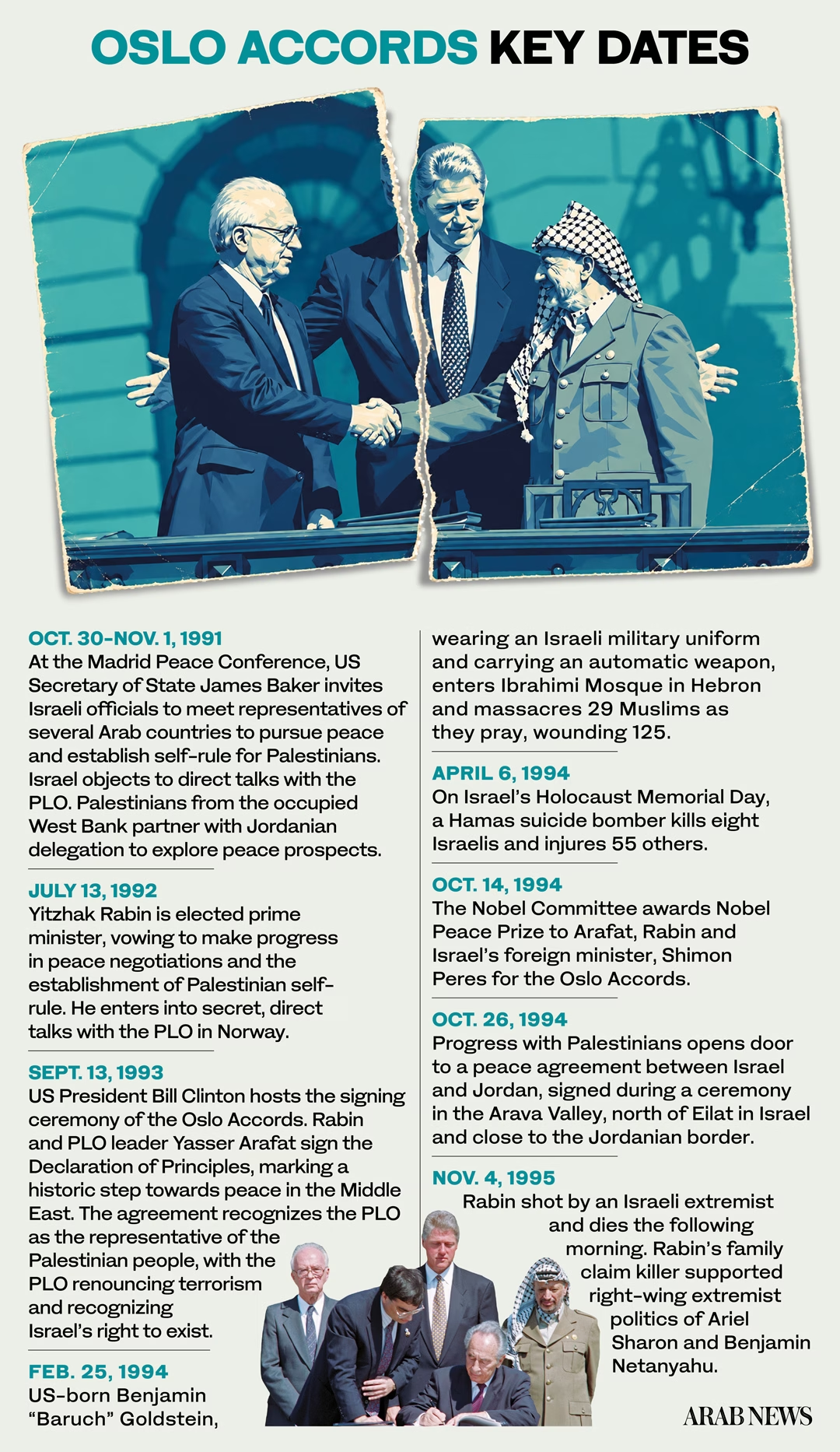
LONDON: Exactly 33 years ago today, on Sept. 13, 1993, Israeli Prime Minister Yitzhak Rabin and Yasser Arafat, the leader of the Palestine Liberation Organization, stood on the South Lawn of the White House in Washington and shook hands for the cameras in front of a beaming US President Bill Clinton.
The historic handshake celebrated the signing of an agreement, the Declaration of Principles on Interim Self-Government Arrangements, which would become known as the Oslo 1 Accord.
At the time, the agreement appeared to hold out such promise for a resolution of the Arab-Israeli conflict that the following year the two leaders, together with Israeli Foreign Minister Shimon Peres, shared the Nobel Peace Prize.
To some, the awarding of the prize seemed premature, as Francis Sejersted, chairman of the Norwegian Nobel Committee, acknowledged in his speech during the award ceremony at Norway’s Oslo City Hall on Dec. 10, 1994.
“It has been said that the Nobel Committee ought to have waited,” he said.
But that, he added, was “to disregard what has already been achieved as a result of the Oslo Accords … Besides, if we had to wait for … perpetual peace, we might have to wait a long time.”
A very long time, as it would turn out.
Within less than 11 months of receiving his Nobel Prize, Rabin was dead, assassinated by a right-wing Israeli extremist. In effect, Oslo 1, and the prospect of a final-status settlement it augured, died with him.
Oslo 1 — so-called because the agreement was the product of a series of secret meetings between negotiators in Norway — did break new ground, says Shira Efron, distinguished chair for Israel policy at global think tank RAND.
“Oslo’s key achievements were a mutual recognition, with Israel recognizing the PLO as the legitimate representative of the Palestinian people, and the PLO recognizing Israel’s right to exist; the normalization of Israeli-Palestinian direct contact, and the creation of the Palestinian Authority as a governing body,” she said.
“These have lasted for over three decades, with the recognition and direct contact remaining the bedrock on which every subsequent negotiation was built, even as each failed in turn.
“The Palestinian Authority itself, however dysfunctional, is Oslo’s most durable institutional legacy, which provides for a framework of Palestinian self-rule in Areas A and B that did not exist before 1993.”
But the accord’s most consequential failure, she said, was that “it was an interim agreement that never named an endpoint. Israel never committed to Palestinian statehood as the outcome.”
Oslo 1 set out a five-year transitional period, designed to build confidence and bridge the gap between the start of limited Palestinian self-government and a final peace settlement between Israel and the Palestinians.
“But there was no enforcement mechanism to hold either side to its commitments, and no external monitor willing to impose costs on both sides for violations,” said Efron.
“Not a single deadline was met, and the vacuum was filled by settlement expansion on one side and terrorism on the other, and currently terrorism on both sides with Jewish attacks on Palestinians that now for the first time far surpass Palestinian violence.
“The interim status quo became the permanent condition.”
Elliott Abrams, senior fellow for Middle Eastern studies at the Council on Foreign Relations in Washington, agrees that Oslo “failed in laying the groundwork for an independent Palestine.”
But Abrams, who served in various foreign policy positions for presidents Ronald Reagan, George W. Bush and Donald Trump, believes that “while Israel is often blamed for this, that is wrong and unfair.”
“The real reason for the failure is the refusal of Palestinians to accept the permanent reality of a Jewish state.”
Oslo, he added, “was built on a rotten pedestal by elevating Yasser Arafat, a man who was against creating a Palestinian democracy, indifferent to building a prosperous state, corrupt, and a terrorist.
“He left behind a shambles that exists still today, with the Palestinian Authority unable to govern Gaza and deeply hated by the majority of Palestinians.”
According to a survey carried out in the West Bank and the Gaza Strip last month by the Palestinian Center for Policy and Survey Research, “a striking 83 percent believe corruption exists within Palestinian Authority institutions, and 65 percent now describe the PA as a burden rather than an achievement.”
The Oslo Accord failed to resolve the core issues at the heart of the conflict, including borders, Israeli settlements, Jerusalem, Palestinian refugees and security arrangements. All these thorny issues were deferred to later “permanent status” talks that were supposed to conclude within five years.
“Oslo relied heavily on gradualism, postponed the most difficult questions and contained few effective safeguards against actions that could alter conditions on the ground before final status negotiations were completed,” said Sanam Vakil, director of the Middle East and North Africa Programme at Chatham House.
“Those weaknesses became increasingly important as settlement expansion continued, violence damaged political confidence and leadership changes reduced the willingness of both sides to accept the risks associated with compromise.”
Subsequent Israeli policies, she added, “deserve particular weight in explaining the erosion of the process, especially where governments expanded settlements or explicitly opposed Palestinian statehood.”
However, “describing the entire period as the systematic sabotage of Oslo by successive Israeli governments obscures significant differences between governments and understates Palestinian political decisions, including the use of violence and failures of governance.”
Oslo’s most significant achievement, she believes, “was that it changed the political structure of the conflict by establishing formal mutual recognition between Israel and the PLO and creating a Palestinian political authority with responsibility for governing parts of the occupied territories.”
As a result, “Palestinian self-government and Palestinian statehood became embedded in international diplomacy in a way that has proved difficult to reverse.” But, she added, “asymmetry between the parties was built into the agreement, weakening it from the start.”
“Its most consequential failure was that an interim arrangement intended to lead toward a permanent settlement gradually became a substitute for one … The result was a process that institutionalized limited Palestinian autonomy without resolving the underlying question of sovereignty.”
The design of Oslo, said Efron, “was flawed from the start, assuming a rough symmetry of goodwill and capability between an occupier and the occupied that never existed, and it had no enforcement mechanism because Washington, acting more as Israel’s advocate than a neutral broker, was never willing to impose costs on either side.”
Implementation, she added, “failed on both sides too: Rabin’s refusal to freeze settlements during the interim period, and Arafat’s failure to rein in terrorism.”
Yet Rabin’s assassination in November 1995, after a rally in support of the Oslo peace process, “was a genuine, unforeseeable shock that removed the one Israeli leader with the standing to sell real concessions.”
The rise of Hamas as a governing and armed rival to the PLO, and the Second Intifada, from 2000 to 2005, “transformed Israeli public opinion,” Efron added.
“Support for a two-state solution among Israelis was around 61 percent in 2012 but has collapsed since, particularly after Oct. 7, 2023.”
According to August’s PSR survey, 44 percent of Palestinians currently support and 50 percent oppose a two-state solution, although backing for a formula based on the 1967 borders is higher, at 56 percent overall and 61 percent in Gaza.
At the same time, 58 percent believe the two-state solution is no longer practical because of settlement expansion, and 64 percent see little or no chance of an independent Palestinian state emerging within five years.
Negotiations are now viewed as the most effective approach by 44 percent of Palestinians, up from 36 percent ten months earlier and at the highest level in four years. Support for armed struggle has fallen from 41 percent to 27 percent, its lowest level in four years.
Today, said Sarah Yerkes, acting co-director of the Middle East Program at the Carnegie Endowment for International Peace, “it is honestly hard to point to a lasting achievement” of Oslo 1, “but its most consequential failure might be the rise of Benjamin Netanyahu.
“Netanyahu came to power (in 1996) riding a wave of anti-Oslo public sentiment in Israel and he has taken that sentiment and amplified it. He has also unleashed and encouraged extreme polarization in Israel and allowed for the Israeli far-right to flourish in a way that has undermined chances for peace time and time again.”
Yerkes also believes that one of the biggest failures of the Oslo process was “the lack of public buy-in to the agreement and its implementation.
“Neither the Israeli nor Palestinian leadership made a real or sincere effort to either involve the public in the negotiating process or to prepare them to accept its outcomes prior to implementation.”
For Oslo to have succeeded, she added, “there needed to be a far more direct and deep people-to-people engagement track that would not only bring together Israelis and Palestinians across borders, but also would help bridge the gap between various factions of Israeli and Palestinian society within their own communities.”
The assassination of Yitzhak Rabin in 1995 “shows how divided the Israeli public was over Oslo and the failure of the Israeli leadership to understand that divide. The same can be said for the Palestinian side.”
Oslo, said Sir John Jenkins, a former UK ambassador to Saudi Arabia, Libya, Syria and Iraq and consul general in Jerusalem, “emerged at a time of huge optimism” and was “based on an assumption that negotiations between participants in an apparently unresolvable conflict, mediated by well-meaning, good faith and intelligent moderators, could succeed.
“It gave hope, that is, where hope had not existed before.”
That hope, however, proved to be an illusion.
“I don’t think Arafat was ever fully on board with the idea of a Palestinian state living in perpetual peace with Israel,” said Sir John.
“I think there was a part of him that was forever irredentist. I think that reflected the feelings of most Palestinians — of whom Hamas were and are simply the most extreme.
“I also don’t think that Israelis ever fully bought into the idea of a Palestinian state in the sense that Palestinians understood the term.”
He added: “So Oslo for me is dead. It died some time in the late 1990s but was kept on life support after that because, for international actors, anything else was an admission of failure.”
For Vakil, “it is reasonable to conclude that the two-state solution is no longer a credible near-term political project, given the territorial fragmentation of the West Bank, the continued expansion of settlements, the destruction of Gaza and the absence of a meaningful negotiating process.”
These conditions, she said, “have reduced the space in which a viable Palestinian state could emerge and have made the political costs of partition considerably greater than they were during the Oslo period.”
For this reason, the Israeli election on Oct. 27 is “particularly important.”
“It is rarely being presented by Israeli politicians as a referendum on the future political relationship with the Palestinians, since the campaign is framed much more explicitly around security, leadership and the aftermath of the war, but in practice it will amount to something close to one.
“The government that emerges will have considerable influence over whether Israel continues toward deeper territorial control and a more permanent separation from the possibility of Palestinian sovereignty, or whether some political horizon for partition can eventually be restored.
“For that reason, I would describe the two-state solution as politically remote rather than definitively dead. The next Israeli government may determine whether that distinction continues to have any practical meaning.”
Hamas, said Sir John, “continues to exercise a veto of violence over any negotiation. They themselves can achieve nothing; they command a core constituency of maybe 25 to 30 percent and clearly speak to a desire for vengeance among many Palestinians.
“Many others want an end to the killing, the fighting and the poverty, but the trouble is that hardly any Israeli now trusts any Palestinian.”
In Israel, Sir John said, “there used to be a peace camp. They now vote for Likud, Bennett, Gantz or Eisenkot, none of whom are interested in a Palestinian state.”
The Palestinian political landscape is also undergoing seismic change.
Last month’s PSR survey found that overall support for Hamas has fallen to 24 percent from 35 percent 10 months earlier, while Fatah, which controls the PA, is at 24 percent.
Confidence in Hamas’s ability to represent Palestinians has also declined, from 41 percent to 28 percent, while 44 percent say that neither Hamas nor Fatah deserves to lead.
“These findings,” said the PSR, “suggest that dissatisfaction is increasingly directed not toward one faction alone but toward the broader Palestinian political system.”
The survey also found that if elections were held today, “Marwan Barghouti would be the strongest presidential candidate.”
Barghouti, a senior Fatah leader who has been imprisoned by Israel since 2002 and is serving multiple life sentences for his role in the Second Intifada, was a supporter of the Oslo initiative, but became disillusioned.
“The mistake was not with the Oslo Accords, but the mistake was with these crazy leaders in Israel — like Netanyahu and Barak — who didn’t implement the agreements,” he said in an interview in August 2001, eight months before his capture by Israeli forces in Ramallah.
“I believe that Oslo did open the door for peace in the Middle East, but unfortunately, the Israelis never implemented the agreements.”
None of this, said Sir John, means the Palestinian issue has disappeared, “but whatever the answer is, I cannot see it being a Palestinian state.
“It needs to satisfy the Palestinian desire for self-determination, for control over their daily lives, for dignity, for an economy, for travel and so forth. But it also needs to provide for Israeli security, otherwise it won’t fly.”
That, he said, means that “the key role must now be played by the regional states. Israel cannot seriously contemplate a future as a garrison state in perpetuity. So how does it become part of a regional system that enables Palestinians to breathe, Israelis to sleep safely, Lebanese to rebuild their country, and everyone else to prosper?
“I don’t know the answer; nor does anyone else, at least not yet. It’s not going to be a repeat of Oslo. But it can only happen if everyone agrees to share the risks.”
Shifting political conditions have always been an obstacle to a final settlement, “but the current phase looks different from the earlier ones,” said Efron.
“Successive Netanyahu governments have deliberately worked to undermine Oslo since his first term, as he was recorded telling settlers in 2001 that he had ‘de facto put an end to the Oslo Accords.’”
The present government’s policy, she added, “seeks to ‘bury the idea of a Palestinian state’ once and for all.
“The current push by Finance Minister Bezalel Smotrich to extend sovereignty over all ‘open areas’ in the West Bank, not only in Area C (Oslo II’s own category, placing roughly 60 percent of the West Bank under Israeli control), while simultaneously extending Israeli enforcement authority into Areas A and B, dissolves the A/B/C distinction itself, a key part of Oslo’s territorial logic that was supposed to shrink toward Palestinian sovereignty over time, not get erased.”
The two-state solution, she said, “is functionally moribund as a negotiated near-term outcome, due to settlement growth, Gaza’s devastation, Palestinian political fragmentation, and Israeli politics and public opinion that shifted to the right, but it’s not ‘dead’ in the sense of having been replaced by any viable alternative, which Israelis and Palestinians can actually subscribe to.”
Israeli support for a two-state outcome has fallen to about a quarter of the public, but support for a single binational state, with equal rights for Jews and Palestinians, is between 1 and 4 percent among Israelis and only 16 percent among Arab citizens of Israel.
At the same time, said Efron, “polling indicates preference for some kind of separation, even if the classic two-state formula has lost credibility. So what’s actually collapsing is confidence that two states is achievable, not the underlying preference for it over the realistic alternative.”
That, she added, “is the real tension: The territorial and political window is closing daily while the public appetite for what continued drift would actually produce — a single state, almost certainly without equal rights for Palestinians — remains nearly non-existent on both sides.”
The two-state solution, the destination to which the Oslo Accords were intended to pave the way, “is less ‘dead’ than being slowly foreclosed by policy that most people on neither side have actually asked for.”
