
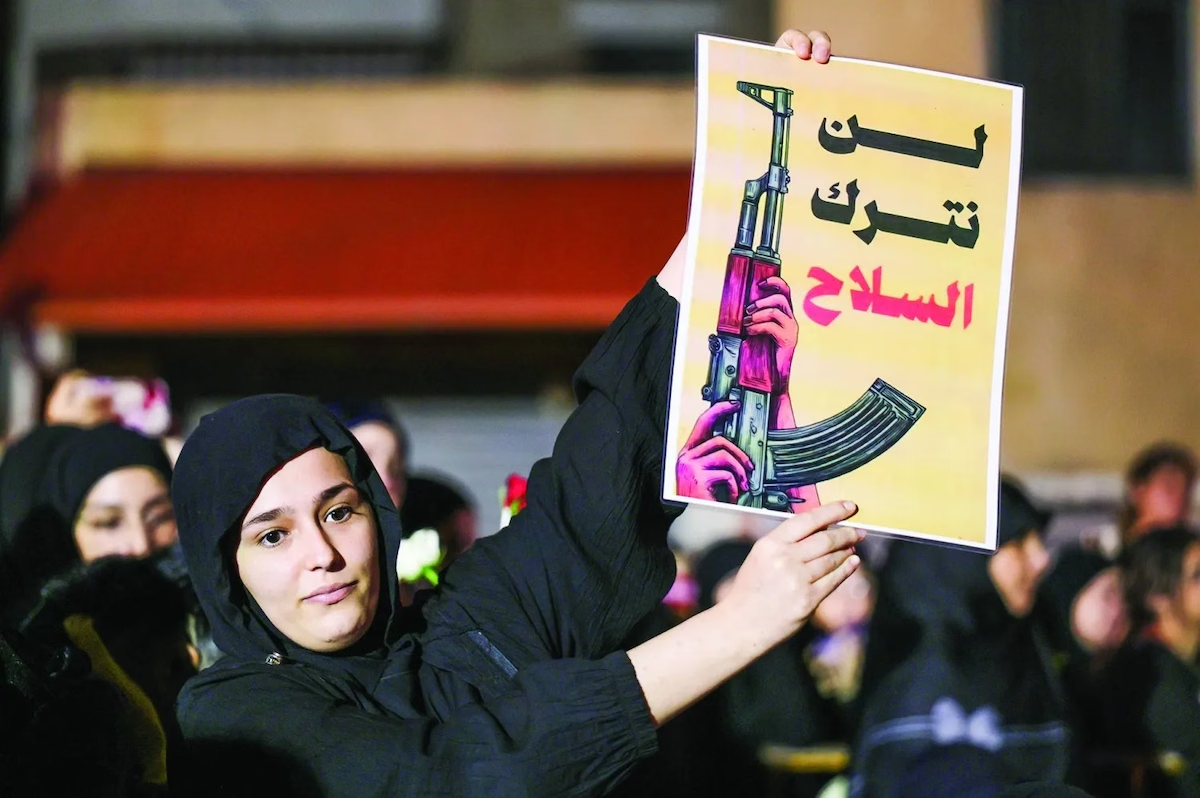
BERLIN: The Shiite duo, Hezbollah and the Amal Movement, are mobilizing to counter the American push to internationalize the framework agreement signed by Lebanon and Israel under US auspices last June.
This internationalization would be achieved by incorporating the agreement into UN Security Council Resolution 1701, after updating it to align with the expiration of UNIFIL’s mandate at the end of this year. Internationalizing the agreement was one of the proposals discussed last week to prevent a security vacuum in southern Lebanon after UNIFIL’s mission ends.
This path is gaining additional sensitivity in light of Israel’s efforts to establish a new security reality in the south, based on the absence of any international force, which would allow it to impose mechanisms for direct coordination between the Lebanese and Israeli armies.
Between betting on a unified official Lebanese position that rejects such trends, and seeking the help of Moscow and Beijing in the UN Security Council through the use of the veto, leading to popular mobilization or field escalation, the options available to the “Shia duo” are numerous, while the margins for maneuver are shrinking after France re-entered the scene to support the American approach, and sought to convince the “duo” of various formulas that prevent reaching a security vacuum in the south, which most local and international forces do not favor.
Hezbollah Secretary General Naim Qassem explicitly declared in his latest appearance that any new international resolution must be within the framework of Resolution 1701 and the ceasefire agreement with Israel on November 27, 2024, considering that “any replacement of the framework agreement is rejected, as it is unconstitutional and illegal,” warning that any force that is not within the aforementioned framework, regardless of its name and description, will be treated as an “occupying force.”
The Amal Movement is completely aligned with Hezbollah’s position regarding the internationalization of the “Framework Agreement,” and it recently stressed its “rejection of including any new agreement or understanding on the text of Resolution 1701 and the Cessation of Hostilities Agreement of 11/27/2024 in any resolution or new UN mandate.”
Three options for confrontation
Although some believe that any international agreement will impose a new reality on the Shiite duo by force of circumstance, political writer Dr. Qassem Qassir, who is closely familiar with Hezbollah’s position, speaks of a range of options that can be pursued to counter these attempts. He points out that “the first effort is the internal one, as no decision can be made in the Security Council without Lebanon’s approval. This naturally requires official approval, whether through the government or through coordination between the presidents. It is clear that Speaker (Nabih) Berri rejects the internationalization of the framework agreement or its inclusion in Resolution 1701, and this was conveyed to US envoy Mike Waltz during his recent visit to Beirut.”
The second approach, according to Qassir, is that “any decision in the Security Council needs the approval of the major powers, especially Russia and China. With the coordination with the Russians and Chinese currently underway, it is possible that Russia or China will resort to using the veto if they object to the decision. Of course, there is no accurate or confirmed information about this matter, but it is also one of the efforts being considered.”
Street mobilization … a possibility
In a statement to Asharq Al-Awsat, Qassir points out that “the third scenario, which is the most important, concerns how any decision will be implemented on the ground. Any international forces that come to Lebanon without the consent of the local parties—especially the Amal Movement, Hezbollah, and the Supreme Islamic Shiite Council—cannot be accepted. If these forces come in coordination with, or through, the Israeli enemy, they will be treated as occupying forces.” He added, “According to information we have, the countries that are trying to participate, such as Italy and France, will not agree to send their forces to Lebanon except after obtaining the consent of the local parties. Naturally, all of this is still within the framework of communications and consultations. If it becomes necessary to mobilize the public to reject this approach, then resorting to this option is a possibility.”
Suicide operation
Political writer and editor-in-chief of the “Janoubia” website, Ali al-Amin, disagrees with Qassir’s view of the “Shia duo’s” options, as he believes that “it has no ability to confront this path, neither in providing the conditions for an official internal position that opposes this trend, nor in benefiting from international positions that would obstruct such a draft resolution in the UN Security Council, especially since the framework agreement is an agreement that the Lebanese government has approved, and no member state of the Security Council will oppose it unless there is an official demand from the Lebanese state against the project, and this seems unlikely after the framework agreement was combined with 1701, in addition to the fact that France has regained its role in the Lebanese-Israeli equation, and has become a party with Washington in arranging the scene in southern Lebanon after the end of the UNIFIL mission at the end of this year.”
In a statement to Asharq Al-Awsat, Al-Amin points out that “(Hezbollah) is issuing overt and covert threats regarding the authorities’ handling of the issue of its detained members in Dahr Al-Baydar, between Bsharri and Batroun. It is also sending messages to the government and the president regarding dealing with the anticipated international resolution. The party may resort to military and security steps to demonstrate that it is in control on the ground, and it may engage in some internal military confrontation. However, this decision would be like a suicide operation, because its repercussions would be catastrophic for it, given that it is now a force facing a Lebanese public opinion that rejects its weapons and insists on the exclusivity of weapons.”
Spreading chaos
The Secretary General speaks of “another method of confrontation that the party may resort to, based on the idea of spreading chaos through civil or sectarian clashes in which (Hezbollah) does not appear to be a party, such as witnessing internal Palestinian clashes in the camps, or Sunni-Christian tensions between Bsharri and Danniyeh, or Christian-Christian tensions, or bombings and problems between Syrians and Lebanese,” considering that “chaos is the most effective means of creating a state of political confusion and hesitation on the part of the authorities. It provides suitable conditions to show that Lebanon will not tolerate serious and decisive steps to establish the authority of the state, while Iran will work to disrupt any local or international political process in which it is not a partner in arranging it.”
