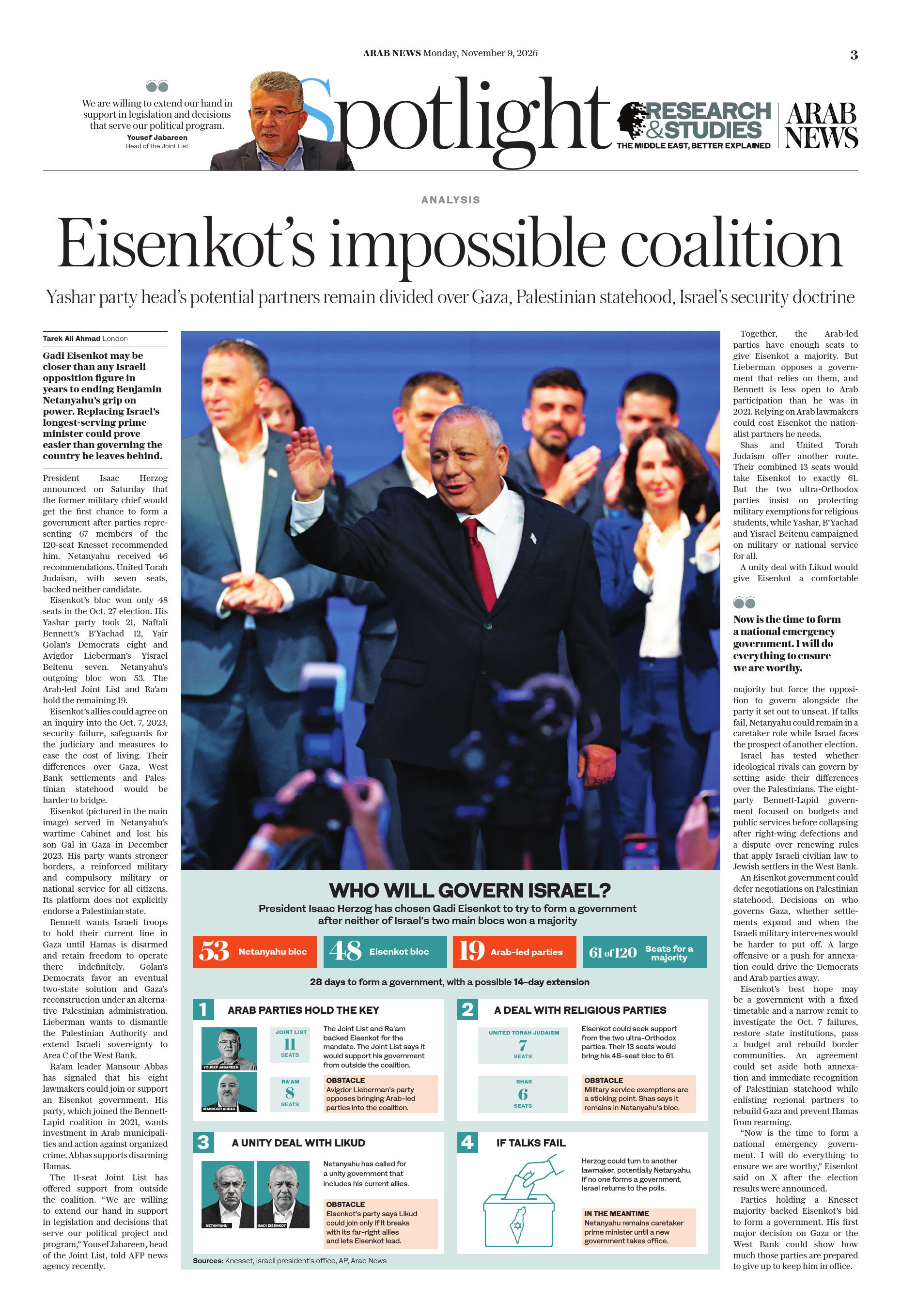
BEIRUT: Gadi Eisenkot may be closer than any Israeli opposition figure in years to ending Benjamin Netanyahu’s grip on power, but replacing Israel’s longest-serving prime minister could prove easier than governing the country that Netanyahu leaves behind.
President Isaac Herzog announced on Saturday that the former military chief would be given the first opportunity to form a government after parties representing 67 members of the 120-seat Knesset recommended him for the job. Netanyahu received 46 recommendations, while the seven-member United Torah Judaism endorsed neither candidate.
On paper Eisenkot has a majority; in practice he commands only 48 seats.
His Yashar party won 21 in the Oct. 27 election, Naftali Bennett’s B’Yachad secured 12, Yair Golan’s Democrats took eight and Avigdor Lieberman’s Yisrael Beiteinu won seven. Netanyahu’s outgoing bloc holds 53, leaving the Arab-led Joint List, with 11 seats, and Ra’am, with eight, in the position of kingmakers.
The arithmetic looks simple; however, the political arithmetic is anything but.
Eisenkot can reach power by accepting Arab-party support, recruiting ultra-Orthodox factions, entering a unity government with Likud or persuading lawmakers to abandon Netanyahu. Each route would force someone in his camp to cross a line drawn during the campaign.
Reacting to the Oct. 27 election results, Meir Javedanfar, an Israeli commentator on Middle East conflicts, said: “History will remember that it was the Jewish PM of Israel, Benjamin Netanyahu, who tried to ruin Israel’s democracy, and it was the Arab citizens of Israel who saved it.”
Opposition leaders agree that Netanyahu has polarized Israeli society, weakened public institutions and avoided accountability for the Oct. 7, 2023, security failure. They can support a state inquiry, protections for the judiciary, repairs to the civil service and measures addressing the cost of living.
Palestine is where their shared program ends.
The parties disagree over who should govern Gaza, whether Israel should retain permanent military control there, whether settlements should expand and whether Palestinians should ever have an independent state.
A former chief of staff of the Israel Defense Forces and member of Netanyahu’s wartime Cabinet, Eisenkot is not a conventional peace candidate. He is associated with the “Dahiya doctrine,” which advocates overwhelming force against areas from which Israel says hostile groups operate.
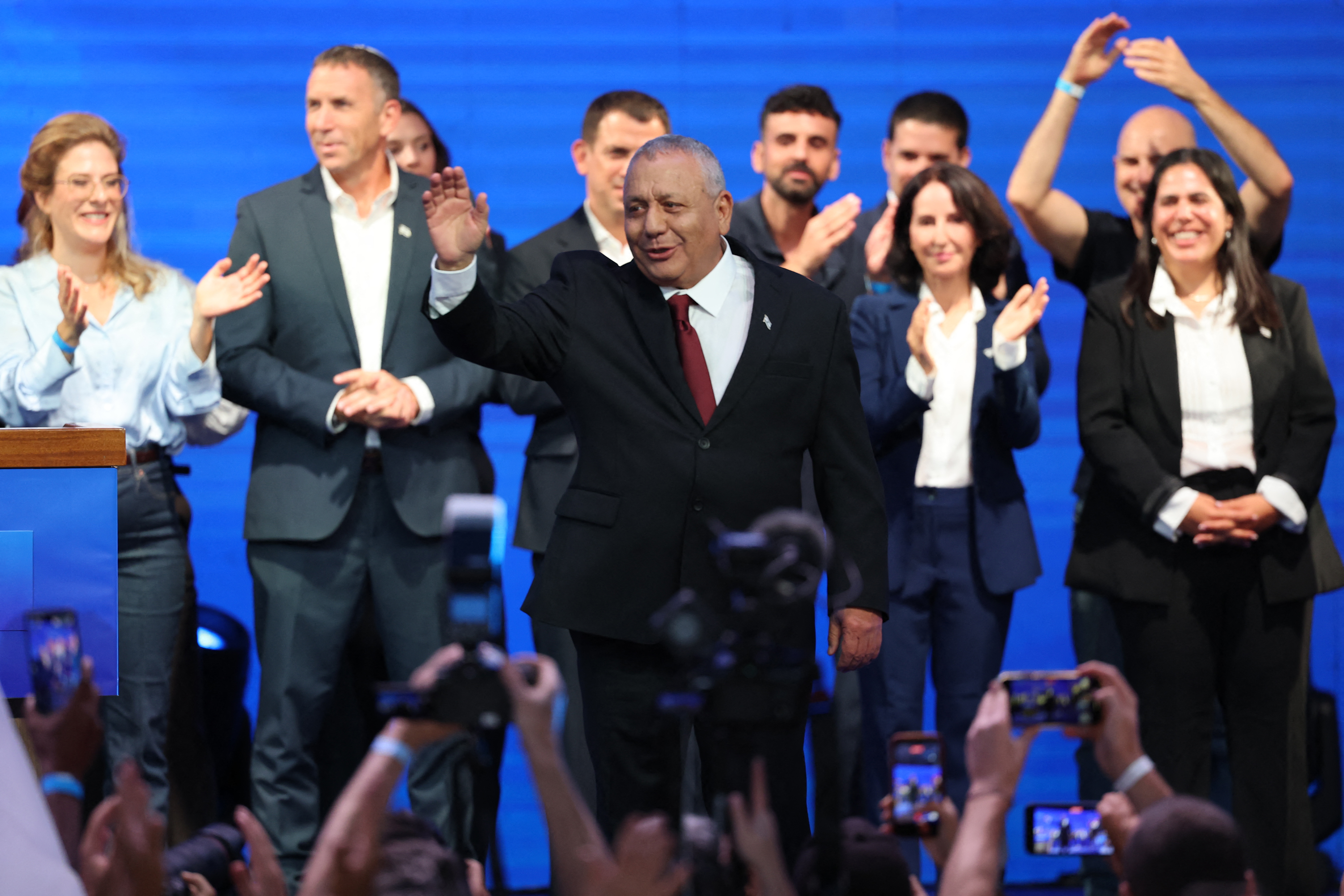
His son Gal was killed while serving in Gaza in December 2023. The loss gave Eisenkot an intensely personal connection to the war and reinforced his standing among Israelis who consider military service the foundation of citizenship.
His disputes with Netanyahu have focused less on whether Israel should use force than on how force is used, toward what strategic objective, and under whose accountable leadership.
Yashar promises a new national security doctrine, stronger borders, a reinforced military and expanded regional partnerships. It also supports compulsory military or national service for all citizens. Its platform speaks of maintaining a Jewish majority but does not explicitly endorse a Palestinian state.
Bennett’s B’Yachad wants Israel to remain behind its current military line in Gaza until Hamas is fully disarmed. If Hamas refuses, Bennett says Israel should disarm it by force. He opposes direct Israeli civil administration of Gaza but supports indefinite freedom for the Israeli military to operate there.
His security program promises a larger and more lethal army, immediate attacks against enemy rearmament, and a move from containment to “decisive victory.”
Golan’s Democrats occupy the other end of Eisenkot’s bloc. They support an eventual two-state solution, oppose annexation in the West Bank and favor rebuilding Gaza under an alternative Palestinian administration supported by Arab and international partners.
They would be expected to resist expanded settlements, mass Palestinian displacement or an open-ended Israeli occupation.
Lieberman offers a third vision. His plan calls for dismantling the Palestinian Authority, abandoning the Oslo framework, preventing the establishment of a Palestinian state and applying Israeli sovereignty to Area C of the West Bank.
For Gaza, he advocates destroying Hamas’ military and civilian institutions before transferring administration to an outside actor.
Eisenkot’s prospective coalition therefore includes one party advocating two states, another determined to prevent Palestinian statehood and a third promising decisive military victory without explaining the political order that would follow it.
This is the coalition he must hold together before considering the parties outside it.
Ra’am leader Mansour Abbas has indicated that his party is prepared to join or support an Eisenkot government. Ra’am made history in 2021 when it entered the Bennett-Lapid coalition, becoming the first independent Arab party to participate in an Israeli government.
Abbas supports Hamas’ disarmament, potentially meeting one of Eisenkot’s conditions. His party’s priorities include investment in Arab municipalities, action against organized crime and recognition of underserved Bedouin communities.
The Joint List has offered outside support without entering the government. That arrangement would allow its lawmakers to help remove Netanyahu while opposing policies they reject in Gaza and the West Bank.
The list supports ending the occupation and establishing a Palestinian state in the West Bank, Gaza and East Jerusalem. Its lawmakers have condemned attacks on civilians but declined Eisenkot’s demand that they describe Hamas as a terrorist organization that must be destroyed.
“We are willing to extend our hand in support in legislation and decisions that serve our political project and program,” Yousef Jabareen, head of the Joint List, told AFP news agency recently. He added: “Our positions are based on human rights and are supported by international law and international conventions.”

With Ra’am’s eight votes and the Joint List voting in favor or abstaining, Eisenkot could theoretically defeat Netanyahu’s 53-seat bloc.
But Lieberman refuses to join a government that includes or depends on Arab parties. Bennett is also far less open to Arab participation than he was in 2021, reflecting the rightward shift in Israeli public opinion since Oct. 7 and the wars that followed.
The question is whether the votes of Palestinian citizens of Israel are accepted as a legitimate foundation for political power.
Netanyahu has long portrayed governments dependent on Arab lawmakers as inherently dangerous. If Eisenkot accepts that argument, he could make it impossible for the opposition to govern even after parties representing a Knesset majority recommended him.
If he rejects it, he could lose the nationalist partners he needs.
The alternative is an agreement with Shas and United Torah Judaism. Together, the ultra-Orthodox parties hold 13 seats — precisely the number required to turn Eisenkot’s 48 into a majority of 61.
Yashar, B’Yachad and Yisrael Beiteinu campaigned on military or national service for all. Their voters include reservists and families who believe they have carried an unfair share of Israel’s wars. The ultra-Orthodox parties insist on protecting exemptions for religious students.
Eisenkot could compromise and become prime minister, but only by retreating from one of his clearest campaign commitments.
A unity government with Likud would provide a comfortable majority but could be even more politically corrosive. An opposition created to end the Netanyahu era would find itself governing alongside Netanyahu or a party still unwilling to break with him.
A prolonged caretaker scenario is not impossible. According to Daniel Shapiro, a former US ambassador to Israel, “Netanyahu may prefer to lead his current government in a caretaker role, refuse any compromises necessary to bring in additional partners, resume the war in Iran during government formation period, and take his chances in about six months.”
Israel has already tested the proposition that ideological enemies can govern together if they agree to avoid the Palestinian question.
The Bennett-Lapid “change government” formed in 2021 with eight parties spanning the nationalist right, center and Zionist left, together with Ra’am. Its members concentrated on budgets, public services and ending Netanyahu’s rule, while shelving their differences over the occupation.
The arrangement collapsed after right-wing defections and a dispute over renewing emergency rules that apply Israeli civilian law to Jewish settlers in the West Bank. The lesson was not merely that a diverse coalition is fragile. It was that maintaining the occupation is itself a policy requiring constant legislation, funding and military decisions. There is no neutral status quo.
An Eisenkot government would face the same structural problem but in more dangerous regional conditions. It could postpone final-status negotiations, but not decisions on Gaza, settlements, settler violence, Palestinian governance or Israeli military operations.
A major attack could drag the coalition toward Bennett and Lieberman. A large Israeli offensive or annexation initiative could drive the Democrats and Arab parties away.
Eisenkot’s best hope may be a limited “repair government” with a fixed timetable and deliberately narrow mandate: investigate Oct. 7, restore state institutions, pass a budget, rebuild border communities and establish clearer national-security decision-making.
A coalition agreement could rule out both annexation and immediate recognition of Palestinian statehood, while supporting a regional mechanism for Gaza’s reconstruction and preventing Hamas from rearming.
Eisenkot has assembled a majority that agrees that Netanyahu should go. “Now is the time to form a national emergency government. I will do everything to ensure we are worthy,” he said on X after the election results were announced.
However, he has not yet assembled one that agrees on what Israeli security is meant to achieve, what political rights Palestinians should possess or whether Arab citizens can determine who governs Israel.
That is why his coalition is possible and perhaps impossible at the same time. It may be strong enough to remove Netanyahu. Whether it can survive the first crucial decision that follows is another matter.