
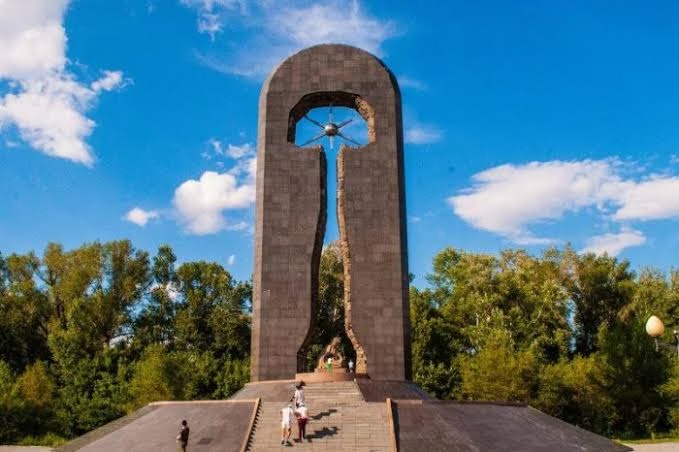
Did Kazakhstan lose influence and domestic stability by voluntarily giving up the world’s fourth-largest nuclear arsenal? The answer, bluntly, is no.
Astana inherited more than 1,400 Soviet strategic warheads and other nuclear materials following the collapse of the Soviet Union. It subsequently abandoned its military nuclear status and joined the Nuclear Non-Proliferation Treaty as a non-nuclear weapon state, and transferred all remaining warheads to Russia.
Now, Astana continues to play a decisive role in building cooperation to address regional and global security challenges, and advocates for regional diplomacy and sustained dialogue to avoid unnecessary escalations.
This week marked the 20th anniversary of the Semipalatinsk Treaty, a legally binding agreement that bans the manufacture, acquisition, testing and possession of nuclear weapons across Central Asia. Signatories include Kazakhstan, Kyrgyzstan, Tajikistan, Turkmenistan and Uzbekistan.
Gulf countries have proven their openness to positive relations with Iran.
Khaled Abou Zahr
The treaty is named after the testing site in Kazakhstan that exposed an estimated 1.5 million people to radioactive fallout and left a lasting impact on public health and the environment. It offers a stark reminder of the devastating consequences of nuclear weapons.
To mark the anniversary, Kazakhstan’s permanent mission to the UN, in cooperation with the UN Office for Disarmament Affairs, organized a forum and published an important study on nuclear-weapon-free zones, the recommendations of which could serve to bring stability not only to Central Asia but far beyond.
If we consider the geography that links the Gulf region, and the broader Middle East, with Central Asia, it is not difficult to foresee how these regions could become a powerhouse for energy, logistics, food security, industrial development, trade and tourism. If we look closely at the map, we notice that the existing barrier to achieving this is the leadership in Iran and its aggressive strategies toward its Western borders. A friendly Iran that did not interfere in the domestic affairs of other countries would create a bridge of opportunities between the two regions.
Despite a recent dispute over cultural heritage, which prompted Uzbekistan to summon Iran’s ambassador over comments about the Registan monument, Tehran maintains positive diplomatic and economic ties with Central Asian countries. This even includes Afghanistan. The regime in Iran presents itself as a defender of Shiites through its policies on the Middle East, yet Tehran is opening up to the Taliban. This was confirmed by visits to Kabul this month by Iran’s energy minister, members of its parliament and 180 businessmen, all in the space of a week. Moreover, deals between the countries exceeding a value of $400 million were announced.
This begs the question: Why does Iran not want to build positive relationships in the Middle East, and what can be done about that?
Following an extension of the Semipalatinsk Treaty, the next step would be to establish regional talks involving Iran, the Gulf states and the wider Middle East
Khaled Abou Zahr
I believe that just as they have proved capable of successfully balancing the influences of China, Russia and the US, countries in Central Asia can, and have a duty to, also play a role in efforts to change the Iranian stance on the Middle East, as it is the key to broader stability for all.
Gulf countries have proven their openness to positive relations with Iran. But Tehran needs to give up its military nuclear program, and halt its destructive interference in the affairs of other countries.
There is such great potential for a bright future that is being thrown away. Together, Central Asia and the Gulf nations possess abundant natural resources, agricultural potential, strategic routes, capital, world-class ports, logistics infrastructure and young populations filled with the ambition to help diversify their economies. Together, they could build markets stretching from East Asia to Europe and Africa.
Kazakhstan’s president, Kassym-Jomart Tokayev, made a strong point in April when, speaking at the Antalya Diplomacy Forum, he called for strategic restraint and a diplomatic resolution to the escalating conflict involving Iran and the Gulf states.
He stressed that “we must act more responsibly and exercise restraint,” while reaffirming Kazakhstan’s solidarity with the Gulf nations and urging all parties to cease hostilities. Addressing the broader implications of the regional conflict, he highlighted the economic consequences and disruptions to maritime trade, particularly around the Strait of Hormuz. Yet he rightly emphasized that negotiations concerning Iran must address the fundamental security issues at stake, which are symbolized by nuclear proliferation.
Tokayev also highlighted the need for stronger preventive diplomacy to avert further regional and global conflicts. One such positive mechanism would be to extend the Semipalatinsk Treaty westward to include Iran, the Gulf and the wider Middle East. This is an initiative that would come from a country that is trusted, and a region that benefits from positive relations with all of the stakeholders.
More importantly, it offers a way for the countries to increase agency in their own affairs. This would not be an internationally led initiative, but one created and spearheaded by the peoples of the region. These countries together could also convince Iran to alter its current stance on the region.
This should therefore be seen as a stepping stone to improved dialogue. Following an extension of the Semipalatinsk Treaty, the next step would be to establish regional talks involving Iran, the Gulf states and the wider Middle East, with the aim of developing shared security guarantees, regular diplomatic consultations and mechanisms for crisis prevention.
The objective would be to move beyond the issue of nuclear nonproliferation toward a comprehensive regional security architecture that gives the countries of the Middle East greater agency in efforts to shape their own futures and build stronger economies for the good of their citizens.
Crucially, this process would be initiated and led by the countries of the region themselves, with Kazakhstan serving as a credible facilitator, drawing on its experience with the Semipalatinsk Treaty and its diplomatic relations across the region.
