
On Oct. 14, 1994, a 21-year-old Egyptian electrician named Mohammed Nagi Mustafa approached Naguib Mahfouz, the Nobel Prize-winning novelist, and plunged a knife into his neck.
Mahfouz was 82 years old. He had spent his life writing about Egyptian society, its people and their struggles, earning the Nobel Prize for Literature in 1988.
The young man who tried to murder him had never read a single word he had written.
When questioned about the attempted assassination, Mustafa reportedly acknowledged that he had not read Mahfouz’s books. He had been convinced that the novelist was an enemy of Islam who deserved to die.
He did not need to read Mahfouz to condemn him, or understand his ideas to decide that he should be killed. All he needed was someone he trusted to tell him that killing this elderly writer was a religious duty.
There is something profoundly disturbing about that story. A young man, barely out of his teens, was prepared to take another human being’s life because someone had persuaded him that murder was an act of faith.
I have been thinking about Mohammed Nagi Mustafa since the horrific shooting at St. George’s Greek Orthodox Church in the village of Hamoud, in Jordan’s Karak Governorate.
Nine people were killed when gunmen opened fire on mourners attending a funeral. People who had gathered to say goodbye to a loved one found themselves confronted with death.
The attack shocked Jordan, a country where Muslims and Christians have lived alongside one another for generations, sharing neighborhoods, schools, workplaces and, most importantly, a sense of belonging to the same nation.
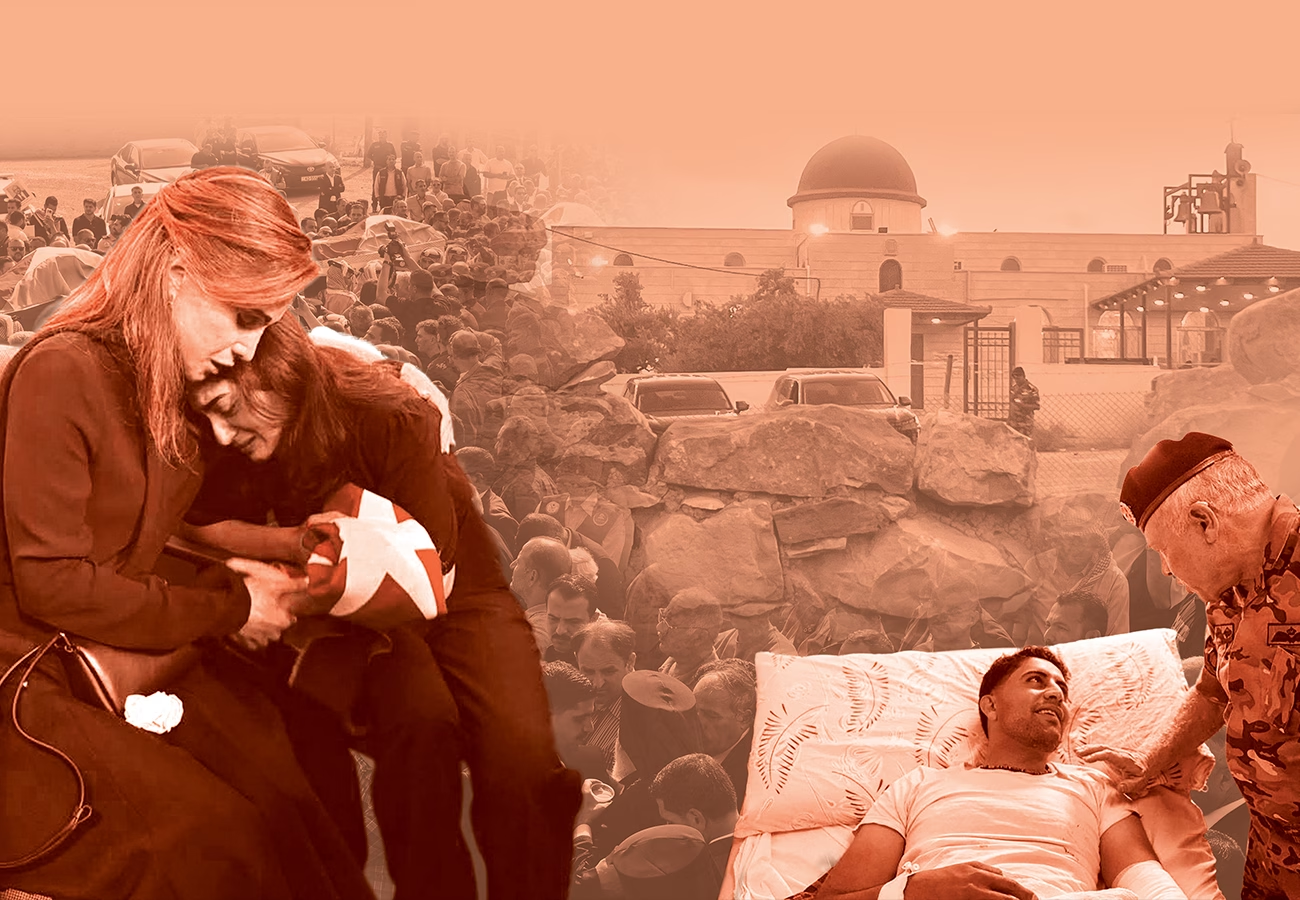
But perhaps the most powerful image to emerge from the tragedy was that of Queen Rania, visibly moved to tears at the funeral home, surrounded by the grieving families of the victims. She was accompanied by Princess Rajwa and Princess Salma, who had come to share in the families’ sorrow.
There was something profoundly human about that scene. Beyond the royal titles, protocol and familiar expressions of sympathy, there were three women sharing the grief of other families.
For me, that image made the tragedy personal to all of us. It brought home the terrible realization that those killed were not strangers whose names we read in the news. They were people like us, with families, hopes and ordinary lives. It could have been our parents, our children, our brothers or sisters. It could have been any one of us.
Much has already been written about the attack. There have been condemnations from political leaders, religious figures and ordinary Jordanians. The familiar declarations of national unity have been repeated, as they should be.
I hesitated to write about the tragedy. So much has already been said, and another expression of outrage, however heartfelt, would add little to the public discussion.
But the story of the young man who stabbed Mahfouz raises a question worth considering.
What goes through the mind of someone who believes that killing an innocent person is an act of righteousness?
I do not know what motivated the men who attacked the church in Karak, whether they acted alone or were influenced by others. Those are questions for investigators to establish.
But I wonder whether they were like the young Egyptian who tried to kill Mahfouz: So convinced of their own righteousness that they could no longer recognize the humanity of those they regarded as enemies.
Perhaps they believed they were defending their religion. Perhaps they had convinced themselves that people attending a funeral deserved to die simply because they worshiped differently.
None of this diminishes their responsibility. Ignorance is not innocence, and religious conviction cannot excuse murder.
But there is a difference between the man who pulls the trigger and the person who teaches him that pulling it is a virtue.
There may be people who know precisely what they are doing when they encourage hatred. They understand that an attack on a church does not merely take innocent lives. It can plant suspicion, spread fear and threaten the trust that holds a society together.
Whether such people played a role in this crime remains to be established.
I am particularly uncomfortable with the familiar tendency to blame foreign conspiracies whenever something terrible happens in our part of the world.
Outside organizations can certainly exploit domestic divisions. But pointing to foreign hands can also become a convenient way of avoiding uncomfortable questions about ourselves.
What if some of the hatred that makes such crimes possible is homegrown?
What if the problem is not simply an organization operating in the shadows, but an entire system of attitudes and beliefs that we have allowed to develop around us?
A system that sometimes begins with a casual insult about another religion, a joke at the expense of a minority, a sermon that portrays those who believe differently as inferior, or a conversation in which prejudice goes unchallenged.
Most people who hear such things will never contemplate violence. But for an impressionable young person, repeated messages of intolerance can gradually become a distorted view of the world.
Sometimes, all that is needed is someone to transform that prejudice into a supposed religious obligation.
This is why arresting the perpetrators, important as it is, cannot be the only response.
We must also examine the environment that produces them: the language we use, the ideas we tolerate, what we teach our children and how we speak about those who are different from us.
This is not about blaming Islam for the actions of extremists. Muslims should not have to defend their religion whenever someone commits an atrocity while invoking its name. Nor should we confuse legitimate religious conviction with extremism.
The question is how a distorted understanding of religion can take root so deeply that a young person comes to believe taking innocent lives will bring him closer to God.
Jordan’s Christians are not strangers or guests in their own country. They are part of its history, identity and national fabric. The bullets fired in Karak were directed at Christians, but the damage they threatened extended to every Jordanian.
Mahfouz survived the assassination attempt, although the attack left him with lasting injuries. His ordeal remains a reminder that we must look beyond the individual who commits violence to the ideas that made him capable of committing it.
According to the Bible, as Jesus hangs on the cross, he asks God to forgive those responsible for his suffering: “Father, forgive them, for they know not what they do.”
Those words have remained with me as I think about what happened in Karak.
Forgiveness is deeply personal, and no one has the right to demand it from grieving families. Justice must take its course.
But justice must also be accompanied by the courage to confront the ideas that turn ordinary young people into killers. Otherwise, we may punish those responsible for one atrocity while leaving untouched the conditions that make another possible.
Some of those who commit such crimes may genuinely not understand what they are doing.
But there are others who know exactly what they are doing.
Amjad Tadros is an award-winning investigative journalist, former Middle East producer for CBS News and ‘60 Minutes,’ and author of ‘The Fixer.’
