
The harshest punishment is for the world to forget you or to view you as a patient with no hope of recovery. This is compounded by your lack of leverage. You have no straits to threaten with closure or a nuclear program to brandish by raising its enrichment levels.
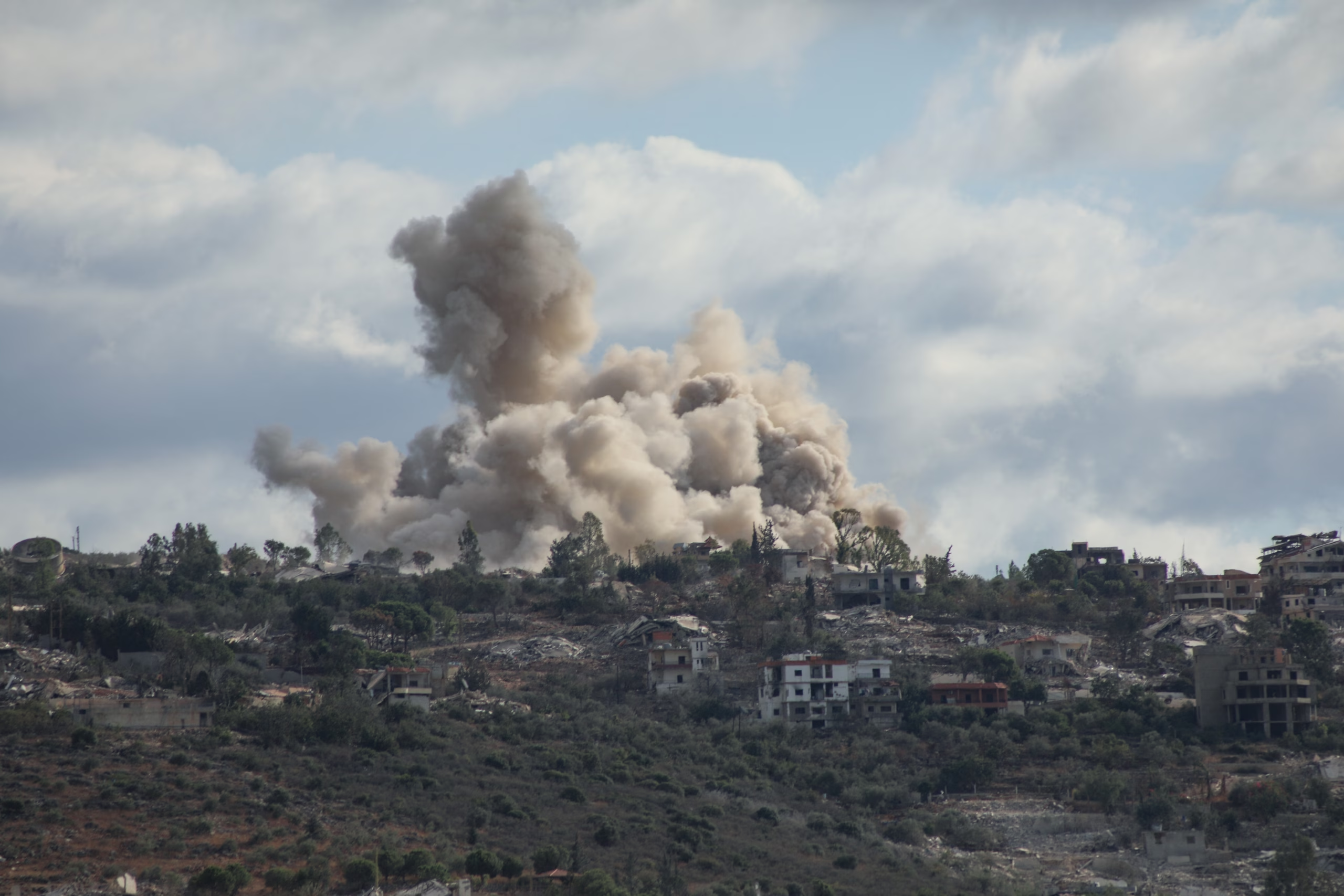
Amid the world’s preoccupation with straits and arsenals, Benjamin Netanyahu’s army completes its major crime, executing a death sentence upon dozens of villages in southern Lebanon. Their guilt, as it claims, is that they were used to launch attacks against Israel. It has destroyed houses, killed their inhabitants and shown no mercy to the trees — as if intending to prevent any witness from testifying before the court of history, should it ever convene.
This agitated army uses the pretext that Hezbollah initiated the war: first to support Gaza in the wake of Yahya Sinwar’s Al-Aqsa Flood and second in retaliation for Israel’s assassination of Iranian Supreme Leader Ali Khamenei. It states explicitly that Lebanon must pay the price for losing the war.
On the road to Sidon, the gateway to southern Lebanon, I recalled old memories. On a distant day, while heading to the newspaper’s headquarters, I watched the autumn rains violently lash Beirut. I saw them tear down the portraits of martyrs from the city walls and rip away words from the enthusiastic slogans penned by fighters, who had falsely imagined they would stand forever. Since those days, the portraits of martyrs have been linked in my mind with the autumn rains that erased their images, which will now hang only on the walls of their homes and with the grief of their mothers.
It is as though this land is afflicted with an unquenchable thirst, consuming the blood of one generation only to renew its longing for the blood of another. While it is true that nations sometimes require martyrs to reclaim their land, sovereignty and independent decision-making, it is equally true that the role of nations cannot be confined to giving birth to martyrs and bidding them farewell. A homeland is an opportunity for life and progress; it is not a factory for martyrs and funerals.
After costly experiences, Hawi concluded that the ultimate mission is to preserve a ‘final garden’ called Lebanon
Ghassan Charbel
When I say martyrs, I mean all those who gave their lives in numerous wars — be it a battle on a mountain or along a demarcation line in Beirut. In that once-divided city, autumn would assault the portraits of all martyrs, regardless of their various affiliations and conflicting slogans. It was the city’s habit to forget its martyrs, distancing itself from their deeds as if they had acted too hastily when throwing their young lives into a fire that would smolder and then reignite once more.
The leaders of parties and militias would pledge never to forget the martyrs, but nations are forgetful. Nothing remains of the martyrs except the grief that consumes the bereaved mothers, widows and orphans.
War fascinated the Lebanese. They rushed into their own conflicts and the conflicts of others. They dreamed of a resounding victory and a knockout blow, only to return disappointed. Lebanon’s composition does not permit this type of victory; it allows only for a pseudo-victory that opens the door to another future war.
I recall now an interview with George Hawi, who participated in launching the Lebanese National Resistance Front against Israel in 1982. He sent young men to resist the occupation but he also sent them to internal wars. In the end, Hawi regretted engaging in the wars between the Lebanese and I was surprised to hear him say: “If only we had not fired a single bullet.” The communist leader’s dreams stretched from Beirut to Moscow. After costly experiences, he concluded that the ultimate mission is to preserve a “final garden” called Lebanon.
The Lebanese squandered the opportunity presented by the Taif Agreement and resumed their journey toward the abyss
Ghassan Charbel
No Lebanese person possesses a final garden other than Lebanon, no matter how fragile and chaotic this garden may be and regardless of how little room it leaves for pursuing grand dreams. The Maronite has no other garden, nor does the Sunni; the same applies to the Shiites and the Druze. Over the decades, Lebanese factions have alternately placed bets that far exceed Lebanon’s capacity to endure.
Experience shows that whenever a Lebanese party relies on a regional or international ally to weaken the position of its domestic partner, conflicts break out, Lebanon becomes more fragmented and the combatants grow weaker despite feeding on stimulants and illusions. Lebanon currently lies beneath its own rubble, after various Lebanese groups pinned their stakes on Palestinian organizations, Israel, Syria or Iran.
For half a century, Lebanon has been plunged into a violent, permanent autumn. The leaves of the tree of coexistence have fallen, along with those of Lebanon’s distinct advantages and its political, banking, educational and tourism roles. The branches of the state apparatus have calcified, giving way to the notorious aroma of the “Lebanese arena.” The leaves of hope have withered and Lebanese youth have taken the path of emigration. The Lebanese squandered the opportunity presented by the Taif Agreement and resumed their journey toward the abyss.
Lebanon currently finds itself in an unprecedented dilemma. Having lost the war, parts of its land are occupied by Israel, which has turned them into scorched earth and vows to do more. The US ambassador to Lebanon has explicitly stated that Israel is not considering a withdrawal from the occupied territory unless Hezbollah is disarmed. Any calm assessment of the international stance in general leads to the belief that there is a global will for Lebanon to exit the military aspect of the conflict with Israel.
The Syrian president understood the dimensions of the new international climate, the reality of the balance of power, Israel’s aggression and its new military doctrine. Consequently, he chose the slogan “Syria first,” which resembles saving the “final garden.”
The Lebanese state possesses no magical solution to escape this dilemma. It has no choice but to bet on Donald Trump’s ability to exert pressure on Netanyahu, provided that Lebanon can fulfill the conditions of returning to being a state that monopolizes the use of weaponry and decisions of war and peace.
In contrast, Hezbollah reads the situation differently, continuing its gamble on Iran and the settlement it might broker with the US. Hezbollah refuses to dwell on the magnitude of the change that has affected its power and regional role after Syria departed the so-called Axis of Resistance. Two years after the loss of its historic Secretary-General Hassan Nasrallah, the party refuses to acknowledge that a Lebanese majority does not support keeping the country suspended over the fires of regional wars.
Lebanon either embarks on the journey of returning to being a state that accommodates everyone or its wounds will deepen in the autumn. Continued fragmentation and loss warn of autumn winds blowing against the Lebanese structure itself, squandering the blood of all martyrs without exception. Only a state worthy of the name can stop the blood of martyrs being wasted. The Lebanese have no right to slaughter their final garden.
