
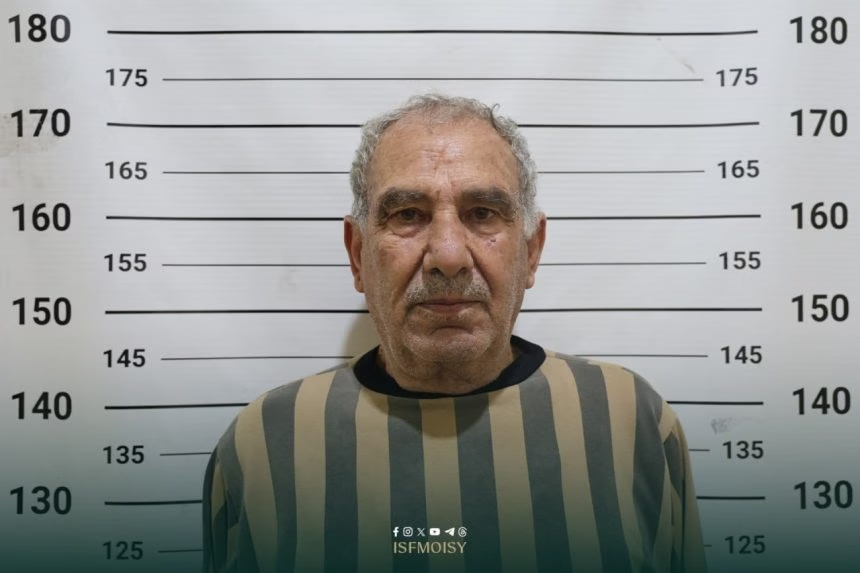
DAMASCUS: Syrian Internal Security Forces have arrested Brig. Gen. Jaber Mehrez Ibrahim, a former commander of the 138th Air Defense Brigade under the ousted Assad regime, the Syrian Arab News Agency (SANA) reported.
SANA said Ibrahim was detained after a “precise surveillance and tracking operation.” He commanded the brigade in the town of Saida, in eastern Daraa province, during the Assad era, the agency said.
Records and preliminary investigations showed he issued orders to kill and arrest people and to suppress protesters, SANA reported. It said he also took part in military campaigns targeting villages and towns in eastern Daraa countryside, pursuing civilians and attacking their homes.
Investigators also said he was directly responsible for the Saida Housing massacre, in which nearly 120 people were killed, according to SANA. His name was further linked to systematic arrests and torture involving many people from the province, including the child Hamza al-Khatib, the agency said.
The report did not say when Ibrahim was arrested, and the allegations against him have not been tested in court.
The Saida Housing massacre
The massacre took place on April 29, 2011, early in the Syrian uprising, on a day protesters called the “Friday of Anger.” It happened near Saida, around the military housing compound and the headquarters of the 138th Air Defense Brigade.
Thousands of unarmed demonstrators from surrounding villages, including al-Jiza, al-Musayfirah and Kahil, were marching toward the city of Daraa to deliver food and medical aid and to help break the military’s siege. Regime forces and Air Force Intelligence opened heavy machine-gun fire on the approaching marchers. An estimated 120 people were killed or went missing, and scores more were wounded or detained.
Among those arrested was 13-year-old Hamza al-Khatib. His mutilated and tortured body was returned to his family weeks later, sparking widespread protests across Syria and international condemnation.
Justice campaign
The arrest is the latest in a campaign by Syria’s current authorities to pursue officials of the Assad government, which fell on Dec. 8, 2024, for alleged war crimes.
The Interior Ministry has announced the arrests of several senior officers over the 2013 Ghouta chemical attack. They include Maj. Gen. Adnan Abboud Halwa, identified as responsible for the attack; Col. Ahmad Habib Ali, a chemical weapons specialist; and Brig. Gen. Khardal Ahmad Dioub, who authorities said helped coordinate logistics for the bombardment.
Authorities have also detained Amjad Youssef, a former Military Intelligence non-commissioned officer implicated in the 2013 Tadamon massacre in Damascus, following a Guardian investigation that first identified him in 2022.
On the anniversary of the Ghouta attack, the head of the National Commission for Transitional Justice, Abdul Basit Abdullatif, renewed a pledge to hold accountable anyone who used chemical weapons, ordered their use or helped carry out the attacks. He said ending impunity was essential to justice and to preventing a recurrence of such crimes.
Decades of massacres
Rights groups and Syrian authorities have documented mass killings under both Hafez al-Assad and his son Bashar, who was toppled in December 2024.
Tadmor Prison, 1980: Troops of the “Defense Saraya” under Rifaat al-Assad killed an estimated 1,000 to 1,200 detainees on June 27, 1980, a day after a failed assassination attempt on Hafez al-Assad. No one has been held accountable, SANA has said.
Hama, 1982: The Syrian Network for Human Rights says regime forces killed between 30,000 and 40,000 civilians and forcibly disappeared about 17,000 others during a nearly month-long assault in February 1982.
Saida Housing, 2011: An estimated 120 marchers heading to besieged Daraa were killed or went missing on April 29, 2011.
Daraya, 2012: Human rights groups reported that between 320 and 700 people, including more than 60 children, were killed between Aug. 20 and 25, 2012.
Ghouta, 2013: A sarin attack on Aug. 21, 2013, killed 1,144 people, according to the SNHR. A UN mission confirmed the use of sarin but was not mandated to assign blame.
Tadamon, 2013: More than 500 people were killed in the Damascus neighborhood on April 16, 2013, according to the Interior Ministry. Residents have documented 288 victims.
