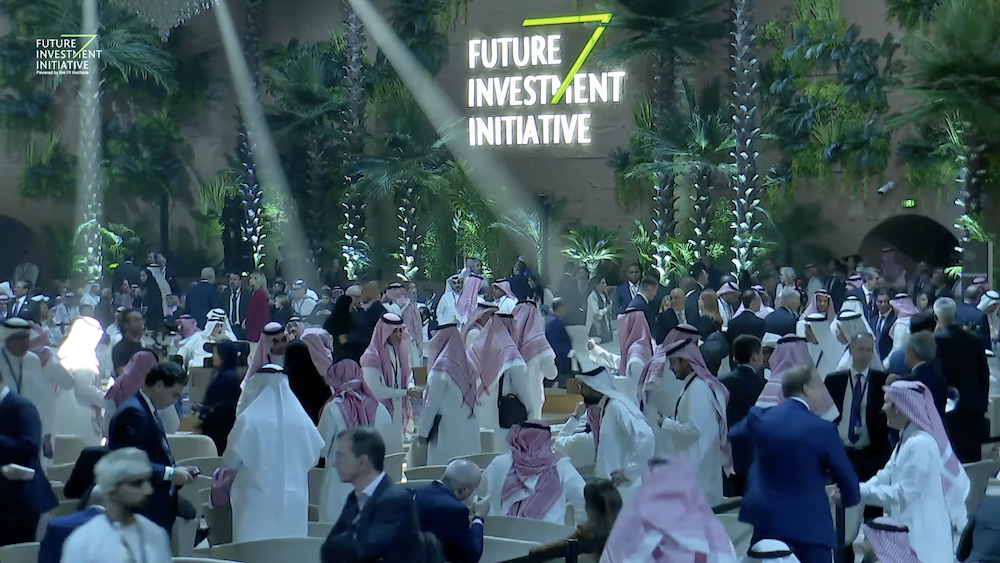
DUBAI: Yasir Al-Rumayyan, Governor of the Public Investment Fund (PIF) and Chairman of the Future Investment Initiative Institute (FII Institute), said the global community must learn how to manage crisis and not be managed by it during his opening remarks for the Future Investment Initiative (FII) in Riyadh.
This year’s three-day FII, with more than 6,000 of the world’s leading decisionmakers, policymakers, investors, entrepreneurs and young leaders in attendance looking to shape the future of the global economy with the theme ‘Investing In Humanity: Enabling a New Global Order.’
“In recent decades, industries as varied as healthcare, telecommunication, energy, retailer have unprecedented of change. The global pandemic has accelerated that change,” Al-Rumayyan said in his welcoming speech.
A discussion in the morning will also revisit the IPSOS survey on what people consider as their priorities in life, that was first discussed in New York in September at a special meeting of the FII Forum.
There will also be presentations by Nobel laureates in a session on what frameworks are necessary to better support human progress.
Other opening day sessions include discussion on the new world order, a special video address from Mukesh Ambani, chairman and managing director of Reliance Industries, and a community discussion among top CEOs including Khaldoon Khalifa Al-Mubarak, managing director and Group CEO of Mubadala Investment Company, Jamie Dimon, chairman and CEO of JPMorgan Chase & Co, Catherine MacGregor, CEO of ENGIE, Noel Quinn, Group CEO of HSBC Holdings and David Solomon, chairman and CEO of Goldman Sachs.
As it happens: The following are live updates on the highlights of the opening day at FII 6th edition. (All timings are GMT)
0700: Dasho Tshering Tobgay, former prime minister of Bhutan: “Where would I invest in, to secure humanity? I would invest in the world because we need a viable place to live in for our future… as an environmentalist I have been passionate about this.”
“I have gone through the priorities report… and there environment, global warming comes at a distant number 8. I was surprised but it gave me hope also. What it told me is you have to address the current needs of the people if you want to take care of climate change, fight climate change.”
“You can’t just expect everybody to become environmentalists if their immediate needs are not met.”
“If we can achieve a certain level of prosperity, then we, all of us, would be more aligned towards fighting climate change.”
“The other reason for hope… is we have the means for common prosperity.”

0650: Leymah Roberta Gbowee: “We should begin to reduce the gap in humanitarian financing.”
“We live in a time where we’ve seen all kinds of innovation. Robots can talk, we don’t need people to do some of the things … in order for us to really begin to get to where really need to get to is to start to do realignment … and some of the basic realignment we can do is to put money where our mouths are,” the 2011 Nobel laureate said.
“That kind of investment also means investing in local communities… you have to go back to the communities where you have the needs, nothing is going there, nothing is trickling.”

0645: Discussions for the opening plenary ‘Our Humanity, Our Priority: A Conversation Among Nobel Laureates’ with Dasho Tshering Tobgay, former prime minister of Bhutan; Leymah Roberta Gbowee, the founder and president of the Gbowee Peace Foundation Africa and Nobel Peace Prize Laureate for 2011 and Kailash Satyarthi, founder of Kailash Satyarthi Children’s Foundation and Nobel Peace Prize Laureate 2014 as speakers.
0635: Yasir Al-Rumayyan, Governor of the Public Investment Fund and Chairman of the Future Investment Initiative Institute (FII Institute), makes his opening remarks.
“Just last month at the FII Priority Summit in New York, we learned that key issues like the cost of living, poverty and unemployment are top concerns across 13 countries. We need to learn how to manage crisis and not to be managed by crisis,” Al-Rumayyan said. “In recent decades, industries as varied as healthcare, telecommunication, energy, retailer have unprecedented of change. The global pandemic has accelerated that change,” he said in his speech.
“We can deal with global problems like climate change through data driven approach,” Al-Rumayyan added, noting that PIF was the first sovereign wealth fund to issue green bonds.
“We cannot do it all alone as investors and entrepreneurs,” the FII Institute chairman said. “We must create quality jobs in a knowledge-based economy … the right partnership will enable us to fulfill our ambitions over the long term.”
“The risk can seem very significant but we can overcome these challenges if we acted like one, through partnerships that I’d like to see here in the FII. The new global order will be set by the discussions we have here in the FII.”

0633: Richard Attias, CEO of FII Initiative, FII 2022 is one of the world’s first carbon-neutral event as part of “our commitment of sustainability.” “Making an impact on humanity is the very reason we are all here today. Our world is facing unprecedented threats but it is also a unique time of new opportunities. We are on the road to a new global order,” he said.
0618: Part of the opening proceedings for the Future Investment Initiative this year features a video presentation of the current global issues including war, famine and environmental degradation.

0608: Attendees get settled as the Future Investment Initiative opening events are about to start.